
Upload a Picture
About this Site | Links | Random Pic | Advanced Search
Home | Latest Additions | Contributors
| Visitors
Fire Engine Photos
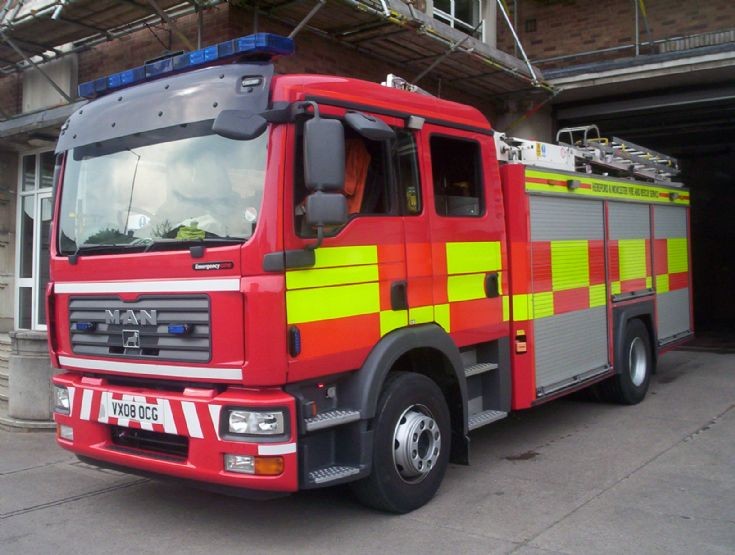
Any feedback on how the CAFS is doing? Some German brigades are standardizing on CAFS and find they very rarely need to set in to a hydrant as a result. It is also great on brush and forest fires, and a real advantage at volunteer stations, when the first due machine can be short-handed, as the line is so much lighter and easier to move around.
Added by Rob Johnson on 15 June 2010.
Added by Rob Johnson on 15 June 2010.
And in this country it is being 'phased out' in some brigades - Humberside as an example, as the Environment Agency are not too happy with it getting into watercourses
Added by Rick Loudon on 16 June 2010.
Added by Rick Loudon on 16 June 2010.
Better for the environment to let things burn, it seems, not to mention the extra exertion by our often short-staffed fire service personnel!
Added by Rob Johnson on 16 June 2010.
Added by Rob Johnson on 16 June 2010.
Compressed air foam. It adds a compound carried in a tank on the pumper and areates the mixture with a belt-driven on board compressor. Unlike Class 3 foam, it is not designed for use on oil or liquid hyrocarbon fires, but for "normal" Class A fires. The foam has about twice the cooling properties of plain water, so the handline is much easier to manage, as it is carrying only about half the weight of water. It is also rsther sticky, so it can effectively insulate vertical exposures or roofs, such as in interface fires where , for example, airborne burning materials can land on building roofs, and it minimises fires starting from the effects of radiant heat. In house fires, it can coat ceilings to slow down vertical fire progression, and contain fire spread before attacking the seat of the fire. It effectively doubles the extinguishing usefulness of the on board water tank, on say a Brirish WT from 400 IG to around 800, which is very useful if you are waiting for a second due pump and are nowhere near a hydrant. It does not need a special branch, and the crew can switch back and forth from CAFS to and from plain water at any time on the same line. It can be used on both the hosereel and/or the attack lines, as indicated by the situation. It is also great for car fires. In some applications, it can also be used with Class 3 foam compound on hydrocarbon fires, but this is usually produced by areation with a special branch. It is used extensively on ships, where you do not want huge amounts of water affecting stability. It is very popular in the US, in Germany and with forest fire protection agencies, because of its protective insulating properties and the fact that it stretches tanker-borne water supplies. It is great to work with, super-effective and makes light work of tackling even quite serious fire situations. I am a fan.
Added by Rob Johnson on 17 June 2010.
Added by Rob Johnson on 17 June 2010.
A very good explanation Rob...I understand that Cy Cafs has been used very successfully on thatched roof fires
Added by Barrie Green on 18 June 2010.
Added by Barrie Green on 18 June 2010.
Yes, but - depending on the installation - some systems can't be used on hydrocarbons, such as gasolene, oil based products and some petrochemicals, which need class 3 foam, known here as ATTF foam.
Added by Rob Johnson on 20 June 2010.
Added by Rob Johnson on 20 June 2010.
MAN


Added by Tom on 15 June 2010.