
Upload a Picture
About this Site | Links | Random Pic | Advanced Search
Home | Latest Additions | Contributors
| Visitors
Fire Engine Photos
No: 44901 Contributor: Jacques Peter Year: 2024 Manufacturers: Delahaye, Magirus Deutz Country: France
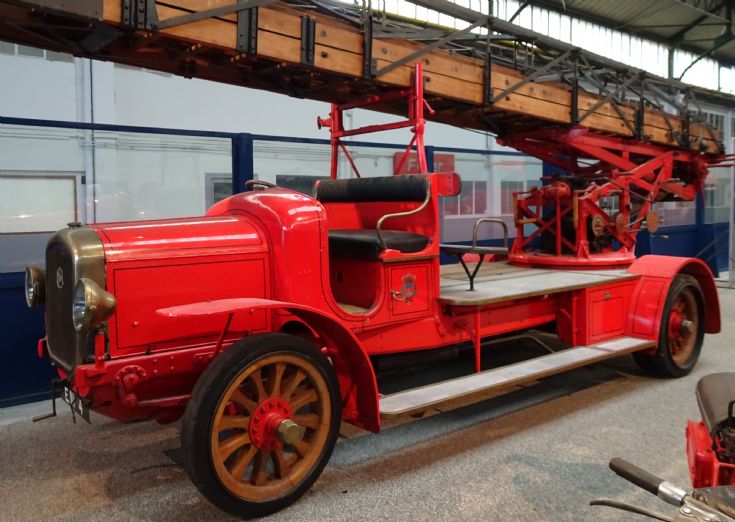
picture 44901 shows it has three sections, unless the fourth one was removed before it was photographed. If it was originally only three, it could never have been a 30 metre ladder. I have actually never heard of any wooden aerial anywhere having four sections, nor one exceeding 85 feet (26 meters). This is borne out by a lot of literature, including documentation of the race between Magirus and Metz to engineer steel turntable ladders - which were introduced by Magirus in 1931 - specifically because neither could build a wooden one longer than 26/27 metres!
Added by Rob Johnson on 14 April 2024.
Added by Rob Johnson on 14 April 2024.
Based on literature which JP kindly forwarded to me, it seems this is an example of a “ missing link”, which I had never seen referenced before. Introduced in 1930, only one year before the Magirus all steel 30 meter four section turntable ladder, this example seems to have a composite structure combining lightweight wood sections with a lot of steel reinforcements and trusses. As the Magirus all steel ladders appeared only a year later, I imagine this construction design was rather short lived, and this museum piece might well be a unique survivor. I have certainly not heard of any other 30 metre ladders which were designed like this, and in the US a lot of early steel ladders were still 85 feet - because the various custom chassis were designed to accommodate 85 foot mid mounted wood aerials already.
Added by Rob Johnson on 16 April 2024.
Added by Rob Johnson on 16 April 2024.
The mystery is now solved! JP talked to the retired curator of the BSPP museum, and he confirmed that this ladder was mis-labeled as a 30 metre unit. It is, in fact, as suspected a 26 metre ladder!
Added by Rob Johnson on 21 April 2024.
Added by Rob Johnson on 21 April 2024.
One has to wonder about its stability, as it does not seems to have any jacking system.
Added by Rob Johnson on 23 April 2024.
Added by Rob Johnson on 23 April 2024.
Delahaye


Added by Rob Johnson on 13 April 2024.