
Upload a Picture
About this Site | Links | Random Pic | Advanced Search
Home | Latest Additions | Contributors
| Visitors
Fire Engine Photos
The Rockville FD in Maryland has had the AB system since 1978. There are several other FDs in Wisconsin that have the AB system. I was sent to a Fire Conference in London in 1975 to collect info on the AB units. They are still slow to have been accepted here.
Added by John Harris on 13 September 2013.
Added by John Harris on 13 September 2013.
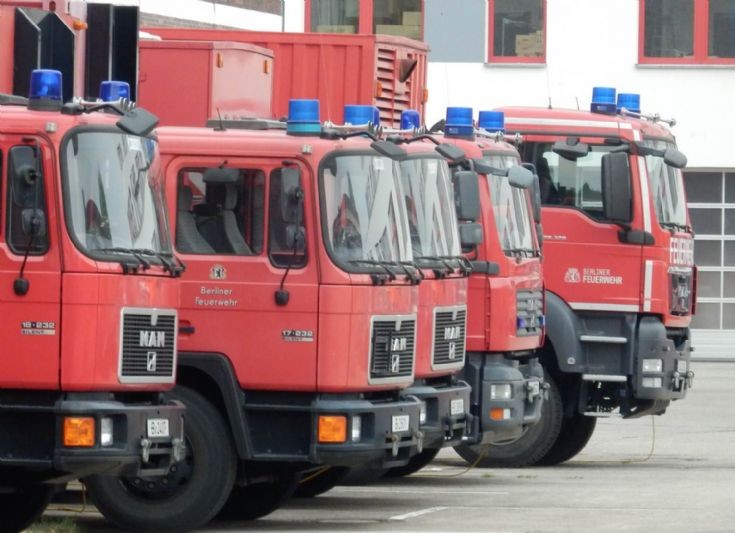
AB = Abrollbehalter, the Literal translation is Exchange Load, It's the exchangeable Pod system that is quite popular in Europe and Great Britain. You have Various different pods with equipment in them, or as a Control Unit. You then only need one prime-mover chassis, which can transport the requied pod to an incident, unload the pod and is avalable to transport another pod if required.
Added by Chris Stone on 14 September 2013.
Added by Chris Stone on 14 September 2013.
Abrollhalter (AB)in German literally translates as "roll-off container". Individual special-purpose modules mounted on small steel wheels are winched by a built-in hydraulic crane on to a pair of steel u-section rails permanently welded to the carrier truck chassis. Loading or unloading takes only a few minutes. This way a very wide variety of special-purpose bodies can be stationed with one or two carriers, and whatever is needed can be loaded up and quite quickly dispatched. The containers are usually designed so they can be operated from the back of the truck, or else fully unloaded and positioned where they are needed at the incident site. This frees the transporter to be available again, if it is required to transport another module to the same or a different incident.
This saves buying numerous special-purpose rigs, which would have relatively little use because they are not turned out very often.
The most common modules are foam, LDH, air, lighting/ventilation and hazmat, but there is no limit, provided the module does not exceed reasonable dimensions and/or weight constraints.
As I mentioned, Berlin City Fire service has more than thirty different and quite varied specifications of modules, and this is typical of many larger European cities.
Added by Rob Johnson on 14 September 2013.
This saves buying numerous special-purpose rigs, which would have relatively little use because they are not turned out very often.
The most common modules are foam, LDH, air, lighting/ventilation and hazmat, but there is no limit, provided the module does not exceed reasonable dimensions and/or weight constraints.
As I mentioned, Berlin City Fire service has more than thirty different and quite varied specifications of modules, and this is typical of many larger European cities.
Added by Rob Johnson on 14 September 2013.
Not a language lesson, but just to clarify. The chassis is described as a Wechselladerfahrzeug or WLF, meaning "vehicle for a choice of changing loads". The modules themselves are Abrollbehalter, meaning "roll-off container".
Berlin has two specialized technical support fire stations amongst its 35 full-time and 54 volunteer stations. These are huge, and house these and other special-purpose units as well as a normal compliment of standard fire trucks and ambulances. They are both staffed 24/7 by additional teams of specially-trained firefighters, who also man a fleet of individual special-purpose units. Tech I has 54 vehicles, modules and trailers, Tech II has about half as many.
A similar approach is adopted in most other German cities, with all of these WLF trucks and AB pods most often concentrated at one station.
But other countries spread them around - Amsterdam, for example, has a single WLF and two or three AB containers at each of 11 of their 21 stations, alternately manned by one or two members of the pump crews. Not surprisingly, a third of their modules are designed primarily for flood control!
John - thanks for your comment. Having never set eyes on a US AB system, it would be really interesting to see if you can dig up any photos, to see how they compare! I have noticed FDNY has recently started using a variety of small two-axle box trailers in their Special Operations Command, but these are of course a lot smaller than the European AB containers.
Added by Rob Johnson on 15 September 2013.
Berlin has two specialized technical support fire stations amongst its 35 full-time and 54 volunteer stations. These are huge, and house these and other special-purpose units as well as a normal compliment of standard fire trucks and ambulances. They are both staffed 24/7 by additional teams of specially-trained firefighters, who also man a fleet of individual special-purpose units. Tech I has 54 vehicles, modules and trailers, Tech II has about half as many.
A similar approach is adopted in most other German cities, with all of these WLF trucks and AB pods most often concentrated at one station.
But other countries spread them around - Amsterdam, for example, has a single WLF and two or three AB containers at each of 11 of their 21 stations, alternately manned by one or two members of the pump crews. Not surprisingly, a third of their modules are designed primarily for flood control!
John - thanks for your comment. Having never set eyes on a US AB system, it would be really interesting to see if you can dig up any photos, to see how they compare! I have noticed FDNY has recently started using a variety of small two-axle box trailers in their Special Operations Command, but these are of course a lot smaller than the European AB containers.
Added by Rob Johnson on 15 September 2013.
Rob please see picture 36057 for a photo of the Rockville unit. It was actually in service earlier than the 1988 date given.
Added by John Harris on 16 September 2013.
Added by John Harris on 16 September 2013.
Interesting to note is that In Germany the prime movers denomination is WLF Wechselladerfahrzeug however the FD Berlin such as the FD Paris likes to be different and calls AB Abrollbehälter.
Other examples:
Pumper rescue in most of Germany : HLF
Pumper rescue in Berlin : LHF
Medic EMS Van in most of Germany : NAW
Medic EMS Van in Berlin : NEF
HLF : Hilfeleistungslöschgruppenfahrzeug
LHF : Lösch- und Hilfeleistungsfahrzeuge
NAW : Notarztwagen
NEF : Notarzteinsatzfahrzeug
Added by Jacques PETER on 17 September 2013.
Other examples:
Pumper rescue in most of Germany : HLF
Pumper rescue in Berlin : LHF
Medic EMS Van in most of Germany : NAW
Medic EMS Van in Berlin : NEF
HLF : Hilfeleistungslöschgruppenfahrzeug
LHF : Lösch- und Hilfeleistungsfahrzeuge
NAW : Notarztwagen
NEF : Notarzteinsatzfahrzeug
Added by Jacques PETER on 17 September 2013.
Mr. Harris , if you have any evidence of Rockville VFD having this unit before 1988, please present it, otherwise I stand by my posting. I lived in Montgomery Co., MD. during this time and personally witnessed the outfitting of this unit. Perhaps we should also query a LIFE MEMBER OF RVFD of my acquaintance for his input.This unit was also featured in the N0V-DEC 1988 issue of Fire Apparatus Journal.
Added by Warren W. Jenkins on 18 September 2013.
Added by Warren W. Jenkins on 18 September 2013.
Hi Jacques
that is not quite correct NAW : Notarztwagen is a rescue ambulance that has physician as member of a three man crew
NEF : Notarzteinsatzfahrzeug is vehicle that brings a physician to an incident "Rendezvous-System"
Added by Chris Hall, Hameln on 18 September 2013.
that is not quite correct NAW : Notarztwagen is a rescue ambulance that has physician as member of a three man crew
NEF : Notarzteinsatzfahrzeug is vehicle that brings a physician to an incident "Rendezvous-System"
Added by Chris Hall, Hameln on 18 September 2013.
Yes, pods are very popular right across Europe, even France is now getting in on them. A symptom of the changing market, I would say. The attitude of "do more with less" being the catchphrase right across the public services sector. In Australia, for example, all pumpers and rescue tenders used to carry an Oxy-Viva, which is a demand valve resuscitator, but also has suction and therapy attachments. It was wonderfully rugged and tough, and saved many lives. Now, however, they're replacing them with BVM's (bag valve masks), because the Oxy-Viva's cost too much to maintain and repair. The BVM's are not half as tough or as versatile, yet they cost less, so that is what we must save lives with. A long post, but I feel that today's climate is putting lives at risk.
Added by Tiger on 05 October 2013.
Added by Tiger on 05 October 2013.
All too true, unfortunately. Not to mention staffing reductions, merging apparatus functions and having rotating fire station closures - all a reflection of current economic conditions and fire service budget cutbacks. These seem to be happening almost everywhere in the World right now, and are reaching crisis dimensions in some places.
I won't go into specifics, but I have seen fire departments here jump-manning an engine, an aerial and an ambulance with a total of two people - who's kidding at this level of manning?
Added by Rob Johnson on 05 October 2013.
I won't go into specifics, but I have seen fire departments here jump-manning an engine, an aerial and an ambulance with a total of two people - who's kidding at this level of manning?
Added by Rob Johnson on 05 October 2013.
MAN


The obvious advantage is that a huge fleet of highly specialized units can be maintained and ready to respond, without the added expenditure of buying and maintaining a corresponding number of chassis cabs.
The ratio of AB chassis to modules varies according to the numbers of turnouts for the individual modules, and seems to be usually around one chassis to three or four modules.
The early chassis were 16 ton two-axle units, but these have grown over the years to include both three and four axle units, with gross weight capacities up to 32 tons.
Interesting that this AB module approach to special-purpose units has spread to many other European countries and to Japan, but has not to North American fire departments. I know of none over here.
Added by Rob Johnson on 12 September 2013.