
Upload a Picture
About this Site | Links | Random Pic | Advanced Search
Home | Latest Additions | Contributors
| Visitors
Fire Engine Photos
No: 35748 Contributor: Ronald Henderson Year: 2013 Manufacturer: Merryweather Country: United Kingdom
In my thinking the French hose carts make sense , if you are not using a hose bed on the truck.
Added by Les Davis on 25 January 2014.
Added by Les Davis on 25 January 2014.
Ron,
Any idea of when this appliance was in service.
With chain drive and solid rubber tyres I would suggest the early 1920's or maybe even earlier.
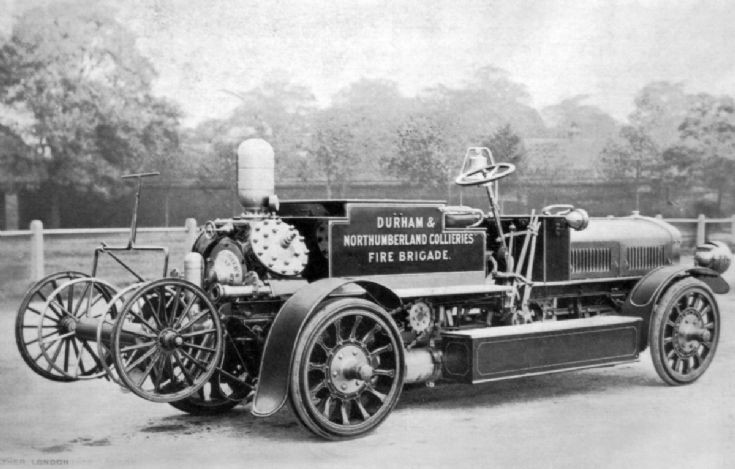
A book I have on Fire Fighting Vehicles mentions that early versions of Merryweather's "Hatfield" pump featured a vertical air vessel, which was easily damaged when loading or removing ladders, although the appliance in your image does not carry a ladder it looks as if it is has the vertical air vessel.
The book also mentions that early (1904 to approx 1914) Merryweather appliances had chassis's designed and built by the Aster Company, Wembley, Middlesex, England.
Regards, Steve P
Added by Steve Prosser on 27 January 2014.
Any idea of when this appliance was in service.
With chain drive and solid rubber tyres I would suggest the early 1920's or maybe even earlier.
A book I have on Fire Fighting Vehicles mentions that early versions of Merryweather's "Hatfield" pump featured a vertical air vessel, which was easily damaged when loading or removing ladders, although the appliance in your image does not carry a ladder it looks as if it is has the vertical air vessel.
The book also mentions that early (1904 to approx 1914) Merryweather appliances had chassis's designed and built by the Aster Company, Wembley, Middlesex, England.
Regards, Steve P
Added by Steve Prosser on 27 January 2014.
Hi David. There were four coal board Merryweathers. They were all later fitted with overhead ladder sets. The horizontal air vessel was for those machines fitted with wheeled escape ladders where the resting of the escape carriage would be impeded by a horizontal air vessel. They were in service from 1911-1912 to 1932.
Aster never built chassis. They supplied the engines, built under licence from France. Merryweathers fabricated their own chassis until adopting those made by Albion.
Added by Ronald Henderson on 27 January 2014.
Aster never built chassis. They supplied the engines, built under licence from France. Merryweathers fabricated their own chassis until adopting those made by Albion.
Added by Ronald Henderson on 27 January 2014.
Les - I too am a fan of the hose cart. The French one-man cart holds 200 meters (655 feet) of 70 mm (2.75 inch) hose with ten pre-connected lengths, and can be used for both hydrant supply or for attack, as it has Stortz-type couplings, which are not directional. Some departments fit a standpipe for quick access to underground hydrants on one cart. Others (including Paris) attach a contolling three outlet divider and two 15 meter lengths of 45 mm attack hose, taking the 70 MM to the fire structure, then using the 45 mm for interior attack. Most French departments carry two carts on every pumper, with a single cart only on some light "first aid" units.
The carts are also very popular in Germany, which uses 75 and 52 mm hoses, and are widespread in Austria, Belgium and Switzerland, with a few in use in the Netherlands too. They were once very common in other European countries, but these coal board pumpers and their successors are the only UK examples I have been able to find.
In Asia, they are standard in Japan, but not common elsewhere, except in departments which use former Japanese fire service units. The Japanese hose carts are rectangular four wheelers, carrying flaked hose, and some larger ones are ride-on battery electrics complete with headlights and rear view mirrors.
In South America, Chile uses a lot of French specification Renaults with hose carts, and a few former French trucks carrying carts are in use in other countries. The old French colonies in Africa also operate French trucks with carts hung on the back.
They have numerous advantages, not least in narrow and/or congested streets and alleys, where a long lay may be necessary and vehicle access is problematical. They also free up locker space, which is increasingly a concern as pumpers are called on to carry more and more rescue and specialized equipment. It is also a comparatively quick and less energy-consuming way to hook up the pump and get lines to work.
I am indeed puzzled as to why more European departments have not introduced them. The kind of mounting used by French fire apparatus outfitters like Sides allow the carts to be swung to the side in a matter of seconds if they are not needed, to access the rear mounted pump controls, high pressure booster reel and roof mounted ground ladders and suction hoses
Added by Rob Johnson on 28 January 2014.
The carts are also very popular in Germany, which uses 75 and 52 mm hoses, and are widespread in Austria, Belgium and Switzerland, with a few in use in the Netherlands too. They were once very common in other European countries, but these coal board pumpers and their successors are the only UK examples I have been able to find.
In Asia, they are standard in Japan, but not common elsewhere, except in departments which use former Japanese fire service units. The Japanese hose carts are rectangular four wheelers, carrying flaked hose, and some larger ones are ride-on battery electrics complete with headlights and rear view mirrors.
In South America, Chile uses a lot of French specification Renaults with hose carts, and a few former French trucks carrying carts are in use in other countries. The old French colonies in Africa also operate French trucks with carts hung on the back.
They have numerous advantages, not least in narrow and/or congested streets and alleys, where a long lay may be necessary and vehicle access is problematical. They also free up locker space, which is increasingly a concern as pumpers are called on to carry more and more rescue and specialized equipment. It is also a comparatively quick and less energy-consuming way to hook up the pump and get lines to work.
I am indeed puzzled as to why more European departments have not introduced them. The kind of mounting used by French fire apparatus outfitters like Sides allow the carts to be swung to the side in a matter of seconds if they are not needed, to access the rear mounted pump controls, high pressure booster reel and roof mounted ground ladders and suction hoses
Added by Rob Johnson on 28 January 2014.
Ron. Very nice pic. I'm fortunate to own a brass helmet and brass button previously belonging to this brigade. Both carry the letters DNC FRB. Presumably meaning this was a Fire and Rescue brigade. Have you any idea when the Rescue was added or deleted from the title? Many thanks, Tony Jones, Chester.
Added by Tony Jones on 30 January 2014.
Added by Tony Jones on 30 January 2014.
Hi Tony, after this delivery photo, the other three Hatfields all had Fire and Rescue titles on the side from new. Ashington Rescue Station had the letters above the door, ....Rescue and Fire Brigade. The coal board brigades provided fire fighting arrangements for local authority councils on an agency basis in parts of Northumberland and Durham until the 1950's, latterly as agents to Durham County and Northumberland County Fire Brigades. Citizens in these areas that required the fire brigade got a coal board fire engine. The coal board engines were also part of the county fire authorities mobilising arrangements. In c1958 the coal board firemen declined to do any other surface fire-fighting, the fire engines were replaced by "rescue cars" which would be when the "Fire and Rescue" title became obsolete.
Added by Ronald Henderson on 31 January 2014.
Added by Ronald Henderson on 31 January 2014.
There was an interesting post from the North of England Institute of Mining and Mechanical Engineers (aka The Mining Institute) today on Facebook. In it they maintain that a Northumberland and Durham Collieries Fire and Rescue Brigade appliance (which looks remarkably like a Merryweather) was in fact built by Armstrong's at their Elswick works i.e. it is an Armstrong not a Merryweather. They quote a paper read by W.C.Blackett before the Institute in 1911 and later published in Volume 41 p. 253ff of the Federated Transactions. I am a Fellow of the Institute and will ask them to send me a copy of the paper, will report back
Added by John Theobald on 16 July 2015.
Added by John Theobald on 16 July 2015.
John ......any progress in you "reporting back" on this interesting subject?
Added by Simon Rowley on 14 October 2017.
Added by Simon Rowley on 14 October 2017.
Merryweather




Next question! Does anyone have a guess at why the collieries' fire service was able to discover the hose cart when apparently no other British fire brigade had any?
Added by Rob Johnson on 19 August 2013.