
Upload a Picture
About this Site | Links | Random Pic | Advanced Search
Home | Latest Additions | Contributors
| Visitors
Fire Engine Photos
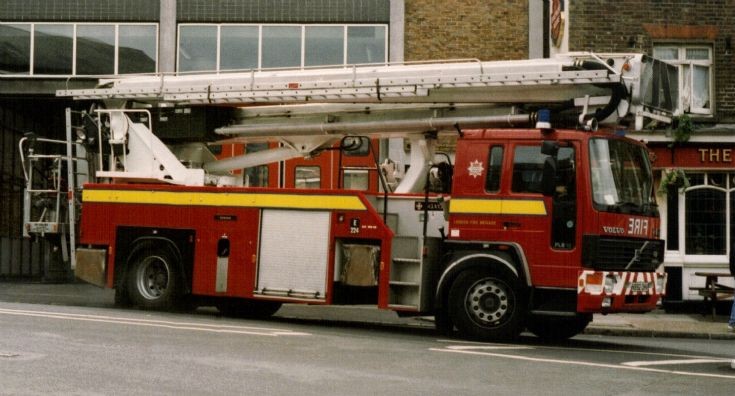
Greenwich HP Volvo FL6.18 Simon N922OHV
London Fire Brigade E22 Greenwich Volvo FL6.18 Saxon Simon SS220 HP (HP20) N922OHV just turned out from Greenwich fire station
London Fire Brigade E22 Greenwich Volvo FL6.18 Saxon Simon SS220 HP (HP20) N922OHV just turned out from Greenwich fire station
This picture is in the following groups
London Fire Brigade, United Kingdom
London Fire Brigade, United Kingdom
I think they have four operational TL and 9 ALP next to spares.All are Mercedes Econic build by Magirus Ulm.
Added by Ed on 06 August 2014.
Added by Ed on 06 August 2014.
Thanks Ed: This seems rather light for an area with eight million people. Greater Paris, which is smaller, has 63 and Berlin, which is half the size of London, has 42. Even Amsterdam, with less than a million population, operates thirteen!
Added by Rob Johnson on 06 August 2014.
Added by Rob Johnson on 06 August 2014.
Rob, my sentiments exactly. Don't think I'd like to live in a high-rise in London when the nearest aerial could be half-an-hour away. The difference in aerial numbers from city-to-city and country-to-country has always baffled me.
Added by Yelp Bullhorn on 09 August 2014.
Added by Yelp Bullhorn on 09 August 2014.
Yelp - I am at a loss, too. The only thing I can think of is that London used to have a 50 foot wheeled escape in every station, so turntable ladders were not so critical. But even in the days when Gordon Honeycombe wrote "Red Watch", the story of the Clifton Gardens hotel fire, around 1970, they had 28 of them. Now it seems they have cut back to half that number!
Added by Rob Johnson on 14 August 2014.
Added by Rob Johnson on 14 August 2014.
Well building are differing standards throughout the world as are firefighting techniques and the UK isn't really in the need of aerials every day of the week. Amsterdam's buildings are extremely close together and the historic nature of them makes them less easy to escape from and fire spread would be much more rapid. There was a survey done in the early noughties which revealed that aerials in the UK are rarely used above the 4 th floor and when they are, they're used more as water towers than for rescues...
Added by Glenn Ramsden on 14 August 2014.
Added by Glenn Ramsden on 14 August 2014.
Glenn - the problem in this survey is one of the chicken and the egg. If UK towns have either no aerials or very few, then of course they will be rarely used! Even when they have them, they are often not manned by a dedicated crew, so if they are needed their turnout is delayed, which often means they cannot be positioned so that they can be deployed effectively. Without a driver/operator, an aerial is just so much hardware.
The cities I mentioned are not the only examples of aerial coverage in urban areas overseas. The ratio of aerial ladders to pumpers is also informative. If Ed is correct, London has one for every eleven pumpers. Most European, Australian and north American cities range from one per 1.5 pumpers to one per three. Only in small towns do we see one to five or more. It seems the UK is at a level which is closer to Third World standards, and this is not explained by different building practices. For example, I do not believe UK construction standards are superior (or even equal) to those in countries like Germany or Sweden, which make much more extensive use of aerials.
Added by Rob Johnson on 15 August 2014.
The cities I mentioned are not the only examples of aerial coverage in urban areas overseas. The ratio of aerial ladders to pumpers is also informative. If Ed is correct, London has one for every eleven pumpers. Most European, Australian and north American cities range from one per 1.5 pumpers to one per three. Only in small towns do we see one to five or more. It seems the UK is at a level which is closer to Third World standards, and this is not explained by different building practices. For example, I do not believe UK construction standards are superior (or even equal) to those in countries like Germany or Sweden, which make much more extensive use of aerials.
Added by Rob Johnson on 15 August 2014.
Well said, Rob. The reason is plain and simple: money. To our government and our local authorities, sadly this is all that matters. The recession has a lot to do with it obviously. But take the West Midlands Fire Service for instance. Those not familiar with the WMFS: urban fire service in the heart of England with 38 wholetime stations, having seen three stations close in the last few years. Major areas covered include Birmingham, Coventry, Wolverhampton and Walsall. 348 square miles and a population of 2.6 million. In the last ten to fifteen years frontline pumps have been reduced from 64 to 40, and aerial numbers reduced from 10 to 4. They call it modernisation; I call it a scandal.
Added by Yelp Bullhorn on 29 August 2014.
Added by Yelp Bullhorn on 29 August 2014.
Yelp - I live in Chicago, which also has a population of 2.6 million, although it is about two thirds of the area of WMFS.
The city once had over 120 fire stations, and now has 99. Many dated from the days of horsedrawn apparatus. As a result, some of them were just unnecessarily close together, once everything was motorized. In addition, some areas of the city were redeveloped, so new stations were added and others relocated.
We now have 99 pumps, 49 aerials, 24 batallion chiefs, six district chiefs and six heavy rescues on each watch, plus a fleet of special-purpose and command vehicles and two fireboats. The actual on-duty watch is around 850 members, excluding EMS crews.
One reason all these resources are available is that firefighters here still work a 56 hour three watch system, which is also quite common in many other US cities.
Added by Rob Johnson on 31 August 2014.
The city once had over 120 fire stations, and now has 99. Many dated from the days of horsedrawn apparatus. As a result, some of them were just unnecessarily close together, once everything was motorized. In addition, some areas of the city were redeveloped, so new stations were added and others relocated.
We now have 99 pumps, 49 aerials, 24 batallion chiefs, six district chiefs and six heavy rescues on each watch, plus a fleet of special-purpose and command vehicles and two fireboats. The actual on-duty watch is around 850 members, excluding EMS crews.
One reason all these resources are available is that firefighters here still work a 56 hour three watch system, which is also quite common in many other US cities.
Added by Rob Johnson on 31 August 2014.
There's not much evidence of lives being lost due to lack of aerial response is there? BTW the survey was carried out when aerials were crewed and I distinctively remember riding a TL and going to very little other than AFA's day in day out. You've got to ask yourself if you are a CFO and an aerial costs not far short of half a million can you justify it without carrying out a suitable audit. Let's have a have survey on here, how many of us are/were aerial operators and how may rescues did we carry out between us. I'll start I was operational on aerials as a firefighter for 10 year before promotion, lives saved by the aerial - none..
Added by Glenn Ramsden on 03 September 2014.
Added by Glenn Ramsden on 03 September 2014.
In the US, their aerial rigs serve a completely different role to aerials in the UK. Which is why I think they have so many more over there. Ignoring the ridiculous white elephants that we in the UK call CARPs, dedicated UK aerials are solely a height appliance for (as we have already discovered) rare rescues, water towers and height inspection purposes. They carry no water and no rescue equipment. Our engines carry all that; they really are a 'jack of all trades'.
US engines are more-or-less soleley a firefighting vehicle. Their primary job is to get water down. (Some do have other roles - rescue squads etc.). But usually it's their ladder trucks that carry all the rescue equipment, and all the tools needed to gain entry, to ventilate a fire, and to cut away to get at hidden hotspots. This explains why US fire departments have so many aerial trucks. They work in tandem with the engine. I think the actual 'stick' in many cases is seen as a bonus, a bonus that they often bring to the party at, say, a house fire where an aerial attack may not necessarily be a nessesity. But if you've you got it, you might as well use it, right! It's very rare to see an aerial appliance at a UK house fire. The usual attendance would be two, three or four engines.
The ladder/boom is no doubt the most expensive part of the whole rig. This is why, in an attempt to save money, Phoenix Fire Department in Arizona (there might be others) run many ladder trucks with no actual aerial stick. They are more or less an equipment truck that it is mobilised when an aerial is definitely not required: road traffic collisions, for instance. It makes perfect economic sense really. Imagine how much diesel is wasted hauling all that not-required weight around. Historically the price of fuel has never really bothered the US, but lately that is becoming more of a concern. Maybe the Phoenix model might become more common. Maybe the multi-role US truck has had its day, in much the same way the UK single-role aerial has seemingly had its.
Added by Yelp Bullhorn on 07 September 2014.
US engines are more-or-less soleley a firefighting vehicle. Their primary job is to get water down. (Some do have other roles - rescue squads etc.). But usually it's their ladder trucks that carry all the rescue equipment, and all the tools needed to gain entry, to ventilate a fire, and to cut away to get at hidden hotspots. This explains why US fire departments have so many aerial trucks. They work in tandem with the engine. I think the actual 'stick' in many cases is seen as a bonus, a bonus that they often bring to the party at, say, a house fire where an aerial attack may not necessarily be a nessesity. But if you've you got it, you might as well use it, right! It's very rare to see an aerial appliance at a UK house fire. The usual attendance would be two, three or four engines.
The ladder/boom is no doubt the most expensive part of the whole rig. This is why, in an attempt to save money, Phoenix Fire Department in Arizona (there might be others) run many ladder trucks with no actual aerial stick. They are more or less an equipment truck that it is mobilised when an aerial is definitely not required: road traffic collisions, for instance. It makes perfect economic sense really. Imagine how much diesel is wasted hauling all that not-required weight around. Historically the price of fuel has never really bothered the US, but lately that is becoming more of a concern. Maybe the Phoenix model might become more common. Maybe the multi-role US truck has had its day, in much the same way the UK single-role aerial has seemingly had its.
Added by Yelp Bullhorn on 07 September 2014.
As you well know Glenn...Ariel's are not just life saving appliances..they are high reach for water towers..safe working platforms..easier access to places at high level...unfortunately a 'disease' started in our brigade ( and I'm sure in others too) where officers wishing to appear 'efficient' did not ' make up' ariels when in truth they should have done for the simple fact of safety of their personnel ...I can remember one incident where an ADO we both know returned an HP that was en route as part of the PDA as it was 'not required' only to then have to request a TL from Scunthorpe for firefighting and crew safety...I'll join your survey and state lives directly saved none...lives of firefighters maybe saved by giving them a safer working environment maybe one or two...jobs attended with TL or HP in use as a water tower or for access.. more than a few...lives saved by using the cage or harness to lower casualties more quickly from height... two I think ?....in 32 years operational service !
As for Ariel's costing about half a million..why did we go down the route of CARPS then ? Costing at least half as much again..then finding out in most cases they were 'not fit for purpose' and in Humbersides case running it as a dedicated Ariel..cost effective ?...I don't think so...oh yes it was .....Frank said it had already paid for itself in wages saved by cutting jobs at Grimsby Peakes Lane ( its original destination as a CARP)...where is it now ? ...Scunthorpe as a retained crewed Ariel !..therefore both Scunthorpe and Grimsby have lost 8 or 10 firefighters each !!
Added by Rick Loudon on 09 September 2014.
As for Ariel's costing about half a million..why did we go down the route of CARPS then ? Costing at least half as much again..then finding out in most cases they were 'not fit for purpose' and in Humbersides case running it as a dedicated Ariel..cost effective ?...I don't think so...oh yes it was .....Frank said it had already paid for itself in wages saved by cutting jobs at Grimsby Peakes Lane ( its original destination as a CARP)...where is it now ? ...Scunthorpe as a retained crewed Ariel !..therefore both Scunthorpe and Grimsby have lost 8 or 10 firefighters each !!
Added by Rick Loudon on 09 September 2014.
31 years of which approx half on tl/alp , 3 lives definately saved and about thirty or so rescues involving walking /lowering people
Added by Donny on 15 September 2014.
Added by Donny on 15 September 2014.
Tragically it has taken less than three years from this thread for current UK fire service guidelines on the use of aerials to come back and bite us. I am of course talking about the horrific events that occurred at Grenfell last year. The media (quite rightly so) have asked serious questions about the initial fire brigade response to the fire that night. Only four pumps and no aerial initially mobilised to reported fire in residential high rise accommodation. The speed of the fire spread played one of the biggest factors that night and you have to ask yourselves, would an aerial being immediately mobilised to the scene have made a difference? Possibly. Could it have been used as a water tower to stop the spread of the fire earlier? Yes it could. Could it have been used to evacuate residents who were cut off by fire and smoke? Definitely. The London Fire Brigade fell foul of brutal funding cuts, which forced them to remove aerial appliances from PDA's to incidents like this. To make it clear, I am in no way blaming the LFB for what happened that night.
With modern fire safety standards and equipment we have forgotten in this country what an aerial appliance was designed for; saving lives. If only one victim could be rescued via ladder that night, wouldn't it be worth the expense?
Added by David Jones on 17 September 2018.
With modern fire safety standards and equipment we have forgotten in this country what an aerial appliance was designed for; saving lives. If only one victim could be rescued via ladder that night, wouldn't it be worth the expense?
Added by David Jones on 17 September 2018.
Well said, David.
Quite rightly-so the LFB "managers" are having to answer some rather probing questions at the inquiry at the moment. Nobody in their right mind could possibly question the actions of the firefighters on that dreadful night - the soldiers on the frontline - as always, they performed heroically, as they fought the losing battle. But in my opinion, the brigade's heirarchy, politicians of both sides and the many penny-pinching, inept local government officials let down the residents of Grenfell, and all their heartbroken families, on that fateful night.
Now some brigades seem in a hurry to obtain ALPs with a much higher reach than the 100 feet they're used to. Joining the high-reach club that Surrey were already a member of, Hertfordshire have bought a super high-reach appliance, and London are getting a few courtesy of The Freemasons, of all people. A certain phrase springs to mind: "Shutting the stable door after the horse has bolted."
Added by Yelp Bullhorn on 28 September 2018.
Quite rightly-so the LFB "managers" are having to answer some rather probing questions at the inquiry at the moment. Nobody in their right mind could possibly question the actions of the firefighters on that dreadful night - the soldiers on the frontline - as always, they performed heroically, as they fought the losing battle. But in my opinion, the brigade's heirarchy, politicians of both sides and the many penny-pinching, inept local government officials let down the residents of Grenfell, and all their heartbroken families, on that fateful night.
Now some brigades seem in a hurry to obtain ALPs with a much higher reach than the 100 feet they're used to. Joining the high-reach club that Surrey were already a member of, Hertfordshire have bought a super high-reach appliance, and London are getting a few courtesy of The Freemasons, of all people. A certain phrase springs to mind: "Shutting the stable door after the horse has bolted."
Added by Yelp Bullhorn on 28 September 2018.
David:
I live in a high rise building in Chicago now, and a few years ago we had a fire in the trash compactor.
The first response included four engines, two aerial ladders, a rescue squad, a snorkel, a battalion chief, a deputy district chief, an EMS chief, a CFD ambulance and around 42 personnel, as well as four CPD cars with eight officers for traffic and crowd control.
I was not watching the clock, but it seems that all of these resources arrived within around seven to ten minutes. The fire was extinguished very quickly.
This level of response is pretty typical of what is to be found in American cities when calls are made to high rise buildings. It makes the LFB first response to the Grenfell Tower seem almost laughable, if it were not so tragic.
Added by Rob Johnson on 28 September 2018.
I live in a high rise building in Chicago now, and a few years ago we had a fire in the trash compactor.
The first response included four engines, two aerial ladders, a rescue squad, a snorkel, a battalion chief, a deputy district chief, an EMS chief, a CFD ambulance and around 42 personnel, as well as four CPD cars with eight officers for traffic and crowd control.
I was not watching the clock, but it seems that all of these resources arrived within around seven to ten minutes. The fire was extinguished very quickly.
This level of response is pretty typical of what is to be found in American cities when calls are made to high rise buildings. It makes the LFB first response to the Grenfell Tower seem almost laughable, if it were not so tragic.
Added by Rob Johnson on 28 September 2018.
David: To your point about the life saving potential of an aerial appliance, various US government agencies have placed a value of between $6.0 and $9.0 million on a single human life.
The aerial's role is mainly in firefighting and firefighter safety - both of which are very important. But even without these valuable capabilities, it seems that a $1.0 million aerial pays for itself even if it only saves one person's life every six to nine years.
Let us also bear in mind the value of an aerial is often determined by its response time. In London each of the thirteen aerials has a response area of an average of 46.6 square miles! So, it is no surprise that it can take at least ten or fifteen minutes to get one to an incident.
At the Grenfell Tower fire, the aerial requested by the first due crew commander took more than a half hour to arrive!
Added by Rob Johnson on 28 September 2018.
The aerial's role is mainly in firefighting and firefighter safety - both of which are very important. But even without these valuable capabilities, it seems that a $1.0 million aerial pays for itself even if it only saves one person's life every six to nine years.
Let us also bear in mind the value of an aerial is often determined by its response time. In London each of the thirteen aerials has a response area of an average of 46.6 square miles! So, it is no surprise that it can take at least ten or fifteen minutes to get one to an incident.
At the Grenfell Tower fire, the aerial requested by the first due crew commander took more than a half hour to arrive!
Added by Rob Johnson on 28 September 2018.
rob, the reason the Ariel at the grenfell fire was delayed because at first the crew commander requested the vehicle in the picture above, and then 15 minutes later, he changed it because the nearest ariel was a TL not a HP
Make HP's 1
err Make ariels one
those were the messages sent by him 15 minutes apart.
the TL was only a 5/10 minute drive on the bell away too.
Added by Oliver Todd on 06 January 2019.
Make HP's 1
err Make ariels one
those were the messages sent by him 15 minutes apart.
the TL was only a 5/10 minute drive on the bell away too.
Added by Oliver Todd on 06 January 2019.
Oliver:
Sounds pretty incompetent!!
And this story begs the question of what the dispatchers did about the call for an HP in the interval of 15 minutes?
A TL could have perhaps just as easily retarded the external vertical extension of the fire above the fourth floor, because it has a monitor - waiting another 15 minutes for a different unit to do the same job was downright irresponsible.
But the point is that at least one of them - and preferably both - should have been there on the first alarm. An occupied high rise apartment building in the middle of the night! Who's kidding here?
Over past years I have asked friends in many countries how they configure an initial response to an occupied high rise apartment building fire in the middle of the night, including people in Japan, France, Belgium, Germany, the Netherlands, Spain and of course the US, as well as some other countries not famous for the quality of their fire protection.
Almost all said they would dispatch two aerials on the first alarm, and several told me thay always send three! Not a single response was that they do not send any...
The only possible conclusion is that London has degenerated into a third World city when it comes to this aspect of fire protection.
Added by Rob Johnson on 08 January 2019.
Sounds pretty incompetent!!
And this story begs the question of what the dispatchers did about the call for an HP in the interval of 15 minutes?
A TL could have perhaps just as easily retarded the external vertical extension of the fire above the fourth floor, because it has a monitor - waiting another 15 minutes for a different unit to do the same job was downright irresponsible.
But the point is that at least one of them - and preferably both - should have been there on the first alarm. An occupied high rise apartment building in the middle of the night! Who's kidding here?
Over past years I have asked friends in many countries how they configure an initial response to an occupied high rise apartment building fire in the middle of the night, including people in Japan, France, Belgium, Germany, the Netherlands, Spain and of course the US, as well as some other countries not famous for the quality of their fire protection.
Almost all said they would dispatch two aerials on the first alarm, and several told me thay always send three! Not a single response was that they do not send any...
The only possible conclusion is that London has degenerated into a third World city when it comes to this aspect of fire protection.
Added by Rob Johnson on 08 January 2019.
Rob,
Unfortunately the UK has been suffering from a chronic underfunding of its fire service for a long time now. As a result of cuts from central government services are being pushed to breaking point and are clearly suffering. Many brigades have adapted well and have convinced the public by calling them an improvement of services. The LFB stopped sending aerials on first responses back at the same time when 14 engines and crews and 10 stations closed. How do you pass that off as an improvement? The LFB has since reinstated aerials on PDA’s and is investing in better aerial appliances but has been given little help from government for even this.
The problem lies at the top; those who make funding decisions have no idea about reality and don’t really seem to care.
Added by David Jones on 09 January 2019.
Unfortunately the UK has been suffering from a chronic underfunding of its fire service for a long time now. As a result of cuts from central government services are being pushed to breaking point and are clearly suffering. Many brigades have adapted well and have convinced the public by calling them an improvement of services. The LFB stopped sending aerials on first responses back at the same time when 14 engines and crews and 10 stations closed. How do you pass that off as an improvement? The LFB has since reinstated aerials on PDA’s and is investing in better aerial appliances but has been given little help from government for even this.
The problem lies at the top; those who make funding decisions have no idea about reality and don’t really seem to care.
Added by David Jones on 09 January 2019.
Comment removed at request of Commentor
David:
It is now forty years since I lived in Britain. Although the US, where I live now, certainly has more than its share of problems, I have no regrets!
Unfortunately, it usually takes a tragedy like the disastrous Grenfell fire to give pause and bring about new thinking when it comes to fire protection, so let's hope some good emerges from this miserable event.
One thing I just cannot understand is that almost every other country in the World provides much better fire protection at far less cost than Britain by employing large numbers of unpaid volunteer firefighters.
Payroll accounts for around 70% of annual costs in most British fire services. When it comes to cutting costs, if indeed you have to, why not add unpaid volunteers? Other big cities like New York, Tokyo and Berlin have volunteers as well as full time crews, and Santiago in Chile has no paid staff but only volunteers protecting more than five million citizens!
Germany has 97% volunteers, countries like Belgium, the Netherlands and France are around 75% volunteer and the US and Japan are at 70%. Many other countries have more than 50%, and of course I have not investigated the situation in others.
But I have found only a handful of places - mainly small city states - where all firefighters are either paid full time or paid on call. In most countries, this is simply a much too expensive way of providing adequate manpower and equipment to address the risks, and as you say - keeping cutting back just does not work...
Isn't there something rather obvious here that the decision makers in the UK are missing?
Added by Rob Johnson on 09 January 2019.
It is now forty years since I lived in Britain. Although the US, where I live now, certainly has more than its share of problems, I have no regrets!
Unfortunately, it usually takes a tragedy like the disastrous Grenfell fire to give pause and bring about new thinking when it comes to fire protection, so let's hope some good emerges from this miserable event.
One thing I just cannot understand is that almost every other country in the World provides much better fire protection at far less cost than Britain by employing large numbers of unpaid volunteer firefighters.
Payroll accounts for around 70% of annual costs in most British fire services. When it comes to cutting costs, if indeed you have to, why not add unpaid volunteers? Other big cities like New York, Tokyo and Berlin have volunteers as well as full time crews, and Santiago in Chile has no paid staff but only volunteers protecting more than five million citizens!
Germany has 97% volunteers, countries like Belgium, the Netherlands and France are around 75% volunteer and the US and Japan are at 70%. Many other countries have more than 50%, and of course I have not investigated the situation in others.
But I have found only a handful of places - mainly small city states - where all firefighters are either paid full time or paid on call. In most countries, this is simply a much too expensive way of providing adequate manpower and equipment to address the risks, and as you say - keeping cutting back just does not work...
Isn't there something rather obvious here that the decision makers in the UK are missing?
Added by Rob Johnson on 09 January 2019.
London had 42 aerials in 1965. This was progressively cut, with just 22 in the mid 90s, the last cut going from 17 to just 11 in the early 2000s. Admittedly, some of these aerials were very close together (Kensington and Chelsea for example). Back when LFB had a more disposable number of aerials, it was not uncommon to see 4 pumps and a TL/ALP/HP on most incidents, fires or AFAs. This no longer happens, with most incidents receiving 1-3 pumps. Before the arrival of the Scanias, London FB operated;
4 Mercedes Econic Magirus DLK 23-12 30m TLs
3 Mercedes Econic Magirus ALP320L 32m ALPs
8 Mercedes Econic Magirus ALP325 32.5m ALPs, 4 at stations and 4 spare
4 Volvo FL6.18 Saxon/ Simon Snorkel SS220 22m HPs as spares (as seen at the top of this post)
The current fleet currently entails;
12 Scania L360 Magirus M32L-AS 32m TLs, 10 at stations and 2 spare
3 Scania P410 Magirus M64L 64m TLs, 3 yet to go operational
4 Mercedes Econic Magirus DLK 23-12 30m TLs, 1 at Clapham and the rest as spares
The remaining 11 aerials do not go out nearly as much as they used to, and the number of times they're used to compared to stood down or not used at an incident is low. This partly justifies the low amount of aerials, however in no way is it a good thing! LFBs busiest TL, Soho, goes out 10 times a day sometimes, doing over 900 shouts a year, whereas the quietest aerial, Hayes, does a handful of shouts a month. It's a tricky situation for sure!
Added by Will Weston on 29 November 2021.
4 Mercedes Econic Magirus DLK 23-12 30m TLs
3 Mercedes Econic Magirus ALP320L 32m ALPs
8 Mercedes Econic Magirus ALP325 32.5m ALPs, 4 at stations and 4 spare
4 Volvo FL6.18 Saxon/ Simon Snorkel SS220 22m HPs as spares (as seen at the top of this post)
The current fleet currently entails;
12 Scania L360 Magirus M32L-AS 32m TLs, 10 at stations and 2 spare
3 Scania P410 Magirus M64L 64m TLs, 3 yet to go operational
4 Mercedes Econic Magirus DLK 23-12 30m TLs, 1 at Clapham and the rest as spares
The remaining 11 aerials do not go out nearly as much as they used to, and the number of times they're used to compared to stood down or not used at an incident is low. This partly justifies the low amount of aerials, however in no way is it a good thing! LFBs busiest TL, Soho, goes out 10 times a day sometimes, doing over 900 shouts a year, whereas the quietest aerial, Hayes, does a handful of shouts a month. It's a tricky situation for sure!
Added by Will Weston on 29 November 2021.
Some small town German volunteer fire companies protecting communities with as few as 10,000 citizens operate a TL, and it may turn out only twenty times a year. But on one or two of those occasions it will be really needed. This is what fire protection means!
Added by Rob Johnson on 30 November 2021.
Added by Rob Johnson on 30 November 2021.
Luxembourg with a population of 360000 operates nineteen aerials. Surprising what a country can afford when almost every firefighter is an unpaid volunteer!
Ed: two of the three London 64m TLs were paid for by London Freemasons, a sort of charity, on condition the machines carried their logo. I have very mixed feelings about freemasons, and funding machines in this way. It has also been reported in summer 2021 that Tower Hamlets council (one of the 33 London boroughs) wanted to buy a 64m for LFB, as there is no current plan to base one in their borough. This seems to me bizarre. Will it be allowed to leave the borough boundary?) see
https://democracy.towerhamlets.gov.uk/documents/s189109/Motion%2011.4%20Labour%20Amendment.pdf
Added by Rob Johnson on 30 November 2021.
Ed: two of the three London 64m TLs were paid for by London Freemasons, a sort of charity, on condition the machines carried their logo. I have very mixed feelings about freemasons, and funding machines in this way. It has also been reported in summer 2021 that Tower Hamlets council (one of the 33 London boroughs) wanted to buy a 64m for LFB, as there is no current plan to base one in their borough. This seems to me bizarre. Will it be allowed to leave the borough boundary?) see
https://democracy.towerhamlets.gov.uk/documents/s189109/Motion%2011.4%20Labour%20Amendment.pdf
Added by Rob Johnson on 30 November 2021.
After 9/11 several charities donated fire trucks to FDNY, and I believe these gestures were well received. Donations of fire appliances also occur quite frequently in some South American countries too, and were commonplace in several East European countries after the fall of communism.
Added by Rob Johnson on 30 November 2021.
Added by Rob Johnson on 30 November 2021.
Rob: To add another city in comparison, in this case, Hong Kong. A number one alarm usually get one Light Rescue Unit (no pump, mainly deal with lighter cases, traffic accident etc), usually a Mercedes Vario or more recently-Sprinter, command by a leading firefighter or Principal Fireman and 4-5 crew. One Major Pumper-used to be Dennis RS/Sabre now Scania P series, usually command by one Station Officer in training or Principal Fireman, one Hydraulic Platform (17.5m height) also with water storage and pump just like Rescue Pumper and a turntable ladder, it could be 37m or 52m crewed by 3 or alternatively, one of the 3 42M ALP, there are 80 17.5M Hydraulic Platform, 13 37m and 10 55m turntable ladder in the fleet.
There are more TL in Kowloon and Hong Kong Island urban areas compare to the suburbs but one are allocated for each main districts. Extra units (LRU, MP, HP) can also be called upon say fire in high rise housing in unsociable hours, just so there are different teams responsible for evacuation, firefighting and search and rescue, ju
Added by Kevin Lo on 03 December 2023.
There are more TL in Kowloon and Hong Kong Island urban areas compare to the suburbs but one are allocated for each main districts. Extra units (LRU, MP, HP) can also be called upon say fire in high rise housing in unsociable hours, just so there are different teams responsible for evacuation, firefighting and search and rescue, ju
Added by Kevin Lo on 03 December 2023.
Kevin: I have visited Hong Kong a few times, and it is of course a city with a huge number of high rise buildings. It also has a very effective fire service, and I am not surprised by the level of response to fires in these structures which you describe. This seems very similar to what you would see in most US and European cities and in Japan or Iran.
One of the 28 recommendations for LFB by the Grenfell investigation was that LFB should start dedicated high rise firefighting training for its members. This demonstrates just how far the Brigade has to come, if it is to be truly effective at these types of incidents!
Added by Rob Johnson on 03 December 2023.
One of the 28 recommendations for LFB by the Grenfell investigation was that LFB should start dedicated high rise firefighting training for its members. This demonstrates just how far the Brigade has to come, if it is to be truly effective at these types of incidents!
Added by Rob Johnson on 03 December 2023.
Simon


Do we know how many London operated and now operates, compared to turntable ladder numbers?
Added by Rob Johnson on 05 August 2014.