
Upload a Picture
About this Site | Links | Random Pic | Advanced Search
Home | Latest Additions | Contributors
| Visitors
Fire Engine Photos
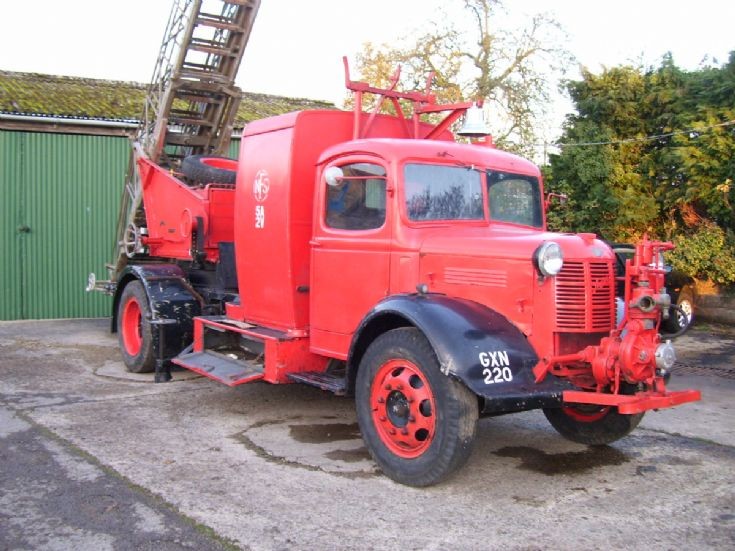
Austin k4 Merryweather TL GXN220
Picture taken by me 9/11/09 This is GXN220, Recently bought by us at auction in Harrogate (it was incorrectly catalogued as GKN220)
This is unusual in having a pto operated 60ft ladder (usually manual)
I would like to know its history if anyone is able to shed any light on it
Picture taken by me 9/11/09 This is GXN220, Recently bought by us at auction in Harrogate (it was incorrectly catalogued as GKN220)
This is unusual in having a pto operated 60ft ladder (usually manual)
I would like to know its history if anyone is able to shed any light on it
Paul,
According to the Fire Brigade Special appliance handbook it was issued to Letchworth in Hertfordshire then transferred to the West Riding of Yorkshire Fire Brigade then I believe it was part of Rowntrees Fire Brigade in York then bought by Ron Moverley of Crake in North Yorkshire who had it a number of years before putting it in the auction at Harrogate. Where are you located in the country ? I run the Eden Camp Rally at Malton in July of each year and you would be most welcome to attend if you wish.
Added by Rick Loudon on 11 November 2009.
According to the Fire Brigade Special appliance handbook it was issued to Letchworth in Hertfordshire then transferred to the West Riding of Yorkshire Fire Brigade then I believe it was part of Rowntrees Fire Brigade in York then bought by Ron Moverley of Crake in North Yorkshire who had it a number of years before putting it in the auction at Harrogate. Where are you located in the country ? I run the Eden Camp Rally at Malton in July of each year and you would be most welcome to attend if you wish.
Added by Rick Loudon on 11 November 2009.
This Austin K4/Merryweather 60'TLP(GXN 220)dates from 1944 and first served at Letchworth in Hertfordshire up until 1948.Its Home Office Number was No20.A second Austin K4/Merryweather TLP(GXN221)also from 1944 served Hertfordshire till 1963.This one also went into preservation.
After 1948,GXN220 served with the West Riding of Yorkshire Fire Brigade alongside 2 other's,these being GXN235-OSS 1962,and GXN241-OOS?.I cannot find any details of when GXN220 actually went out of service,but will try and do a little more research on this.Its good though to see another one of these Austin K4/Merryweather TLP's still in preservation.
Added by Pete Matten on 11 November 2009.
After 1948,GXN220 served with the West Riding of Yorkshire Fire Brigade alongside 2 other's,these being GXN235-OSS 1962,and GXN241-OOS?.I cannot find any details of when GXN220 actually went out of service,but will try and do a little more research on this.Its good though to see another one of these Austin K4/Merryweather TLP's still in preservation.
Added by Pete Matten on 11 November 2009.
Thanks for the info guys.
Rick, GXN220 is currently 8 miles away from Eden Camp !
The pto powers the ladder out & it slides back under its own weight. Got this all working again yesterday. The rotation of the ladder is sill manual. The pto set up looks like the proper kit. Its very well installed. Looking carefully, you can see it's a later fitment,
Added by Pul Thackrah on 12 November 2009.
Rick, GXN220 is currently 8 miles away from Eden Camp !
The pto powers the ladder out & it slides back under its own weight. Got this all working again yesterday. The rotation of the ladder is sill manual. The pto set up looks like the proper kit. Its very well installed. Looking carefully, you can see it's a later fitment,
Added by Pul Thackrah on 12 November 2009.
Paul:
Good to see this rig, with its war-time service and all, safely in preservation - front-mount Barton Pump and all.
There's a sad photo at picture 1867; of a not-so-fortunate Austin K4 TTL, whose identity has not yet been determined.
BTW, the PTO is the red hand-wheel on the right, with the black drive-belt?
So, in addition to the mounting being trained(turned) by hand, the ladder must be elevated(angled up) by hand also; and then the PTO extends the ladder in length...?
Great photo.
Regards, from Canada,
Pat_R-B
Added by Pat Rivers-Bowerman on 13 November 2009.
Good to see this rig, with its war-time service and all, safely in preservation - front-mount Barton Pump and all.
There's a sad photo at picture 1867; of a not-so-fortunate Austin K4 TTL, whose identity has not yet been determined.
BTW, the PTO is the red hand-wheel on the right, with the black drive-belt?
So, in addition to the mounting being trained(turned) by hand, the ladder must be elevated(angled up) by hand also; and then the PTO extends the ladder in length...?
Great photo.
Regards, from Canada,
Pat_R-B
Added by Pat Rivers-Bowerman on 13 November 2009.
Pat,
The red wheel isn't part of the pto.
The pto is underneath, adjacent to the prop shaft. It is engaged by a lever in the cab & drives a automatic clutch which in turn drives the winch that extends the ladder. There is a lever on left hand side about half way along the chassis, when this is lifted it releases the brake on the winch and increases the engine speed thus allowing the automatic clutch to engage the winch and wind out the ladder. The ladder is connected to the winch by a steel cable that runs up the ladder on a series of pullys. Letting go of the lever stops the ladder and applies the brake so the ladder can't side back down. Pushing this lever down releases the brake and the ladder comes down under its own weight.
Regards,
Paul
Added by Paul Thackrah on 13 November 2009.
The red wheel isn't part of the pto.
The pto is underneath, adjacent to the prop shaft. It is engaged by a lever in the cab & drives a automatic clutch which in turn drives the winch that extends the ladder. There is a lever on left hand side about half way along the chassis, when this is lifted it releases the brake on the winch and increases the engine speed thus allowing the automatic clutch to engage the winch and wind out the ladder. The ladder is connected to the winch by a steel cable that runs up the ladder on a series of pullys. Letting go of the lever stops the ladder and applies the brake so the ladder can't side back down. Pushing this lever down releases the brake and the ladder comes down under its own weight.
Regards,
Paul
Added by Paul Thackrah on 13 November 2009.
Ah, thanks Paul, for patiently sharing your new acquisition and its historical value..
Next "guess"; the red hand-wheel is for training the turn-table around; and the aluminum-coloured hand-wheel is for elevating and depressing the ladder's angle ??
I've never seen one of these wonderful rigs in real life, obviously; so I gotta pester you, the lucky owner, with the questions.... as a rural VFD; never been near a hydrant, or, any Aerial Apparatus; in any of my runs......
Last one...the Barton Front Mount Pump must be clutched in, at its location; and then the Pump Operator must have to go back to the cab, to increase throttle RPM's ?
Interested, as these rigs were designed for "untrained" war-time volunteers; if I could walk around an example; I would have a wonderful time figuring it all out !
Once again'
Pat_R-B
Added by Pat Rivers-Bowerman on 13 November 2009.
Next "guess"; the red hand-wheel is for training the turn-table around; and the aluminum-coloured hand-wheel is for elevating and depressing the ladder's angle ??
I've never seen one of these wonderful rigs in real life, obviously; so I gotta pester you, the lucky owner, with the questions.... as a rural VFD; never been near a hydrant, or, any Aerial Apparatus; in any of my runs......
Last one...the Barton Front Mount Pump must be clutched in, at its location; and then the Pump Operator must have to go back to the cab, to increase throttle RPM's ?
Interested, as these rigs were designed for "untrained" war-time volunteers; if I could walk around an example; I would have a wonderful time figuring it all out !
Once again'
Pat_R-B
Added by Pat Rivers-Bowerman on 13 November 2009.
I would disagree with your last comment Pat....the members of the National Fire Service during WW2 were not necessarily untrained 'war-time' volunteers. The NFS was the coming together of hundreds of smaller fire brigades many of which were very professional and in no way could be considered 'untrained'
The NFS must not be confused with the AFS...Auxilary Fire Service. I would suggest that the AFS members would be unlikely to operate TLs.
Regarding the pump operation, many TLs have incorporated pumps, I would suggest that operating a TL in a safe manner is a job on its own....I think that a second crew member would be tasked to look after the pump operation.
I think that it may well be the case that the red handle forward of the fulcrum frame is in fact a cable reel and not an operating control.
Added by Barrie Green on 14 November 2009.
The NFS must not be confused with the AFS...Auxilary Fire Service. I would suggest that the AFS members would be unlikely to operate TLs.
Regarding the pump operation, many TLs have incorporated pumps, I would suggest that operating a TL in a safe manner is a job on its own....I think that a second crew member would be tasked to look after the pump operation.
I think that it may well be the case that the red handle forward of the fulcrum frame is in fact a cable reel and not an operating control.
Added by Barrie Green on 14 November 2009.
Pat & all,
The red wheel is a cable reel, there is one on the other side too. They are on quick release mounts and detatch in 2 seconds.
The Barton pump is driven off the front of the crankshaft, where the starting handle would have fitted on the std K4 truck. The gearbox, the casing nearest the radiator grill, of the pump is permanently driven. Just forward of that is the lever,hanging down in the picture, that engages the pump, the casing with the silver cap on. There are no controls for the pump in the cab. The engine speed is raised by a hand throttle near the headlamp you can't see in the photo.
Pat is correct. These rigs were designed for inexperianced opperators, although obviously they would have to be shown the basics.
I believe Spitfire's fell into the same catagory !
Brave lads.
Oh and to train the turntable, you release the lock and shove it by hand.
The aluminium wheel does indeed alter the angle of the ladder when in it deployed position. To deploy the ladder, you release the safety lock on the cab roof. Then at the very back is a hand winch that pulls the ladder into the lock at end of the rack that is controlled by the aluminium hand wheel. This is the deployed, ready for use position, as in the photo. The operational angle of the ladder can now the varied with the hand wheel between 45 and 75 degrees to the horizontal.
Regard,
Paul
Added by Paul Thackrah on 15 November 2009.
The red wheel is a cable reel, there is one on the other side too. They are on quick release mounts and detatch in 2 seconds.
The Barton pump is driven off the front of the crankshaft, where the starting handle would have fitted on the std K4 truck. The gearbox, the casing nearest the radiator grill, of the pump is permanently driven. Just forward of that is the lever,hanging down in the picture, that engages the pump, the casing with the silver cap on. There are no controls for the pump in the cab. The engine speed is raised by a hand throttle near the headlamp you can't see in the photo.
Pat is correct. These rigs were designed for inexperianced opperators, although obviously they would have to be shown the basics.
I believe Spitfire's fell into the same catagory !
Brave lads.
Oh and to train the turntable, you release the lock and shove it by hand.
The aluminium wheel does indeed alter the angle of the ladder when in it deployed position. To deploy the ladder, you release the safety lock on the cab roof. Then at the very back is a hand winch that pulls the ladder into the lock at end of the rack that is controlled by the aluminium hand wheel. This is the deployed, ready for use position, as in the photo. The operational angle of the ladder can now the varied with the hand wheel between 45 and 75 degrees to the horizontal.
Regard,
Paul
Added by Paul Thackrah on 15 November 2009.
Some of the comments regarding the AFS are totally incorrect,the AFS was created in 1938 to
compliment the full time city brigades initially.
They remained the AFS until the government Nationalised the fire brigade during the early part of the war when problems arose with organisation and equipment incompatibility.When the entire country became part of the NFS.
some wholly AFS stations did operate the Austin TL`s during the war.As an ex member of the AFS until it was disbanded i can assure you we were not untrained as the comments seem to imply,far from it.after the war when the fire brigades were
handed back to civilian control the civil defence act was brought in which included the AFS etc.
in the time of conflict the local, brigade would be the initial fire fighting force so these type of appliances were not required by the AFS.I have not included dates as ia am at work and the info is not to hand,PS I went on to serve as a retained firefighter/Lff for 27 years,and only left due to ill health
Added by Barry knight on 19 November 2009.
compliment the full time city brigades initially.
They remained the AFS until the government Nationalised the fire brigade during the early part of the war when problems arose with organisation and equipment incompatibility.When the entire country became part of the NFS.
some wholly AFS stations did operate the Austin TL`s during the war.As an ex member of the AFS until it was disbanded i can assure you we were not untrained as the comments seem to imply,far from it.after the war when the fire brigades were
handed back to civilian control the civil defence act was brought in which included the AFS etc.
in the time of conflict the local, brigade would be the initial fire fighting force so these type of appliances were not required by the AFS.I have not included dates as ia am at work and the info is not to hand,PS I went on to serve as a retained firefighter/Lff for 27 years,and only left due to ill health
Added by Barry knight on 19 November 2009.
I have an identical TL, GXN215. The most visible difference is that mine does not have the 'bus-shelter' crew-cab. Mine also has the PTO modification to power the ladder extension. Although these were painted grey when they entered service for the NFS, they were repainted red after the war. The repainting was very thorough - a complete nut&bolt stripdown, as there isn't a single trace of grey, even in the nooks and crannies under the chassis! I am told that they went back to the Merryweather works after the war, and were stripped, repainted, and had the PTO gear fitted.
Added by David Moore on 11 August 2010.
Added by David Moore on 11 August 2010.
I am seeking a photo of GXN 234 similar TL that was stationed at Widnes Lancs then transferred to St Helens.
Added by Alan Lea ex Cheshire Fire Brigade on 12 August 2010.
Added by Alan Lea ex Cheshire Fire Brigade on 12 August 2010.
David, The Austin T.L K4 you have was of West Sussex Fire Brigade origins serving both at the Counties Worthing and Chichester Fire Stations they were swopped over the other K4/TL being GXN 210 I can't remember which TL went to which station first without looking through my notes.
When GXN 215 arrived within the brigade it was indeed wartime grey livery, during the fifties it was repainted fire engine red and also coach lined as well. It would have had the Barton Front Mounted pump and the rear crew cab intact. During the year 1963 each of these T.Ls were returned to workshops for a major overhaul, sometime prior to this they were fitted with a mechanical ladder operation by the Home Office (funding) the work was thought to have been carried out at the Home Office Workshops at Swindon, again I do have the dates and the infor on what was carried out and cost.
During the severe winter of 1963 GXN 215 the front mounted pump froze and cracked writing it off. it was around this era that on these TLs the crew cabs were removed as well as the pumps making the appliances a basic special appliance as prior to this they turned out as Pump Turntable Ladders, when in workshops they were stripped to the bare metal and new wings fitted I can't recall if the cab was removed I believe it was. When finished a Lucas Acorn style blue light was fitted in the centre roof of the cab and two tone horns placed the on a front mantlepiece on the cab with the West Sussex motif on the nearside and offside cab doors, paint finish was excellent! and was done by hand! immucalate. I have failed to mention that during the fifties one of the ladders collapsed on drill. I do, as I am sure most readers to this forum will have a list of registrations and original stations of allocation also work carried out on these appliances, one of which had a conversion of the rear crew cab to fully enclosed crew conversion with windows set in it seating changed position.
The sister machine to yours has the Crew Cab and Barton Pump placed back on, the reason being was the gent who restored it obtained one and refitted it and the pump to restore it to its original state. You will see a photo of it elsewhere on this site in a neglected disrepair sitting in a side street in Southampton. The Owner
had made attempts to sell it but to no avail was going to convert to a commercial lorry. Devon
Fire Brigade converted one of the Ladders onto a Bedford T.K chassis. I will add finally if you ran yours as described it will have no bell fitted in the format you have it. GXN 210 I believe did'nt have the correct Barton Front Mounted Pump fitted, I also seemed to recall a problem in the early days with the drive on the Bartons again being modified by the Home Office. I will have a look at my information as many of the original Bartons were changed early on these appliances life I do have the numbers.
Added by BOB CARVER on 12 August 2010.
When GXN 215 arrived within the brigade it was indeed wartime grey livery, during the fifties it was repainted fire engine red and also coach lined as well. It would have had the Barton Front Mounted pump and the rear crew cab intact. During the year 1963 each of these T.Ls were returned to workshops for a major overhaul, sometime prior to this they were fitted with a mechanical ladder operation by the Home Office (funding) the work was thought to have been carried out at the Home Office Workshops at Swindon, again I do have the dates and the infor on what was carried out and cost.
During the severe winter of 1963 GXN 215 the front mounted pump froze and cracked writing it off. it was around this era that on these TLs the crew cabs were removed as well as the pumps making the appliances a basic special appliance as prior to this they turned out as Pump Turntable Ladders, when in workshops they were stripped to the bare metal and new wings fitted I can't recall if the cab was removed I believe it was. When finished a Lucas Acorn style blue light was fitted in the centre roof of the cab and two tone horns placed the on a front mantlepiece on the cab with the West Sussex motif on the nearside and offside cab doors, paint finish was excellent! and was done by hand! immucalate. I have failed to mention that during the fifties one of the ladders collapsed on drill. I do, as I am sure most readers to this forum will have a list of registrations and original stations of allocation also work carried out on these appliances, one of which had a conversion of the rear crew cab to fully enclosed crew conversion with windows set in it seating changed position.
The sister machine to yours has the Crew Cab and Barton Pump placed back on, the reason being was the gent who restored it obtained one and refitted it and the pump to restore it to its original state. You will see a photo of it elsewhere on this site in a neglected disrepair sitting in a side street in Southampton. The Owner
had made attempts to sell it but to no avail was going to convert to a commercial lorry. Devon
Fire Brigade converted one of the Ladders onto a Bedford T.K chassis. I will add finally if you ran yours as described it will have no bell fitted in the format you have it. GXN 210 I believe did'nt have the correct Barton Front Mounted Pump fitted, I also seemed to recall a problem in the early days with the drive on the Bartons again being modified by the Home Office. I will have a look at my information as many of the original Bartons were changed early on these appliances life I do have the numbers.
Added by BOB CARVER on 12 August 2010.
What appears to be a red hand wheel on the side of the ladder is in fact a reel, one was fixed to each side of the ladder and contained a line which was attached to the head of the ladder in high winds to prevent deflection. This ladder was raised from rest by hand and turned by hand and elevated by hand, the front mounted pump shaft was engaged by use of the gear stick in the cab and the pump engaged by lifting the red lever seen on the side of the pump.
Added by John Hick on 15 August 2011.
Added by John Hick on 15 August 2011.
John I think you will find the line on these drums were called ground control lines and were attached to the front and rear of the monitor at the head of the ladder to move it without a man at the top of the ladder.even later TTL's had them I only ever used them on drill.
Added by Dave Price on 16 August 2011.
Added by Dave Price on 16 August 2011.
Good morning all, just a couple of notes, there were 50 Austin K4 60' Merryweather TLs. They were all delivered in NFS grey, they were all wholly hand operated (including extending the ladder) and none had Barton pumps, a very basic appliance.
During the NFS period 1941-1948 many, but not all, were converted to power ladder extension as GXN220 was. Barton front mounted pumps were also fitted during this period, whether they all received them I don't know.
Preserved GXN223 is still in its wholly manually operated condition, the Home Office conversion was never carried out on this machine.
Unlike the rest of the wartime built appliances all the TLs built between 1940 and 1945 stayed on the run, the 60 footers being useful machines in areas that had never seen TLs before World War II.
Hope this helps
Added by Mike Hebard on 17 August 2011.
During the NFS period 1941-1948 many, but not all, were converted to power ladder extension as GXN220 was. Barton front mounted pumps were also fitted during this period, whether they all received them I don't know.
Preserved GXN223 is still in its wholly manually operated condition, the Home Office conversion was never carried out on this machine.
Unlike the rest of the wartime built appliances all the TLs built between 1940 and 1945 stayed on the run, the 60 footers being useful machines in areas that had never seen TLs before World War II.
Hope this helps
Added by Mike Hebard on 17 August 2011.
My TL, GXN215 looks like it has never had a Barton. There are no bolt-holes in the chassis or on the front wings. If it was fitted and subsequently removed, I think it must also have had a new pair of wings and a new bumper. Seems unlikely.
Added by David Moore on 17 August 2011.
Added by David Moore on 17 August 2011.
David, I have a very early picture of GXN215(post-war)whilst operating out of Worthing Fire Station(West Sussex)and shows it to have had a Barton Pump fitted.
Added by Pete Matten on 17 August 2011.
Added by Pete Matten on 17 August 2011.
I have recently bought an Austin Merryweather 60 ft turntable ladder which we are led to believe was sold at Harrogate Auctions a few years ago. This was once owned by Ron Moverley. There is no number plate attached to it but we are under the impression it is GXN 220. The photo on this site picture 20681 is exactly like my vehicle. It was red but it is now grey. When it was bought at the auctions it was red, bought by a man at Pickering and sold to friend of mine who turned it back to grey. I have now bought it from him. Can anyone give me any information about it.
Added by Bruce Grange on 03 April 2013.
Added by Bruce Grange on 03 April 2013.
Have to agree with Dave Price's comments about the safety line reels either side of the ladder mounting. These safety reels continued to be fitted to TL's (the 100' mechanical / hydraulic) Merryweather ladders. There were connection eyelets at the head of the top extension. When used in high winds several men might be needed to steady the line.
Added by Colin Foster on 04 April 2013.
Added by Colin Foster on 04 April 2013.
Since making the comment about GXN215 not having a Barton, I have had a closer look and see evidence of it having been fitted. There is a piece of ali checkerplate on each wing covering the holes where the mounting frames had been, together with patches to the radiator grille.
Added by David Moore on 04 April 2013.
Added by David Moore on 04 April 2013.
Were the TL's supplied with the pump's for the NFS.
I have some photo's of the Isle of Wight Austin GXN 213 with a barton pump fitted.
Added by Graham Bain on 05 April 2013.
I have some photo's of the Isle of Wight Austin GXN 213 with a barton pump fitted.
Added by Graham Bain on 05 April 2013.
50 of these supplied to the National FS in 1943/44, Reg Numbers GXN201 to GXN250, None had pumps fitted when new but many of them were retro fitted before the NFS was disbanded in 1948
I have
GXN 205, 210, 211, 221223, 224, 225, 227, 228, 231, 238, shown has having been in preservation
Added by Ken Reid on 29 November 2014.
I have
GXN 205, 210, 211, 221223, 224, 225, 227, 228, 231, 238, shown has having been in preservation
Added by Ken Reid on 29 November 2014.
Ken, you have missed mine, GXN215, which regularly goes out to 1940s shows in the Midlands. See www.nfs-afs.org.uk
Added by David Moore on 02 December 2014.
Added by David Moore on 02 December 2014.
Can anybody help me? Still seeking a photo of GXN 234 stationed at Widnes Lancs, (now Cheshire, ) then transferred to St Helens now Merseyside
Added by Alan Lea on 08 December 2014.
Added by Alan Lea on 08 December 2014.
Alan the only picture I have seen of GXN 234 is in a line up of the St.Helens appliances in the Town Hall yard by the old station. If you contact Simon Ryan Brigade historian at Merseyside BHQ he will be able to help as he has this picture.
Added by Dave Price on 12 December 2014.
Added by Dave Price on 12 December 2014.
GXN 205 was in Swindon town centre commemorating the 75th anniversary of the Battle Of Britain in 2015. It is owned by the Wannel Family. I have a photo of it.
Added by David Sibun on 11 October 2016.
Added by David Sibun on 11 October 2016.
we have GXN219 at the museum of RAF fire fighting. it is n the process of being restored as we speak. back to the original NFS grey.
Added by Jo Munro on 27 August 2020.
Added by Jo Munro on 27 August 2020.
Hi - I know am the current keeper of GXN220 and shes still running and in good hands, kept nice and dry inside with some other NFS Appliances
Added by Simon Maynard on 13 April 2025.
Added by Simon Maynard on 13 April 2025.
Austin




Didnt this machine end up with the works FB at Rowntrees of York? they certainly had one at one time.
Added by Barrie Green on 11 November 2009.