
Upload a Picture
About this Site | Links | Random Pic | Advanced Search
Home | Latest Additions | Contributors
| Visitors
Fire Engine Photos
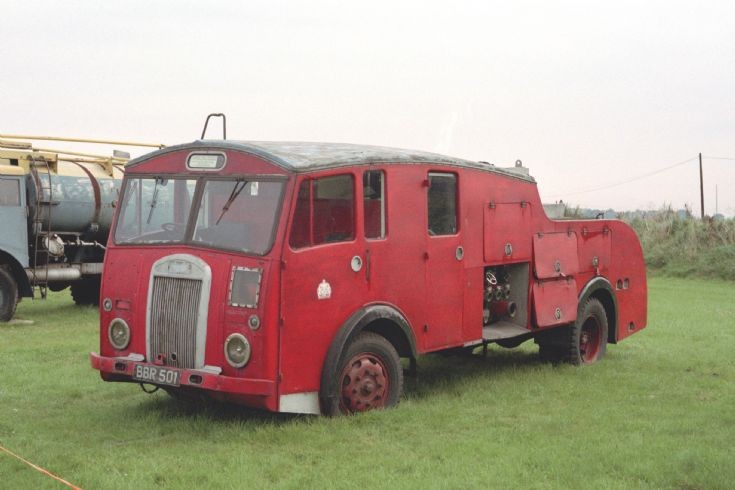
I think I have seen pictures of this machine before in service and if so I am hope I am right in saying that the lower lockers were removed to give better ground clearance and not mising as a resut of general decay.
Added by John D on 08 November 2009.
Added by John D on 08 November 2009.
Chris,
This is an F7 and not an F12 the tell tale differences are; round cab door handles and the extra window between the cab doors - the F7 was 12" longer than the F12 but mechanically identical
Added by Rick Loudon on 08 November 2009.
This is an F7 and not an F12 the tell tale differences are; round cab door handles and the extra window between the cab doors - the F7 was 12" longer than the F12 but mechanically identical
Added by Rick Loudon on 08 November 2009.
Hi Rick, interested to know how to identify an F12 over an F7, ignorantly had not picked up on the extra window. I think it was from the FSNBF Roger Pennington cards that said an F12 was 12" shorter than an F7? so never looked further. Anyway, in I think the current Heritage Commercials magazine there is what looks like an F7 for sale (extra window) but in the tiny picture it appears to have non round cab door handles? Says it has been barn stored for years, clearly needs work, but is interesting. It has an unusual feature, which is what appears to be a vertical join in the bodywork between the cab & lockers with what looks like a rubber seal. I have seen it on some other Denniss, always meant to ask someone if they knew why (perhaps to reduce any flex in the body?)
Added by John D on 17 November 2009.
Added by John D on 17 November 2009.
Hi John (and Rick), hope you don't mind if I join in at this point. The extra window in the cab is a red herring I'm afraid - it is normal for F7s and F12s to have this and indeed F15s but F8s which are shorter do not have it. An F7 has a 13' 6" wheelbase and an F12, 12' 6" giving the one foot overall difference. I am told that the '7s' were found to be too long to navigate city streets easily and so a shorter version was made which went on to be produced in much greater numbers.
It is true that the locker layout can be a good way of telling the difference, particularly the hard suction locker which on an F12 overlaps the rear crew door but doesn't on an F7. The locker behind the pump controls is longer on an F7 but as not all F12s have midships pumps, that might not help much. I used to think that the round door handles were a definite indication of an F7 until I saw a photo of an F12 which had both styles fitted - one on the cab and the other on the lockers! This may be the exception that proves the rule.
I am told that 75 F7s were built (plus one hybrid) and 346 F12s so in most cases saying 'F12' will be correct.
On the matter of the appliance you have seen advertised, I will supply more info when I am not late for work like I am now!
Added by Chris Wood on 17 November 2009.
It is true that the locker layout can be a good way of telling the difference, particularly the hard suction locker which on an F12 overlaps the rear crew door but doesn't on an F7. The locker behind the pump controls is longer on an F7 but as not all F12s have midships pumps, that might not help much. I used to think that the round door handles were a definite indication of an F7 until I saw a photo of an F12 which had both styles fitted - one on the cab and the other on the lockers! This may be the exception that proves the rule.
I am told that 75 F7s were built (plus one hybrid) and 346 F12s so in most cases saying 'F12' will be correct.
On the matter of the appliance you have seen advertised, I will supply more info when I am not late for work like I am now!
Added by Chris Wood on 17 November 2009.
John, its an F15 that is for sale - sorry was for sale - a good friend has bought it- its ex City of Sheffield RWB 999 pics to follow, the F15 was a generally built as a water tender version of the F12 in that it had a bigger water tank than the pump escape although one or two were built to carry escape ladders LNR 900 ex Leicestershire and Rutland was such an example, they were however mechanically the same - I'm unsure as to the reason behind the separate cab/ body but it would certainly help prevent 'flexing' as you say
Added by Rick Loudon on 17 November 2009.
Added by Rick Loudon on 17 November 2009.
Our F7 has a small window at the rear of the cab (behind the back crew seats) I have never worked out what that was for....it doesn't really allow much light into the rear cab, the driver cannot see it so it isnt for observation, one of lifes great mysteries,
Added by Barrie Green on 18 November 2009.
Added by Barrie Green on 18 November 2009.
Hi Rick, thanks for that, very interesting (looking forward to seeing the pictures). So the question is which is rarer an F15 or an F7, I always thought the latter, but now thinking about it you don't here of many F15's.
Added by John D on 18 November 2009.
Added by John D on 18 November 2009.
Barrie,
My F12 999 MRA ex Derbyshire has a small window in the cab roof behind the rear seats - this is to check the escape head securing gear is engaged - I wonder (as an F7 is longer by 12") if the escape head securing gear is behind the cab and therefore that window is for that purpose ? if this is the case please look out of it and check the head is secure !
John,you'll have to get Chris Wood to get them posted ! you're right there are'nt many F15's but I would suggest even fewer F7's I can only think of four - Southampton, Huddersfield, Chester and Brighton (although the latter was in an unrestored state nr Clonmel in South Tiperrary in the ROI )
Added by Rick Loudon on 18 November 2009.
My F12 999 MRA ex Derbyshire has a small window in the cab roof behind the rear seats - this is to check the escape head securing gear is engaged - I wonder (as an F7 is longer by 12") if the escape head securing gear is behind the cab and therefore that window is for that purpose ? if this is the case please look out of it and check the head is secure !
John,you'll have to get Chris Wood to get them posted ! you're right there are'nt many F15's but I would suggest even fewer F7's I can only think of four - Southampton, Huddersfield, Chester and Brighton (although the latter was in an unrestored state nr Clonmel in South Tiperrary in the ROI )
Added by Rick Loudon on 18 November 2009.
Our escape head securing gear is mounted inside the cab Rick
Added by Barrie Green on 18 November 2009.
Added by Barrie Green on 18 November 2009.
Reading Berkshire Dennis f7 FMO 635 once my machine also
Added by Jason on 18 November 2009.
Added by Jason on 18 November 2009.
Jason,
Ooops sorry!- I knew I'd forgotton one - or two ?
Barrie,
Yes my F12's head securing gear lever is in the cab but before the warning light was fitted this window was a visual way of checking if it was engaged - and is still the best way !
Added by Rick Loudon on 19 November 2009.
Ooops sorry!- I knew I'd forgotton one - or two ?
Barrie,
Yes my F12's head securing gear lever is in the cab but before the warning light was fitted this window was a visual way of checking if it was engaged - and is still the best way !
Added by Rick Loudon on 19 November 2009.
Chris, thanks for the info you supplied I missed it before my previous posting. Really would love to see those pictures. I like the Dennis logic of the window for viewing escape gear, there has to be a practical reason as it is a lot of hard work to put it in purely for aesthetics.
Added by John D on 19 November 2009.
Added by John D on 19 November 2009.
John D, I'll put some photos on soon but via a friend as I don't have email or my own computer for that matter!
There is evidence of a roof window on the Huddersfield F7 but I think it went out of use during it's service.
Another F7 survivor is the Leicester City machine, GRY 863 and Hampshire's HOU 558 is still tucked away somewhere as far as I know.
Added by Chris Wood on 19 November 2009.
There is evidence of a roof window on the Huddersfield F7 but I think it went out of use during it's service.
Another F7 survivor is the Leicester City machine, GRY 863 and Hampshire's HOU 558 is still tucked away somewhere as far as I know.
Added by Chris Wood on 19 November 2009.
My ex f7 has a window on the rear wall of the cab about 12 inches by 5 inches and a lamp in the crew compartment and on the engine hump/radiator cowl
Added by Jason on 20 November 2009.
Added by Jason on 20 November 2009.
Dennis


Added by Barrie Green on 08 November 2009.