
Upload a Picture
About this Site | Links | Random Pic | Advanced Search
Home | Latest Additions | Contributors
| Visitors
Fire Engine Photos
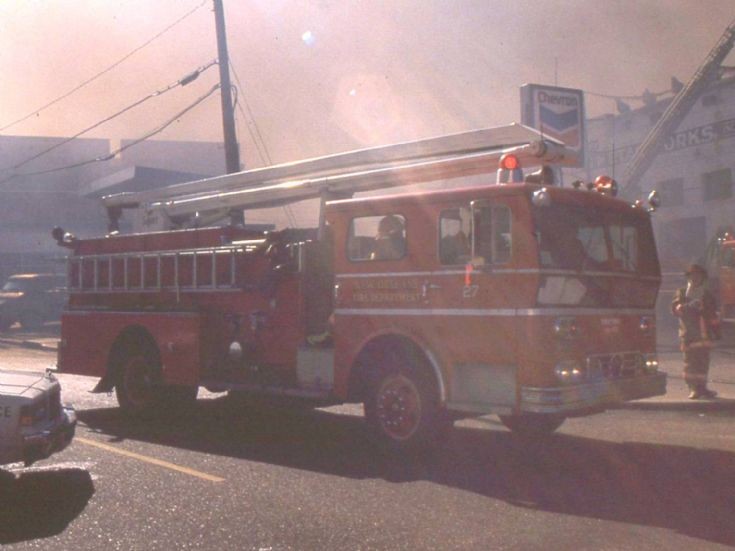
No: 19203 Contributor: Jacques Peter Year: 1989 Manufacturer: Ward LaFrance Country: United States of America
And; for Pav: dimly, through the smoke, "cough-cough"; you can see the fireman in his "grannie seat", twisted around, to "have a dekko" at what's going on.
BTW, would this rig be a "Scoosh" in the Scottish Brigades ?
Great on-scene photo, Jacques.
Regards, from Canada,
Pat_R-B
Added by Pat Rivers-Bowerman on 09 September 2009.
BTW, would this rig be a "Scoosh" in the Scottish Brigades ?
Great on-scene photo, Jacques.
Regards, from Canada,
Pat_R-B
Added by Pat Rivers-Bowerman on 09 September 2009.
Hi Pete,
Many thanks as usual for your comments.
I noticed you wrote "squrt" which i have also seen written on some trucks in the US, I thought it was a spelling mistake. What is the right term? Squirt or Squrt?
Cheers and thnaks - JP
Added by Jacques PETER on 09 September 2009.
Many thanks as usual for your comments.
I noticed you wrote "squrt" which i have also seen written on some trucks in the US, I thought it was a spelling mistake. What is the right term? Squirt or Squrt?
Cheers and thnaks - JP
Added by Jacques PETER on 09 September 2009.
Yes Pat, a beautiful shot indeed, love the roof beacons too!! Thanks Jacques
Added by Pav on 09 September 2009.
Added by Pav on 09 September 2009.
Jacques,the FDNY operated back in 1970,2 Mack CF pumper/telesqurts(I have picture),also when I visited and stayed with a friend in Chula Vista,California back in 1990 his FD operated several Ford and Crown pumper/tele-squrt apparatus.Also just looked through some old USA fire magazines that shows several pictures,one is from the Los Angeles City FD.Its spelt-Squrt.
Added by Pete Matten on 09 September 2009.
Added by Pete Matten on 09 September 2009.
Pat_R-B,the correct title of the appliance(apparatus)your talking about is the Scoosher which is an old Glasgow slang word for a water pistol,the word"scoosh"to a Glasgow fireman means to give a quick wash down with a(branch)jet.
The only resemblence to the picture here are the booms,the Scoosher had a ladder fixed to the lower boom(which could be removed)which could be raised after the booms were raised for rescue,and firefighting use.
The Scoosher was first introduced to the Glasgow Fire Service in 1968,the first 3 being built by Dennis on the Dennis'D'Series chassis,the bodywork was done by J.C.Bennett a Glasgow body manufacturer.These were known as the Mark 1.
Due to there potential,Glasgow ordered another five,the Mark 2,these being mounted on the Dennis'F46A chassis.In 1973,six more Scooshers were ordered these being chassied on Dodge K850 Tricentrol chassis,these had bodywork by Carmichael and Sons of Worcester.These later ones were unofficially known as Mark 2A's.In total,the Glasgow Fire Service put into use,14 Scooshers.
In actual fact,the Scoosher didn't last long with the Glasgow Fire Service-but thats another story.
Added by Pete Matten on 09 September 2009.
The only resemblence to the picture here are the booms,the Scoosher had a ladder fixed to the lower boom(which could be removed)which could be raised after the booms were raised for rescue,and firefighting use.
The Scoosher was first introduced to the Glasgow Fire Service in 1968,the first 3 being built by Dennis on the Dennis'D'Series chassis,the bodywork was done by J.C.Bennett a Glasgow body manufacturer.These were known as the Mark 1.
Due to there potential,Glasgow ordered another five,the Mark 2,these being mounted on the Dennis'F46A chassis.In 1973,six more Scooshers were ordered these being chassied on Dodge K850 Tricentrol chassis,these had bodywork by Carmichael and Sons of Worcester.These later ones were unofficially known as Mark 2A's.In total,the Glasgow Fire Service put into use,14 Scooshers.
In actual fact,the Scoosher didn't last long with the Glasgow Fire Service-but thats another story.
Added by Pete Matten on 09 September 2009.
"Scoosher" - Pete, thanks for the info.
I had tried the "Google", but it wasn't very helpful - had to go for the experts, here.
Regards, from Canada,
Pat_R-B
Added by Pat Rivers-Bowerman on 10 September 2009.
I had tried the "Google", but it wasn't very helpful - had to go for the experts, here.
Regards, from Canada,
Pat_R-B
Added by Pat Rivers-Bowerman on 10 September 2009.
The first comment here indicates the truck is a Ward LaFrance from the 70s. The unusual shape of the windshield is a good clue to this.
Added by Michael Feldman on 25 November 2011.
Added by Michael Feldman on 25 November 2011.
The squirt concept did not survive very long in the US either, although some cities like New Orleans did keep theirs in service for many years, as illustrated in this photo. A few cities actually removed them and continued to operate their pumpers without the squirt attached.
The problem was that the operator often could not see where the jet was going, because these pre-dated the days when aerial units had cameras which could be viewed by the operator on the ground. Bearing in mind that all US pumps are required by NFPA regulations to have a deck gun, the advantage of having the monitor only a relatively short distance higher was often not all that significant either.
Chicgo still uses a pair of 15 meter snorkels, which are very busy responding to structure fires in many different areas of the city. But these have the advantage that they have a member in the cage, so they can take full advantage of the flexibility of the snorkel platform. Even so, there are only two in the entire city, compared to 46 30 meter ladders and tower ladders.
Added by Rob Johnson on 19 June 2013.
The problem was that the operator often could not see where the jet was going, because these pre-dated the days when aerial units had cameras which could be viewed by the operator on the ground. Bearing in mind that all US pumps are required by NFPA regulations to have a deck gun, the advantage of having the monitor only a relatively short distance higher was often not all that significant either.
Chicgo still uses a pair of 15 meter snorkels, which are very busy responding to structure fires in many different areas of the city. But these have the advantage that they have a member in the cage, so they can take full advantage of the flexibility of the snorkel platform. Even so, there are only two in the entire city, compared to 46 30 meter ladders and tower ladders.
Added by Rob Johnson on 19 June 2013.
At that time on the New Orleans Fire Department, I recall two Ward LaFrance Squirts of that model. Engine 29, located at Central Station, in the French Quarter, and Engine 14, housed with Ladder 1 at the time on South Robertson Street in the Central Business District.
Added by Glenn M Joshua on 17 May 2021.
Added by Glenn M Joshua on 17 May 2021.
Ward LaFrance


Thanks for this classic picture Jacques,you can nearly taste that smoke going down your lungs.
Added by Pete Matten on 08 September 2009.