
Upload a Picture
About this Site | Links | Random Pic | Advanced Search
Home | Latest Additions | Contributors
| Visitors
Fire Engine Photos
No: 8219 Contributor: Jacques Trempe Year: 2008 Manufacturer: Unknown Country: United States of America
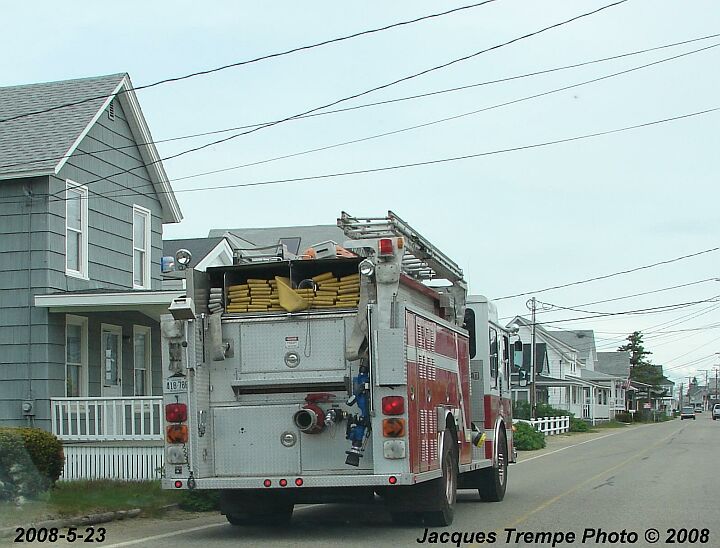
Barry, this looks like a typical American pumper(engine)and yes it should carry suction hose.This may be carried above lockers on shelf on the left side of the
apparatus, or maybe in the rear top locker.The bottom rear locker I should think
holds what is called in the States, a booster reel(hosereel).The hose set-up is
quiet typical of American fire apparatus, the delivery hose-already connected is connected to the hydrant by a firefighter having been dropped off the engine on route(its flacked-but already connected-one length to another)at the nearest hydrant, the appliance(engine/apparatus)then carries on to the actual incident rolling hose along the road to reach the incident.Over here, we would drop a mate off with standpipe/key&bar and a couple of lengths of delivery hose-because our main concern was reaching the fire as soon as posible and starting
to get to work with what water we had in the tank, the hydrant man new he had 3or4 minutes to run out and connect the hydrant before lose of water.I hope this answers some of your questions.
Added by Pete Matten on 26 May 2008.
apparatus, or maybe in the rear top locker.The bottom rear locker I should think
holds what is called in the States, a booster reel(hosereel).The hose set-up is
quiet typical of American fire apparatus, the delivery hose-already connected is connected to the hydrant by a firefighter having been dropped off the engine on route(its flacked-but already connected-one length to another)at the nearest hydrant, the appliance(engine/apparatus)then carries on to the actual incident rolling hose along the road to reach the incident.Over here, we would drop a mate off with standpipe/key&bar and a couple of lengths of delivery hose-because our main concern was reaching the fire as soon as posible and starting
to get to work with what water we had in the tank, the hydrant man new he had 3or4 minutes to run out and connect the hydrant before lose of water.I hope this answers some of your questions.
Added by Pete Matten on 26 May 2008.
This pumper has over 1000 feet of five inch supply hose, which is unusual, because most water systems do not have enough pressure to move water this distance from a hydrant. As can be seen, carrying this quantity of LDH reduces the load of attack hose which can be accommodated.
Hose loads vary greatly between departments, and even between pumpers, depending on local conditions. This is probably best illustrated by looking at different FDNY pumpers.
A typical - but by no means universal - load would be as follows:-
1- Either a 200 foot 1" booster reel, mounted in the rear center locker, or (much more often) a preconnected 1" "trash line", usually installed either in a front bumper tray or as a crosslay above the central pump bay. This is mainly 100 to 150 feet long.
2- Between two and four preconnected crosslays, above or next to the pump. These may be a combination of 1.5", 1.75". 2.0" and occassionally 2.5", and are usually 200, 250 or 300 feet long, in 50 foot lengths.
3- The main hose load goes in the bed. Supply hose is either 4" or more often 5", in 100 foot lengths, and 600 to 800 feet is typical. Attack hose may include 200 to 300 feet of preconnected 1.5" to 2.0", but normally includes around 800 feet of 2.5". Some departments add 500 to 600 feet of either 3" or 3.5" to feed ground monitors or ladder pipes. These attack lines are supplied in 50 foot lengths, so they can be broken down to the desired length as needed.
4- Many departments add a front bumper suction inlet and preconnect around 200 feet of 5" supply hose. Some also add preconnected a length of 5" hose to one or both side inlets of the pump.
5- Additional bundles of 1.5". 1.75" or sometimes 2.0" attack hose are carried in or on side lockers for interior attack, especially in high rise buildings. These are typically three to five 50 foot lengths.
6- Usually two ten foot suction hoses are carried. For most pumpers, this is 6 inch diameter, and it is often used for hydrant connections if the pumper is near enough to the hydrant. Some FDNY pumpers also carry 3" suctions, but nobody has ever been able to explain why!
Added by Rob Johnson on 25 August 2014.
Hose loads vary greatly between departments, and even between pumpers, depending on local conditions. This is probably best illustrated by looking at different FDNY pumpers.
A typical - but by no means universal - load would be as follows:-
1- Either a 200 foot 1" booster reel, mounted in the rear center locker, or (much more often) a preconnected 1" "trash line", usually installed either in a front bumper tray or as a crosslay above the central pump bay. This is mainly 100 to 150 feet long.
2- Between two and four preconnected crosslays, above or next to the pump. These may be a combination of 1.5", 1.75". 2.0" and occassionally 2.5", and are usually 200, 250 or 300 feet long, in 50 foot lengths.
3- The main hose load goes in the bed. Supply hose is either 4" or more often 5", in 100 foot lengths, and 600 to 800 feet is typical. Attack hose may include 200 to 300 feet of preconnected 1.5" to 2.0", but normally includes around 800 feet of 2.5". Some departments add 500 to 600 feet of either 3" or 3.5" to feed ground monitors or ladder pipes. These attack lines are supplied in 50 foot lengths, so they can be broken down to the desired length as needed.
4- Many departments add a front bumper suction inlet and preconnect around 200 feet of 5" supply hose. Some also add preconnected a length of 5" hose to one or both side inlets of the pump.
5- Additional bundles of 1.5". 1.75" or sometimes 2.0" attack hose are carried in or on side lockers for interior attack, especially in high rise buildings. These are typically three to five 50 foot lengths.
6- Usually two ten foot suction hoses are carried. For most pumpers, this is 6 inch diameter, and it is often used for hydrant connections if the pumper is near enough to the hydrant. Some FDNY pumpers also carry 3" suctions, but nobody has ever been able to explain why!
Added by Rob Johnson on 25 August 2014.
Unknown


Added by Barry on 25 May 2008.