
Upload a Picture
About this Site | Links | Random Pic | Advanced Search
Home | Latest Additions | Contributors
| Visitors
Fire Engine Photos
No: 814 Contributor: FF Wayne Yanish Year: 1920 Manufacturer: Ford Country: United States of America
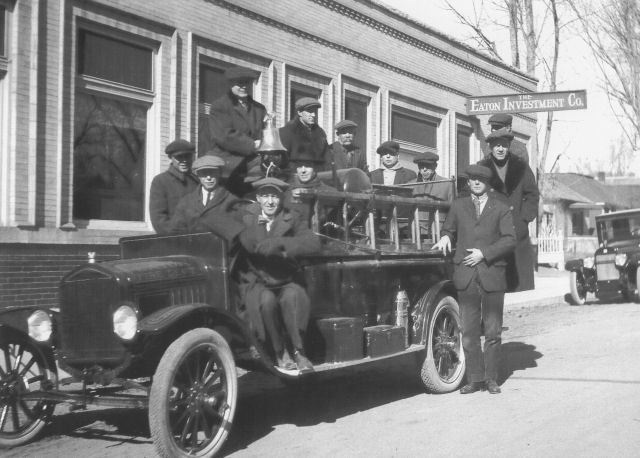
1920 Model T Chemical Fire Engine
I believe this is a Ford Model T Chemical Fire Engine. I'm not sure of the year of the truck. This picture is from old negatives we recently found in our old fire station from about 1920. They negatives were never developed until now. The negatives were specially developed for us because of there age down in Denver. We did some research and even figured out what kind of camera took the picture! See our web site at: www.eatonfire.org and go to "EFD Archives" for more information.
I believe this is a Ford Model T Chemical Fire Engine. I'm not sure of the year of the truck. This picture is from old negatives we recently found in our old fire station from about 1920. They negatives were never developed until now. The negatives were specially developed for us because of there age down in Denver. We did some research and even figured out what kind of camera took the picture! See our web site at: www.eatonfire.org and go to "EFD Archives" for more information.
The Ford was a very popular "chemical engine" in the US throughout the period 1910 to 1930. Athough specifications varied widely, the chemical engine usually had two 40-gallon soda-acid tanks and one hosereel, a small hose bed for 2.5 inch hose, one or two short ground ladders, a couple of hand extiguishers, and a few miscellaneous items such as axes, lanterns, etc.
It was usually the first responder, as it could get to work without hooking up to a hydrant and was able to handle or contain many small fires before the pumper and hose truck combination also arrived on scene.
A few had as many as four tanks, but these left little room for anything else. Although chemical engines were still bought by some fire deoartments in to the 1930s, they died out beginning in the 1920s, when fire departments started placing chemical tanks and hosereels on their newer pumpers, thereby creating the "triple combination".
They first appeared as hand or horse drawn units in the 1890s, before which fire departments had to rely on hydrants or open water sources for even minor fire situations.
In Europe, chemical engines were also widely used, as well as "gas pumpers", which used compressed air or CO2 instead of the soda-acid reaction to pressurize the water. In the UK, these tank and hosereel systems mainly cropped up on escape carriers before they were seen on pumps, because the escape was usually the first due unit to arrive. As early as 1905 London and other cities had the system even on their horse drawn escape vans. In their 1913 annual report to the LCC the Brigade attributed these as being able to deal with a very significant number of fires. Only 66 out of 3, 387 London fires required the use of one or more fire pumps!
Added by Rob Johnson on 16 August 2013.
It was usually the first responder, as it could get to work without hooking up to a hydrant and was able to handle or contain many small fires before the pumper and hose truck combination also arrived on scene.
A few had as many as four tanks, but these left little room for anything else. Although chemical engines were still bought by some fire deoartments in to the 1930s, they died out beginning in the 1920s, when fire departments started placing chemical tanks and hosereels on their newer pumpers, thereby creating the "triple combination".
They first appeared as hand or horse drawn units in the 1890s, before which fire departments had to rely on hydrants or open water sources for even minor fire situations.
In Europe, chemical engines were also widely used, as well as "gas pumpers", which used compressed air or CO2 instead of the soda-acid reaction to pressurize the water. In the UK, these tank and hosereel systems mainly cropped up on escape carriers before they were seen on pumps, because the escape was usually the first due unit to arrive. As early as 1905 London and other cities had the system even on their horse drawn escape vans. In their 1913 annual report to the LCC the Brigade attributed these as being able to deal with a very significant number of fires. Only 66 out of 3, 387 London fires required the use of one or more fire pumps!
Added by Rob Johnson on 16 August 2013.
Ford


Added by Lynnea St John on 31 December 2006.