
Upload a Picture
About this Site | Links | Random Pic | Advanced Search
Home | Latest Additions | Contributors
| Visitors
Fire Engine Photos
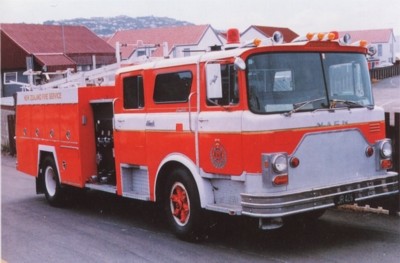
Possibly the bodywork are built by local NZ company and the style are still used today.Mack are quite popular in NZ but in 1990s-now the NZ FS replaced the Macks with Scania.However FDNY still use their Mack CF pumper/tower truck till today as reserve.
Added by Bomba Boy on 19 December 2006.
Added by Bomba Boy on 19 December 2006.
Brian Denton 1995 "Chariots for Fire" Reed Books places this photograph in the capital of New Zealand, when the appliance was a relief pump in the Wellington Region. The body was manufactured by Wormalds who were a major fire appliance manufacturer at that time. It would be nice if some of our New Zealand colleagues could comment on this very unique machine, , , ,
Added by Pavel Zaremba on 20 December 2006.
Added by Pavel Zaremba on 20 December 2006.
This was a Pump in the Wellington area, and has now been decommissioned. The locker section was most likely built by Wormalds, but the cupboard style doors were typical in this part of the country - other areas had roller type lockers.
This is a unique appliance in New Zealand - most Macks here were in fact Aerials - Auckland City has a Mack Aerialscope, and there were various TTL's, Snorkels and Telebooms around the country. Those still in commission include Auckland City and Tauranga. I believe the Department of Corrections may still have a Mack Pump based at the Paremoremo Prison. Take a look at www.111emergency.co.nz for more information about NZ appliances.
Added by Darren Hodgetts on 23 February 2007.
This is a unique appliance in New Zealand - most Macks here were in fact Aerials - Auckland City has a Mack Aerialscope, and there were various TTL's, Snorkels and Telebooms around the country. Those still in commission include Auckland City and Tauranga. I believe the Department of Corrections may still have a Mack Pump based at the Paremoremo Prison. Take a look at www.111emergency.co.nz for more information about NZ appliances.
Added by Darren Hodgetts on 23 February 2007.
This is one of three Mack "pumps" used in the Wellington City Brigade with bodywork built by Wormalds in NZ. The first was in the late 70's, the last in 1982. Other Macks used in Wellington include a MC series "Telesquirt", and a CF Mack TTL with 100' ladder. There were several Mack aerial appliances used around NZ in the 80's and 90's.
Added by Michael D on 07 October 2008.
Added by Michael D on 07 October 2008.
I'm am definitely sure that Paremoremo still has their CF Mack.
Added by James Marks on 13 October 2008.
Added by James Marks on 13 October 2008.
"Granny Seats" again, Pavel.
As originally built, this Mack CF would have the open-ended cab, with the rear-facing seats behind those parallelogram [lozenge?] windows - mid-mount engine and pump.
Wormalds would have added the rear cab-doors and closed it in; and done the rest of the body. Don't know about shifting the Mid-Mount Pump Panel from USA LH side to this RH side.
Picture # 4890 shows a USA Mack CF Pumper; and Picture # 5055 shows another Mack Pumper with "Granny Seat" occupants.
This rig is truly a fascinating combination of classic USA Pumper and British-style Pumper.
Would love to see more of her.
Regards, from Canada,
Pat_R-B
Added by Pat Rivers-Bowerman on 29 November 2008.
As originally built, this Mack CF would have the open-ended cab, with the rear-facing seats behind those parallelogram [lozenge?] windows - mid-mount engine and pump.
Wormalds would have added the rear cab-doors and closed it in; and done the rest of the body. Don't know about shifting the Mid-Mount Pump Panel from USA LH side to this RH side.
Picture # 4890 shows a USA Mack CF Pumper; and Picture # 5055 shows another Mack Pumper with "Granny Seat" occupants.
This rig is truly a fascinating combination of classic USA Pumper and British-style Pumper.
Would love to see more of her.
Regards, from Canada,
Pat_R-B
Added by Pat Rivers-Bowerman on 29 November 2008.
Michael,I've just been looking through some of my old pictures.They were right-hand drive.
Added by Pete Matten on 14 March 2010.
Added by Pete Matten on 14 March 2010.
Upon further investigation with my colleagues, I've learned that there were actually 4 of these pumps used in Wellington (before my time). There were some variations to the body work. I have some photo's of others and will see if I can get them on here. They were all right hand drive.
Added by Michael D on 22 March 2010.
Added by Michael D on 22 March 2010.
We have just purchased the ex Auckland 1978 Mack CF685RFC with 100' ladder from Steve Knowles Reg.JB4878 and intend putting into contracting work.
Added by Warren at Coast Central Contracting Ltd on 05 July 2010.
Added by Warren at Coast Central Contracting Ltd on 05 July 2010.
I have an original copy of this picture and it shows this 1982 Mack/Custon-built lowline pumper as having the registration JR426.Just above the window below the orange lights it also states it was on the run from Station 31 when this photograph was taken.
Added by Pete Matten on 18 September 2010.
Added by Pete Matten on 18 September 2010.
Cheers Pete. Count on you as always to sort out a crisis. I'm also having problems identifying the differences of the bodywork on the Pumpers. Is it Austral, Lowes, Mills-Tui or Warmauld?
Added by Andrew Middleton on 18 September 2010.
Added by Andrew Middleton on 18 September 2010.
JR 426 was last the appliance at Auckland Maximum Security Prison as an Industrial appliance.
Added by Bruce Perry on 21 September 2010.
Added by Bruce Perry on 21 September 2010.
JR 426 was a rebuild of original registration IW 2229 that was involved in an accident. In answer to Andrew M it was assembled by Wormald. It has recently been replaced at the prison and disposed of.
Added by David Miller on 06 December 2011.
Added by David Miller on 06 December 2011.
I just brought a 1982 mack CF685 ex Wellington, Newtown and Rotorua ladder fire struck now a tiny home. Would like a photo when is use if anyone has one. 02102262513 cell.
Added by Julie Anderson on 06 August 2017.
Added by Julie Anderson on 06 August 2017.
Sounds like KU 1463. Have a look at www. 111emergency.co.nz/J-M/KU1463.htm
Added by David Miller on 08 August 2017.
Added by David Miller on 08 August 2017.
Yes you are correct, I found that site after commenting here.
Added by Julie Anderson on 09 August 2017.
Added by Julie Anderson on 09 August 2017.
Nothing here about pump or water tank capacities for these. The CF was a custom fire appliance chassis and the pumpers, which were very widely used in North America, were rated from 3, 640 LPM @ 10 AT with a three meter lift upwards. Most ran with water tanks between around 1,000 and 1,800 litres, but some went a bit higher. The range was very well respected for reliability and ruggedness, and many were exported to South America after serving in the US, with a second service life extending out to a total which often exceeded forty years!
As mentioned here, they were also used for aerial ladders, towers, rescues, tankers and other specialized applications, including several with tandem rear axles. For many years they were the standard brand for FDNY - as well as dozens of other major city departments.
Added by Rob Johnson on 01 April 2024.
As mentioned here, they were also used for aerial ladders, towers, rescues, tankers and other specialized applications, including several with tandem rear axles. For many years they were the standard brand for FDNY - as well as dozens of other major city departments.
Added by Rob Johnson on 01 April 2024.
Mack


Added by George Frankenfield on 14 July 2006.