These beasts fill a very important role in countries where hydrants are rare or unknown, and open water sources either scarce or inaccessible.
Very common in many south American countries, giant tankers also show up in many rural and even heavily urbanized communities all over the World.
Here in the US, semitrailer tankers are rare, but three and even four axle tankers are everywhere at fire stations covering rural risks, usually carrying 3, 000 to 3, 500 USG each.
The tactic is to employ folding open dams, feeding regular pumpers at the fire location, which are refilled by a relay of tankers replenishing themselves at the nearest water source. The relay can often include half a dozen tankers, sometimes many more!
Each tanker usually carries a collapsed dam, which can be set up and filled in a few minutes by well trained volunteers.
Even in Kuwait City, which is quite modern, the fire service has to rely on tankers, because most parts of the city have no network of water mains.
When I lived there, each one of the 28 stations had a tanker, usually carrying 6, 000 to 8, 000 liters, in addition to a pumper, a rescue truck and an aerial. But the central fire station on the sixth ring road housed no less than forty (yes, 40!) huge semitrailer tankers like this example.

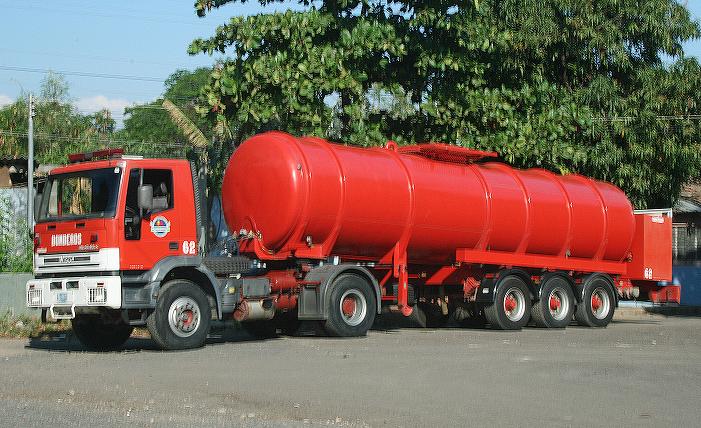


Very common in many south American countries, giant tankers also show up in many rural and even heavily urbanized communities all over the World.
Here in the US, semitrailer tankers are rare, but three and even four axle tankers are everywhere at fire stations covering rural risks, usually carrying 3, 000 to 3, 500 USG each.
The tactic is to employ folding open dams, feeding regular pumpers at the fire location, which are refilled by a relay of tankers replenishing themselves at the nearest water source. The relay can often include half a dozen tankers, sometimes many more!
Each tanker usually carries a collapsed dam, which can be set up and filled in a few minutes by well trained volunteers.
Even in Kuwait City, which is quite modern, the fire service has to rely on tankers, because most parts of the city have no network of water mains.
When I lived there, each one of the 28 stations had a tanker, usually carrying 6, 000 to 8, 000 liters, in addition to a pumper, a rescue truck and an aerial. But the central fire station on the sixth ring road housed no less than forty (yes, 40!) huge semitrailer tankers like this example.
Added by Rob Johnson on 13 July 2017.