
Upload a Picture
About this Site | Links | Random Pic | Advanced Search
Home | Latest Additions | Contributors
| Visitors
Fire Engine Photos
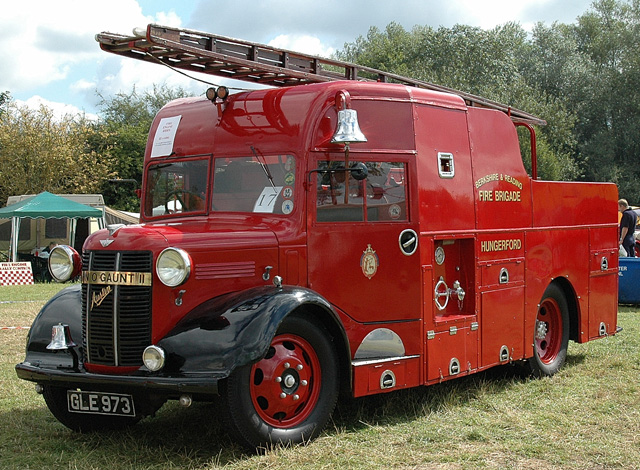
Yes, this was indeed a rebodied vehicle that began life as a National Fire Service appliance. In its original guise it was part of a batch that is believed to have covered the registration block GLE 790 to GLE 994, most of which were configured as Heavy Units.
Added by Ian Moore on 14 October 2007.
Added by Ian Moore on 14 October 2007.
Please can anyone help, I have some Reading Berks photos. But i am looking for more. My dad served with them mid 70's to late 90's.
I find them one of the hardest brigades to source photos etc...
Added by Chris on 12 November 2007.
I find them one of the hardest brigades to source photos etc...
Added by Chris on 12 November 2007.
I can confirm that this was built as a heavy pump unit and the log book showed that it carried a leyland or a Tangye pump, it was rebuilt for peace time use by fitting a water tank where the crew cab was with one hose reel on top and was fitted with a gear pump driven off the gear box P.T.O. it was also fitted with a dennis No 2 main pump at the rear driven via a martin harper transfer box from the road engine, It served at Hungerford untill the late fifties and then went to Adwest Engineering as a works appliance until I purchased it in 1980
Added by Mick Paull on 28 November 2008.
Added by Mick Paull on 28 November 2008.
Glad to see this veteran preserved, and in such good shape.
Anyone got a rear view of this beauty ?
Regards, from Canada,
Pat_R-B
Added by Pat Rivers-Bowerman on 28 November 2008.
Anyone got a rear view of this beauty ?
Regards, from Canada,
Pat_R-B
Added by Pat Rivers-Bowerman on 28 November 2008.
Interesting and rather unusual peacetime conversion, which looks almost as if it might have been an original design. Several brigades came up with various ways to reconfigure these former AFS/NFS appliances: there were a large number of relatively new ex-NFS units avilable when control was returned to the county and municipal brigades, and post war production of new fire engines did not really get under way until 1949 and 1950.
Two questions, if I may. What capacity water tank was added? And, if the tank displaced the crew seat, did the reworking offer alternative accommodation for the crew - or did it just operate with only two firemen?
Added by Rob Johnson on 06 November 2013.
Two questions, if I may. What capacity water tank was added? And, if the tank displaced the crew seat, did the reworking offer alternative accommodation for the crew - or did it just operate with only two firemen?
Added by Rob Johnson on 06 November 2013.
It would only have a very small 'first aid' tank, maybe 75 or 100 galls water being controlled via the famous 'five way valve' which can be seen on the panel behind the oic door. On another subject, just think how awkward it would be to ring that hand-bell through the sliding window with your left hand ???
Added by Barrie Green on 06 November 2013.
Added by Barrie Green on 06 November 2013.
Barrie - I imagine that's why they added the Winkworth electric bell on the front bumper.
These rather shrill little bells were more commonly installed on police vehicles and ambulances, but Darlington Fire Brigade had them on their Land Rovers and small utility vans at this time.
If the tank on this conversion was so small, you would think it could have been installed under the crew seat, without affecting its ability to carry a full crew? Fifteen cubic feet could accommodate around 75 to 100 gallons quite easily. And what about the space freed up by removing the original fixed heavy pump and its engine?
Added by Rob Johnson on 07 November 2013.
These rather shrill little bells were more commonly installed on police vehicles and ambulances, but Darlington Fire Brigade had them on their Land Rovers and small utility vans at this time.
If the tank on this conversion was so small, you would think it could have been installed under the crew seat, without affecting its ability to carry a full crew? Fifteen cubic feet could accommodate around 75 to 100 gallons quite easily. And what about the space freed up by removing the original fixed heavy pump and its engine?
Added by Rob Johnson on 07 November 2013.
Barrie, are you talking about the Wheel being the 5 way valve? If so how does it function?
Added by Les Davis on 07 November 2013.
Added by Les Davis on 07 November 2013.
Yes Les it was a selector with five positions, I will try to remember them !!!
1. Closed
2. Tank-Pump-Reel
3. Hydrant-Reel
4. Hydrant-Tank
and another setting which I cannot for the life of me remember even though I was driving an old Dennis this morning !!!! Old age and senility kicking in !
Oh yes of course
5. Hydrant-Pump-Reel
All self explanatory I think....
Added by Barrie Green on 07 November 2013.
1. Closed
2. Tank-Pump-Reel
3. Hydrant-Reel
4. Hydrant-Tank
and another setting which I cannot for the life of me remember even though I was driving an old Dennis this morning !!!! Old age and senility kicking in !
Oh yes of course
5. Hydrant-Pump-Reel
All self explanatory I think....
Added by Barrie Green on 07 November 2013.
The wheel was a rotary five-position valve. It could supply the pump from the tank, supply the pump from an external hose line (hydrant or another pump), supply the reel directly from an external hose line, bypassing the pump, or fill the tank from the external hose line. The fifth position was, of course, "off".
Added by Rob Johnson on 07 November 2013.
Added by Rob Johnson on 07 November 2013.
I always remember the use of the 5-way valve in the order of use at a fire. 6oclock-Tank-Pump-Reel, as the tank emptied, 10oclock-Hydrant-Pump-Reel, 4oclock only if decent hydrant pressure, Hydrant-Reel, 2oclock-to refill after the job Hydrant-Tank, 12oclock closed and ready for the next shout. 6-10-4-2-12, that's how I learned it in Birmingham in 1965.
Added by Tony Madsen on 22 August 2022.
Added by Tony Madsen on 22 August 2022.
Taff: I can imagine position four was not very often a good choice, as the combination of hydrant pressure along with the friction loss in 120 or 180 feet of 3/4 inch tubing must have rarely produced much of a jet….
We had these valves on our Darlington machines dating from the early 1950s, a Dennis F12, a Commer Whitson and a Commer Carmichael. We also had an ex NFS heavy unit as a reserve for a while - but it was unmodified, except of course for its shiny red paint job.
Added by Rob Johnson on 23 August 2022.
We had these valves on our Darlington machines dating from the early 1950s, a Dennis F12, a Commer Whitson and a Commer Carmichael. We also had an ex NFS heavy unit as a reserve for a while - but it was unmodified, except of course for its shiny red paint job.
Added by Rob Johnson on 23 August 2022.
Austin




Added by D.J.Attwood on 14 October 2007.