
Upload a Picture
About this Site | Links | Random Pic | Advanced Search
Home | Latest Additions | Contributors
| Visitors
Fire Engine Photos
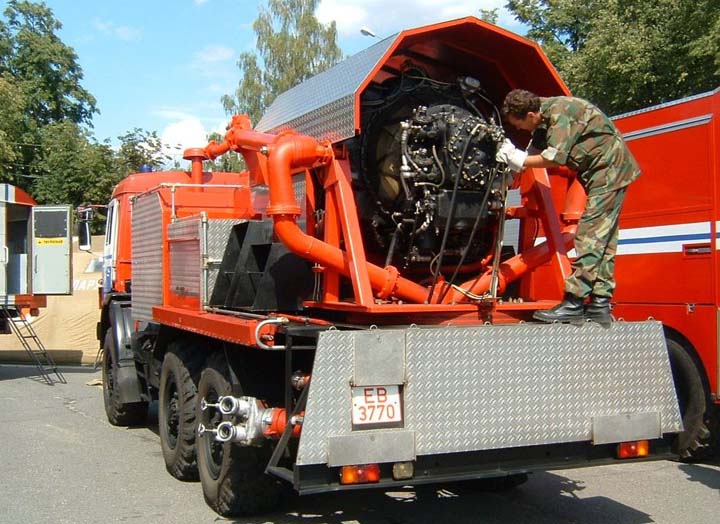
Believe this to be one of the vehicles that has a jet turbine fitted for fine water mist production. Could be asbestos gloves or similar as they seem to be on thick side.
Added by Scammell573 on 26 March 2008.
Added by Scammell573 on 26 March 2008.
What we have here, gentlemen, is a water mist firefighting system, based on a jet engine. A large volume of water is entered into the system via the multiple intakes (clearly visible on the left side), which than travels into the nozzles up front (see the other picture). The powerful stream of air & exhaust fumes breaks up the streams and carries the water mist over a few dozen meters.
This is how it works (a Hungarian prototype on T-34 tank chassis with two jet engines recycled from 2 MIG-21 'Fishbed' fighters):
youtube.com/watch?v=uyGDxglTVgA&NR=1
A well-known example is the BASF Turbolöscher:
wissen.swr.de/warum_chemie/feuerloeschen/themenseiten/t3/s4.html
standort-ludwigshafen.basf.de/ueber-uns/werkfeuerwehr/?id=V00-efJCyC1KBbsf.d4
A vehicle of compareable size to our Kamaz would be the one used by the Werkfeuerwehr Schwarze Pumpe in the former German Democratic Republic. It was built on IFA chassis back in 1984:
galerie.bos-fahrzeuge.info/details.php?image_id=35136
And here it is today (now part of the fire service of Vattenfall Mining Europe AG):
galerie.bos-fahrzeuge.info/details.php?image_id=25773&mode=search
I would even go on to say the Germans used the same engine as the Belarusians.
I don't know whether the colour of the gloves actually plays a role here...jet engine maintenance could be done even with bare hands - maybe it's some sort of an internal rule to use white gloves when performing checks & maintenance, who knows...
Added by Konrad Nowak on 26 March 2008.
This is how it works (a Hungarian prototype on T-34 tank chassis with two jet engines recycled from 2 MIG-21 'Fishbed' fighters):
youtube.com/watch?v=uyGDxglTVgA&NR=1
A well-known example is the BASF Turbolöscher:
wissen.swr.de/warum_chemie/feuerloeschen/themenseiten/t3/s4.html
standort-ludwigshafen.basf.de/ueber-uns/werkfeuerwehr/?id=V00-efJCyC1KBbsf.d4
A vehicle of compareable size to our Kamaz would be the one used by the Werkfeuerwehr Schwarze Pumpe in the former German Democratic Republic. It was built on IFA chassis back in 1984:
galerie.bos-fahrzeuge.info/details.php?image_id=35136
And here it is today (now part of the fire service of Vattenfall Mining Europe AG):
galerie.bos-fahrzeuge.info/details.php?image_id=25773&mode=search
I would even go on to say the Germans used the same engine as the Belarusians.
I don't know whether the colour of the gloves actually plays a role here...jet engine maintenance could be done even with bare hands - maybe it's some sort of an internal rule to use white gloves when performing checks & maintenance, who knows...
Added by Konrad Nowak on 26 March 2008.
Hey Fireman, you're not related to this Konrad chap by any chance?? I think between the two you'd have us all baffled!! Just joking, thanks Konrad, , love your explanation and input, ,
Added by Pavel on 27 March 2008.
Added by Pavel on 27 March 2008.
Hey Guys but what would this contraption be used for? with thanks from Tiger.
Added by Tiger on 09 August 2011.
Added by Tiger on 09 August 2011.
There are quite a few options. First and foremost, to extinguish large industrial fires - e.g. large pools of burning oil, chemical fires and others that would normally require large amounts of foam (which has to be brought in in bulk, lots of fragile equipment would have to be set up, the attack would have to be very well-coordinated etc.). Water is being delivered as a mist - it's a very efficient cooling agent and as it immediately turns to vapour, it won't get under the burning oil (which is why it can't normally be used in tackling B-class fires). Another application could be putting out fires in large buildings or tunnels, or at least cooling their interior down to a temperature which allows crews to enter them. I did hear a suggestion once that it could be used to fight forest fires, but I don't think this would work - you have to consider the fact that it still needs large volues of water in order to work properly. Which is why it is normally used only at industrial estates/plants with their own water supply systems.
Added by Konrad Nowak on 09 August 2011.
Added by Konrad Nowak on 09 August 2011.
and one more - this vehicle can be in fire brigade of nearest oil refinery - Mozyr - not far from Gomel
Added by Vitaliy on 12 March 2012.
Added by Vitaliy on 12 March 2012.
Correct me if i'm wrong but was the initial one based on the Tnk Chassis not designed to fight oil well fires after the !st Iraq war?
Added by Andy on 12 March 2012.
Added by Andy on 12 March 2012.
Andy. Since seeing this photo on here I have done some research which would suggest you are indeed correct.
Added by Monkey Boy The 3rd on 13 March 2012.
Added by Monkey Boy The 3rd on 13 March 2012.
I wouldn't call the Hungarian prototype the "initial" one. The techonology itself came from the Soviet Union, and it had been used since at least the 1970s. 3 such appliances (based on ZIL 157 chassis as far as I can remember) were used to extinguish a large fire at a test oil well in Karlino (northern Poland) in 1980/1981. The incident is known as the "Karlino oil eruption" - see Wikipedia for details.
Added by Konrad Nowak on 13 March 2012.
Added by Konrad Nowak on 13 March 2012.
Konrad.The second generation of Basf turbolöscher, has engines from Alpha jetfighters.
Anders F . Sweden.
Added by Anders Fallström on 17 June 2014.
Anders F . Sweden.
Added by Anders Fallström on 17 June 2014.
Related items. The state Department of Licensing based the value of your car for the first three.
Added by Toms Sko on 06 August 2015.
Added by Toms Sko on 06 August 2015.
Kamaz


Added by Pavel - Western Australia on 26 March 2008.