
Upload a Picture
About this Site | Links | Random Pic | Advanced Search
Home | Latest Additions | Contributors
| Visitors
Fire Engine Photos
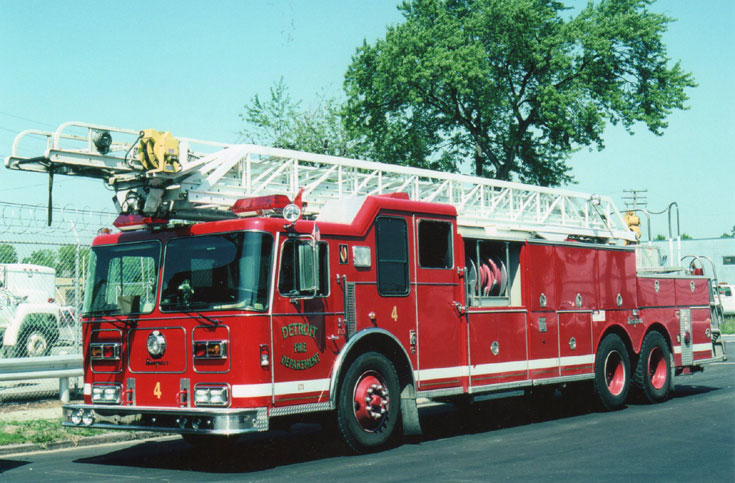
No: 7000 Contributor: Neil McCarten Year: 1999 Manufacturer: Seagrave Country: United States of America
Detroit FD is unusual! Since motorization, their aerial ladder rigs have had chemical tanks (pre WWII) and after WWII booster tanks because DFD pumpers did not carry water or booster hose until the mid-1960s. Although a few ladders were delivered after that time w/o boosters, the Pierce ladder fleet in use today have 60GPM/300 GWT systems. The boosters has been maligned by many FDs, but has been useful for flue fires, trash, overhaul and when engine response has been delayed, such as when Devils Nights events occur.
BTW, the rig posted is a 1990 Seagrave L series, this model was produced starting in 1988.
Added by Warren W. Jenkins on 30 October 2013.
BTW, the rig posted is a 1990 Seagrave L series, this model was produced starting in 1988.
Added by Warren W. Jenkins on 30 October 2013.
Thanks, Warren. As usual, you have an encyclopedic knowledge of US apparatus! It certainly was a unique arrangement for Detroit to have given the water carrying role to their aerial ladder trucks rather than the engine fleet.
One of my favorite books is the London Fire Brigade's annual report from 1913. One hundred years ago, London also had chemical tanks and reels on all of their ladder trucks ("escape vans") but did not have them on any of their pumpers. This started in the 1890s and the rationale was that both always operated out of the same station, and the ladder truck turned out first - filling the role of both the US chemical engine in a two-piece engine company and of course the carrier for the 50 foot wheeled ladder - although some carried a monster 70 footer before the aerial ladder became more commonplace.
So, its a very old concept!
Added by Rob Johnson on 31 October 2013.
One of my favorite books is the London Fire Brigade's annual report from 1913. One hundred years ago, London also had chemical tanks and reels on all of their ladder trucks ("escape vans") but did not have them on any of their pumpers. This started in the 1890s and the rationale was that both always operated out of the same station, and the ladder truck turned out first - filling the role of both the US chemical engine in a two-piece engine company and of course the carrier for the 50 foot wheeled ladder - although some carried a monster 70 footer before the aerial ladder became more commonplace.
So, its a very old concept!
Added by Rob Johnson on 31 October 2013.
Rob, I must give credit for my info to 2 volumes from my library: Seagrave Fire Apparatus History(1991) and Detroit Fire Apparatus History(1990) by Matthew Lee.
I started building my fire library while a teenager, and have accumulated over 300 volumes, mostly US Apparatus related, with a small sub-collection of FD histories about Maryland depts.
I have also collected all the major US fire-related magazines/periodicals, again specializing in Maryland subjects.I have also photographed in excess of 5, 000 apparatus in the last 25 years.
Added by Warren W. Jenkins on 31 October 2013.
I started building my fire library while a teenager, and have accumulated over 300 volumes, mostly US Apparatus related, with a small sub-collection of FD histories about Maryland depts.
I have also collected all the major US fire-related magazines/periodicals, again specializing in Maryland subjects.I have also photographed in excess of 5, 000 apparatus in the last 25 years.
Added by Warren W. Jenkins on 31 October 2013.
Detroit engines normally lay from the fire to the hydrant. The ladder normally has the front of the fire building, and this put the booster line right in front of the fire. Of all the Seagrave Sedan Pumpers used by Detroit, not a single one carried any tank water.
Added by R. Davey on 01 April 2019.
Added by R. Davey on 01 April 2019.
My dad Drove Detroit fire engines during his career on the DFD. He was an FEO (fire engine operator) He started with the open cab rigs then as Detroit started buying Sedans he drove them as well. He said they never carried water because of insurance requirements as written by the fire underwriters. The thought was an Engine was more of a requirement to putting out fire than a ladder truck, therefore Detroit had booster or chemicals on a ladder truck. Detroit also used the older sedans ( J models 1936-37-38) as foam carriers later on in their careers.
Added by Thomas E Gaines on 27 June 2021.
Added by Thomas E Gaines on 27 June 2021.
Some cities in Europe, including Berlin - which tends to be one of the most innovative - have recently replaced 23mm high pressure booster reels with dual flaked pre-conneted 38mm low pressure hoses. These can flow plain water but are permanently hooked up to the pumper's CAFS installation. They are each set to flow up to 400 LPM water or 1200 LPM class A or B compressed air foam for a rapid attack on all types of fires. Their rescue pumpers carry 1600 litres of tank water, but are usually backed up by a water tender holding a further 4000 litres. These are often hooked up to a pumper even before making a hydrant connection.
Newer pumpers in Paris have a similar set up, but use lighter 32mm hose and a maximum water flow of 350 LPM, flowing around 1000 LPM A or B compressed air foam as needed, but they still retain high pressure 23mm hose reels for minor incidents, washdowns and overhaul. The Paris FPT pumper has a 2900 litre water tank.
Added by Rob Johnson on 27 June 2021.
Newer pumpers in Paris have a similar set up, but use lighter 32mm hose and a maximum water flow of 350 LPM, flowing around 1000 LPM A or B compressed air foam as needed, but they still retain high pressure 23mm hose reels for minor incidents, washdowns and overhaul. The Paris FPT pumper has a 2900 litre water tank.
Added by Rob Johnson on 27 June 2021.
Seagrave


Does anybody know the history of this Detroit rig?
Added by Rob Johnson on 29 October 2013.