
Upload a Picture
About this Site | Links | Random Pic | Advanced Search
Home | Latest Additions | Contributors
| Visitors
Fire Engine Photos
No: 5420 Contributor: Paul Warnock Year: 2005 Manufacturer: Seagrave Country: United States of America
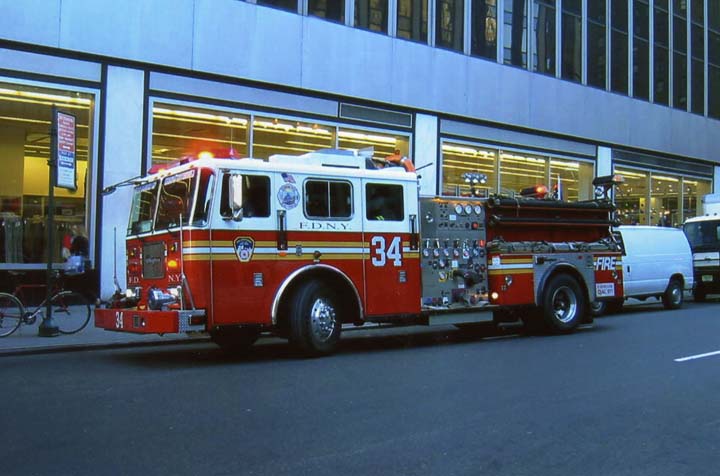
FDNY Engine 34 Maddison Square Garden
FDNY Engine 34 spotted at an incident near to Maddison Square Gardens in December 2005.
FDNY Engine 34 spotted at an incident near to Maddison Square Gardens in December 2005.
This picture is in the following groups
Fire Department New York, USA
Fire Department New York, USA
F.d.n.y.engine co 34 is a 2002 seagrave jb 1000/500 pumper located with tower ladder co 21, a aerialscope 75ft at 440 west 38th street, manhattan.engine co 34's new 2002 seagrave replaced another new piece of apparatus, this actually being an 2002 american la france 1000/500 which was used by this company having been purchased due to the lose of so many pumpers on Sept 11th 2001.the alf is still on the f.d.n.y.roster, but not operational with an engine company.
Added by Pete Matten on 03 January 2008.
Added by Pete Matten on 03 January 2008.
Hi David, it would appear in New York, that stations with 2 appliances have the engine for firefighting and a ladder truck which is an arial. The crews seem to do a general training course then when asigned a station they then specialise and keep to just one appliance. Unlike in the UK we may swop for one type of appliance to another after suitable training, ( FDNY call this ' walking the floor ')The ladders seem to carry the rescue gear, RTA kit, stretcher. And seem to go on the roof to tactical ventilate buildings.
Added by Paul Warnock on 03 January 2008.
Added by Paul Warnock on 03 January 2008.
David, in 2006 the F.D.N.Y.responded to 209, 397 medical emergencies throughout the city of New York.This is actual incidents attended by Engine Co's/Ladder Co's of the department where assistence was given by firefighters on scene before arrival of medical teams from the F.D.N.Y./EMS or other organisations. Equipment carried on apparatus is much the same as here in the UK, but maybe a lot less.A friend back in the late 1980's said to me, we've got these Mack/Ward new apparatus but nothing to put in the lockers?.I still wonder what he meant....Added by Pete M
Added by Pete Matten on 03 January 2008.
Added by Pete Matten on 03 January 2008.
Hi Paul!German firefighters works in the same way! Driver/pumpoperator from the first to the last day at the firebrigade they work for!Same thing with the SCBA-user, the ladder-driver/operator!In mine opinon, boring.
Anders F. Sweden.
Added by Anders Fallström on 12 July 2014.
Anders F. Sweden.
Added by Anders Fallström on 12 July 2014.
It seems more and more US fire departments - especially in smaller cities - are "cross training" increasing numbers of personnel to perform multiple roles instead of concentrating on separate engine or truck tasks.
This is partly being driven by economics. When an engine or truck is staffed by only three (or even two) members, multitasking is the only sensible way to make effective use of available numbers of responders.
Most big cities still have five riders on most or all of their engines and trucks, and have cut back on personnel costs by closing fire stations. But smaller towns have tended to reduce crews rather than stations, so instead of two engines, a truck and a chief with sixteen riders, these departments tend to show up with four engines, an aerial and a chief. They still respond with the NFPA recommended 16 firefighters, but in the early stages the first due crews have to do whatever is needed, rather than limiting themselves to classic engine or truck duties.
As truck companies usually take the lead at road accidents too, this cross-training helps in situations where engines respond first to these kinds of incidents.
Finally, many smaller full time and volunteer fire companies operate a quint instead of a dedicated aerial for cost reasons, so its crew have to be familiar with both pumper and truck operations.
BTW, quints are comparatively rare in large or medium sized US city fire departments, as the truck response to most incidents is usually outnumbered by the engines which are dispatched to the same incident.
Personally, I think the cross-training solution probably gives an incident commander more flexibility and the opportunity to deploy available resources more productively than the separate engine and truck roles, but tradition dies hard!
Added by Rob Johnson on 06 November 2019.
This is partly being driven by economics. When an engine or truck is staffed by only three (or even two) members, multitasking is the only sensible way to make effective use of available numbers of responders.
Most big cities still have five riders on most or all of their engines and trucks, and have cut back on personnel costs by closing fire stations. But smaller towns have tended to reduce crews rather than stations, so instead of two engines, a truck and a chief with sixteen riders, these departments tend to show up with four engines, an aerial and a chief. They still respond with the NFPA recommended 16 firefighters, but in the early stages the first due crews have to do whatever is needed, rather than limiting themselves to classic engine or truck duties.
As truck companies usually take the lead at road accidents too, this cross-training helps in situations where engines respond first to these kinds of incidents.
Finally, many smaller full time and volunteer fire companies operate a quint instead of a dedicated aerial for cost reasons, so its crew have to be familiar with both pumper and truck operations.
BTW, quints are comparatively rare in large or medium sized US city fire departments, as the truck response to most incidents is usually outnumbered by the engines which are dispatched to the same incident.
Personally, I think the cross-training solution probably gives an incident commander more flexibility and the opportunity to deploy available resources more productively than the separate engine and truck roles, but tradition dies hard!
Added by Rob Johnson on 06 November 2019.
Pete:
Engine companies generally carry a lot more hose than British pumps. As you mention they do, however, usually carry a lot less other equipment, and normally only two ladders, including an 8 meter extension.
Given that the pump is usually around 5700 LPM capacity, a typical American engine can support several hose lines over long distances if necessary. So the equipment which a British pump would carry is on the truck, along with a vast array of ladders up to 12, 13.5 or 15 meters - depending on the department.
Despite this generalization, there is a trend here as well to try to get everything in to (or on to) a single vehicle, so equipment loads are in practice very variable - and sometimes quite extensive.
Some engines have oversized tanks - up to 11, 500 liters - while the rescue engine with hydraulic extrication gear is becoming much more popular.
Other hybrids include foam triples, quads with lots of ladders, pumper-hazmat combinations and other exotics - all in an effort to reduce the costs of having dedicated specials on the roster, not to mention extra staffing expenses.
Added by Rob Johnson on 07 November 2019.
Engine companies generally carry a lot more hose than British pumps. As you mention they do, however, usually carry a lot less other equipment, and normally only two ladders, including an 8 meter extension.
Given that the pump is usually around 5700 LPM capacity, a typical American engine can support several hose lines over long distances if necessary. So the equipment which a British pump would carry is on the truck, along with a vast array of ladders up to 12, 13.5 or 15 meters - depending on the department.
Despite this generalization, there is a trend here as well to try to get everything in to (or on to) a single vehicle, so equipment loads are in practice very variable - and sometimes quite extensive.
Some engines have oversized tanks - up to 11, 500 liters - while the rescue engine with hydraulic extrication gear is becoming much more popular.
Other hybrids include foam triples, quads with lots of ladders, pumper-hazmat combinations and other exotics - all in an effort to reduce the costs of having dedicated specials on the roster, not to mention extra staffing expenses.
Added by Rob Johnson on 07 November 2019.
Seagrave


Added by David Sapsford on 03 January 2008.