
Upload a Picture
About this Site | Links | Random Pic | Advanced Search
Home | Latest Additions | Contributors
| Visitors
Fire Engine Photos
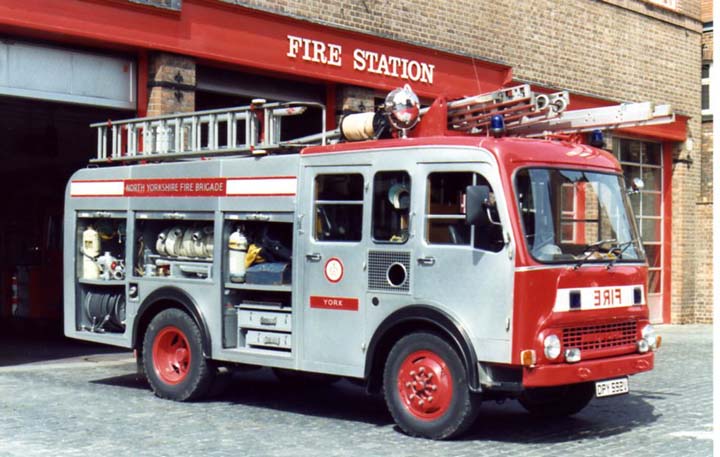
The great thing about fire engine enthusiasts is the diverse opinions of what is best. I couldn't agree more that this appliance is more interesting to look at than the modern volvos. However, If you're looking for a late 70's appliance that was (and still is) beautiful to look at, you need go no further than picture 1615. Fire engines should be red ..... All over!
Added by Mark on 02 January 2008.
Added by Mark on 02 January 2008.
Hi John, thanks for the comments. I will have a look I should have some of the pictures you have mentioned if so I will upload them as soon as I can. The Bedfords were so reliable, very basic engine and chassis but easy to maintain and work on. They rarely brokedown, and it was the bodywork that was rotting away toward the end of there careers. unlike some of the Volvos which have had to have some major chassis repairs already. This particular model of pump was very handy for running around York, they were so compact. Nowadays we would not get all the kit on them.
Added by Paul Warnock on 02 January 2008.
Added by Paul Warnock on 02 January 2008.
Mark. I agree with you comments however i have a particular interest in appliances from the 1960s and 70s, the big ET's and wheeled escapes especially.
Added by Paul Warnock on 02 January 2008.
Added by Paul Warnock on 02 January 2008.
Paul, I can understand why you like the big ET's of the 60's and 70's. My particular interest is of the 70's and 80's. My dad was a fireman and drove, amongst others, a 1965 Dennis ET (see picture 1609), a 1980 Shelvoke ET (see picture 1626), the 1977 Dennis WTL that I mentioned above and a 1984 Dennis TL that I now own (see picture 1781).
Did you have a look at the photo and website that I recommended on your photo of the Durham ET (picture 5360)?
All the best.
Added by Mark on 02 January 2008.
Did you have a look at the photo and website that I recommended on your photo of the Durham ET (picture 5360)?
All the best.
Added by Mark on 02 January 2008.
Paul - a lot of urban fire stations in many European countries often have both a compact pumper for access to old town areas with narrow streets and tight corners, as well as a "full-size" rescue pumper.
The small pumper - usually a Benz, Iveco, Renault, or Nissan (depending where you are) typically has a 1, 600 to 2, 000 LPM pump, a five person cab, BA sets, a 1, 000 liter tank, one hosereel and an 8 meter ladder or a set of scaling ladders (plus a mandatory hook ladder in France).
As you say, there is not room fr "all the kit", but the full-size backup pumper does have it all, and can usually get pretty close to the incident, while the compact pumper can get right in there straight away for the initial attack.
These pumpers are typically on 6 to 9 tonne GVW chassis, and are both narrower and shorter than their bigger brothers.
In Japan, this approach is taken to the extreme, because most towns have densely built-up areas with mainly wooden structures and very narrow roads and back lanes.
The solution is for large fleets of tiny first responding pumpers on pickup chassis operated from numerous stations by local community volunteers.
These have a crew cab and carry nothing much more than a portable pump, hoses and branches. But they respond very quickly and can contain a typical structure fire to prevent it spreading, until the full-time brigade turn up. Typically half a dozen of these mini pumpers will respond to any urban or suburban structure fire!
City center areas are however covered by full-time stations with larger pumpers, although in practice even these are rather compact by European standards. For this reason, Japanese brigades operate a lot of special purpose units and large numbers of dedicated rescue trucks with full five man crews.
Added by Rob Johnson on 09 July 2017.
The small pumper - usually a Benz, Iveco, Renault, or Nissan (depending where you are) typically has a 1, 600 to 2, 000 LPM pump, a five person cab, BA sets, a 1, 000 liter tank, one hosereel and an 8 meter ladder or a set of scaling ladders (plus a mandatory hook ladder in France).
As you say, there is not room fr "all the kit", but the full-size backup pumper does have it all, and can usually get pretty close to the incident, while the compact pumper can get right in there straight away for the initial attack.
These pumpers are typically on 6 to 9 tonne GVW chassis, and are both narrower and shorter than their bigger brothers.
In Japan, this approach is taken to the extreme, because most towns have densely built-up areas with mainly wooden structures and very narrow roads and back lanes.
The solution is for large fleets of tiny first responding pumpers on pickup chassis operated from numerous stations by local community volunteers.
These have a crew cab and carry nothing much more than a portable pump, hoses and branches. But they respond very quickly and can contain a typical structure fire to prevent it spreading, until the full-time brigade turn up. Typically half a dozen of these mini pumpers will respond to any urban or suburban structure fire!
City center areas are however covered by full-time stations with larger pumpers, although in practice even these are rather compact by European standards. For this reason, Japanese brigades operate a lot of special purpose units and large numbers of dedicated rescue trucks with full five man crews.
Added by Rob Johnson on 09 July 2017.
Bedford


These machines were far better than the modern volvos, which are bland to look at and i don't think as reliable.
I have spent many hours at York fire station and hardly saw any of the Bedfords go wrong, happy days when fire engines looked like this, not like shoeboxes.
Thanks Paul for bringing back happy memories, just a question if you don't mind, do you have any photos of PAJ you can upload and the old ford a series Et that was based at York too?
Cheers Paul and happy new year, John.
Added by John Johnstone on 02 January 2008.