The pump outlet manifold is rather typical of French pumpers. Rather than relying on adaptors, which is common practice in most countries, they are commonly fitted with several different diameter valved deliveries - like this example. The photo is not all that clear, but it looks like we have one 110 mm for LHD, one for standard 65 mm, one for 45 mm, another 65 mm one (yellow colored) for CAF and another for 32 mm unlined forestry hose. The dual hose reels are also typical of all French CCF units. The left side is a short 19 mm high pressure reel, while the right side has several lengths of 32 mm flat hose, which is usually not already preconnected to the pump.
These big tankers can perform both as direct fire attack tenders (if they can get near enough) and also as a supply source to replenish smaller CCF units, which are more suited to aggressive off road roles but have much smaller tanks. A typical response in some departments includes three CCF units with tanks around 3,000 to 4,000 litres and one of these 8X4 trucks, along with an officer in a Land Rover or similar light 4X4 utility. French fire services are very well organized to deal with forest and brush fires, as these are frequent events especially in central and southern France. In fact, French fire services actually operate more CCF units than structural pumpers, with over 4,000 of each type currently in use.

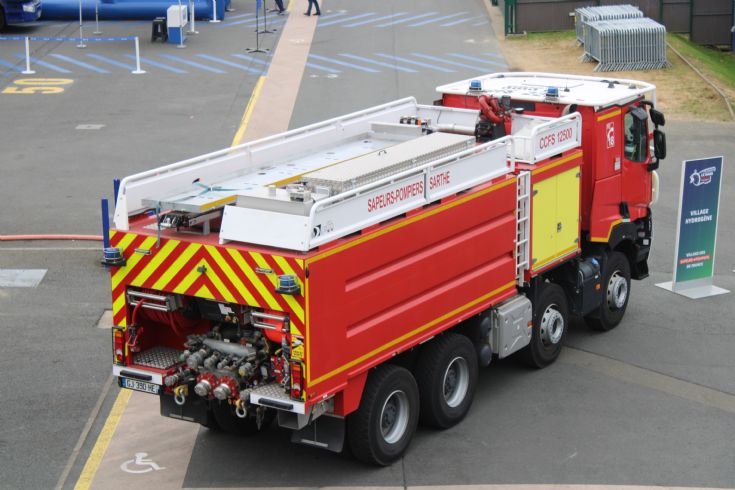


These big tankers can perform both as direct fire attack tenders (if they can get near enough) and also as a supply source to replenish smaller CCF units, which are more suited to aggressive off road roles but have much smaller tanks. A typical response in some departments includes three CCF units with tanks around 3,000 to 4,000 litres and one of these 8X4 trucks, along with an officer in a Land Rover or similar light 4X4 utility. French fire services are very well organized to deal with forest and brush fires, as these are frequent events especially in central and southern France. In fact, French fire services actually operate more CCF units than structural pumpers, with over 4,000 of each type currently in use.
Added by Rob Johnson on 12 February 2026.