
Upload a Picture
About this Site | Links | Random Pic | Advanced Search
Home | Latest Additions | Contributors
| Visitors
Fire Engine Photos
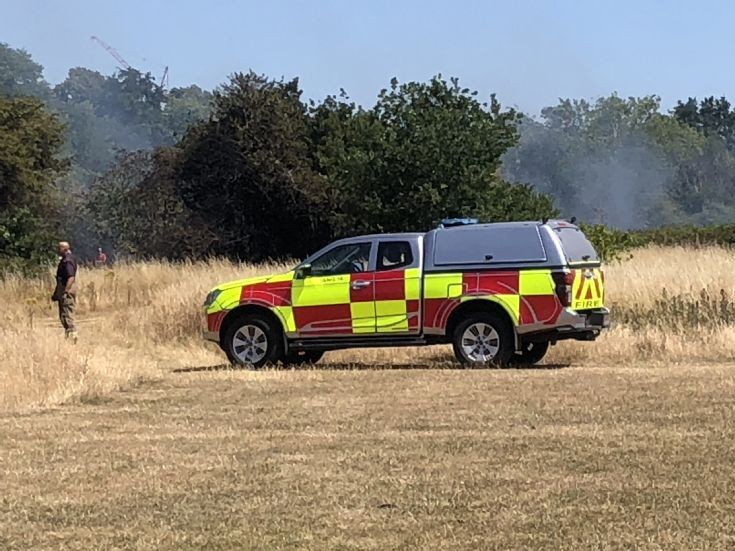
Isuzu DMax wildfire unit London FB YT23DRZ
Fire fogging unit at grass fire Wanstead Flats E London, part of Epping Forest. This quickly went to a ten pump fire as houses are nearby though the SE wind was helpful, blowing the fire towards the Alex lake on the Flats. These units are leased in from Angloco for the summer and carry no brigade markings. This vehicle has an Angloco fleet no of 14. More here
www.london-fire.gov.uk/about-us/services-and-facilities/v.." rel="noreferrer nofollow">www.london-fire.gov.uk/about-us/services-and-facilities/v...
"The Brigade's wildfire response vehicles provide off-road capability enabling the transportation of additional equipment closer to fires on open ground. Each vehicle carries approximately 475 litres of water, a backpack blower, ear defenders, beaters and misting lance technology, which allows firefighters to pump water and drive, enabling them to tackle grass fires more quickly and safely. The Brigade is currently trialling four wildfire response vehicles across the capital."
Last year they had a couple of Toyota Hilux in white. This year they have 4 x D-Max in silver.
Fire fogging unit at grass fire Wanstead Flats E London, part of Epping Forest. This quickly went to a ten pump fire as houses are nearby though the SE wind was helpful, blowing the fire towards the Alex lake on the Flats. These units are leased in from Angloco for the summer and carry no brigade markings. This vehicle has an Angloco fleet no of 14. More here
www.london-fire.gov.uk/about-us/services-and-facilities/v.." rel="noreferrer nofollow">www.london-fire.gov.uk/about-us/services-and-facilities/v...
"The Brigade's wildfire response vehicles provide off-road capability enabling the transportation of additional equipment closer to fires on open ground. Each vehicle carries approximately 475 litres of water, a backpack blower, ear defenders, beaters and misting lance technology, which allows firefighters to pump water and drive, enabling them to tackle grass fires more quickly and safely. The Brigade is currently trialling four wildfire response vehicles across the capital."
Last year they had a couple of Toyota Hilux in white. This year they have 4 x D-Max in silver.
The caption mentions a ten pump fire. On this scale of incident, perhaps a first response with European or US sized 4X4 brush tankers might well have been more helpful? Combined with CAFS, these certainly make the best use of limited manpower and water resources much more effectively than either the tiny foggers, or structural pumpers, or a combination of both. Although brush pumpers are generally not much use for interior structural firefighting, they can be very helpful when it comes to protecting exposures, especially when equipped with stiff compressed air foam.
Added by Rob Johnson on 17 July 2025.
Added by Rob Johnson on 17 July 2025.
Angloco


Ed: this is London and hydrants are rarely far away. In the above incident it was only a few hundred metres away.
Added by Rob Johnson on 13 July 2025.