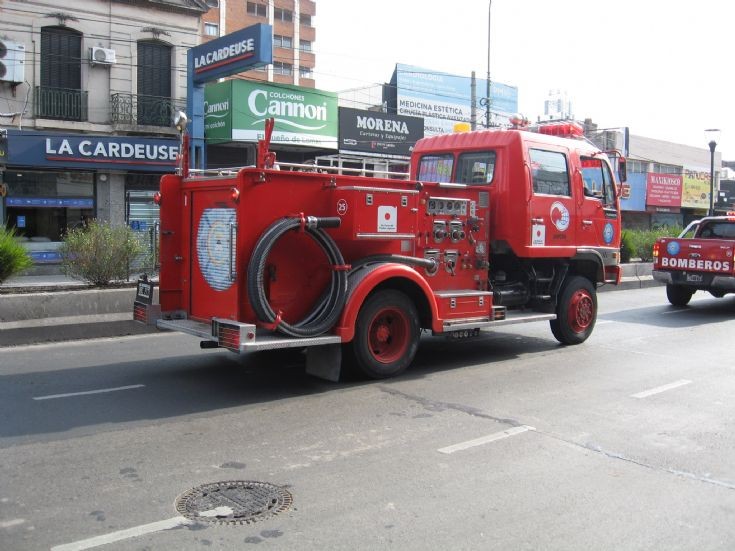
Most Japanese pumpers carried a hose cart in the rear compartment, but as this one has a locker cover it’s not clear if this example has one. The carts were often on four wheels and contained flaked hoses rather than the roll up hoses on typical European hose carts. Some of the larger ones were battery powered, with a driver, steering and lights, but these were only carried on larger heavy pumpers. Just as in the US in those days, these small pumpers carried very little equipment beyond hoses and fittings, and these smaller units did not typically have any water tanks, nor did they carry ladders.
What they did have were numbers! Combining full time and volunteers, it was not unusual for between six and ten of them to constitute the first response to a structure fire, and to focus primarily on exposure protection in communities with closely packed wooden structures in areas with narrow streets and many access challenges.





What they did have were numbers! Combining full time and volunteers, it was not unusual for between six and ten of them to constitute the first response to a structure fire, and to focus primarily on exposure protection in communities with closely packed wooden structures in areas with narrow streets and many access challenges.
Added by Rob Johnson on 06 February 2025.