
Upload a Picture
About this Site | Links | Random Pic | Advanced Search
Home | Latest Additions | Contributors
| Visitors
Fire Engine Photos
FDNY overcomes the rather high friction losses in 1.75 inch hose over long stretches by having attack lines of 200 to 300 feet of 1.75 inch preconnected to a much longer 2.5 inch hose line. For short stretches, the line can be broken before the adapter, while even high volume branches can still be operated using the 1.75 for improved maneuverability and handling when compared to the 2.5.
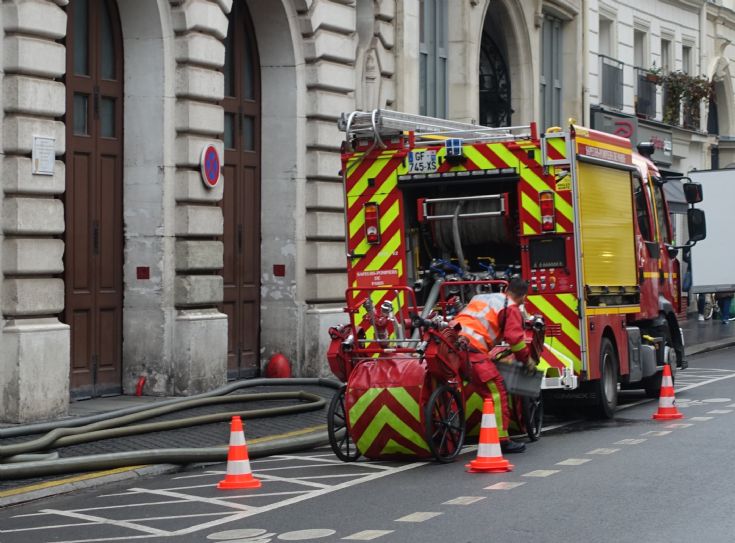
As seen in this photo, the BSPP achieve the same benefits by attaching two 45 mm hoses to each hose cart. It attack mode, the cart is taken to the fire structure, rolling out 65 mm hose, then the 45 is laid out for interior work.
Added by Rob Johnson on 04 February 2024.
As seen in this photo, the BSPP achieve the same benefits by attaching two 45 mm hoses to each hose cart. It attack mode, the cart is taken to the fire structure, rolling out 65 mm hose, then the 45 is laid out for interior work.
Added by Rob Johnson on 04 February 2024.
Gimaex


Many other fire services have followed these guidelines, which are similar to the common German practice of deploying a 52 mm hose with a minimum 400 LPM flow. These tactics are both very similar to what is practically the same approach in the US and Canada, where interior structure fires in residential properties are usually addressed with a 1.75 inch line flowing around 125 USGPM, which is 455 LPM. The larger 2.5 inch is reserved for bigger structures and exterior defensive lines.
Added by Rob Johnson on 03 February 2024.