
Upload a Picture
About this Site | Links | Random Pic | Advanced Search
Home | Latest Additions | Contributors
| Visitors
Fire Engine Photos
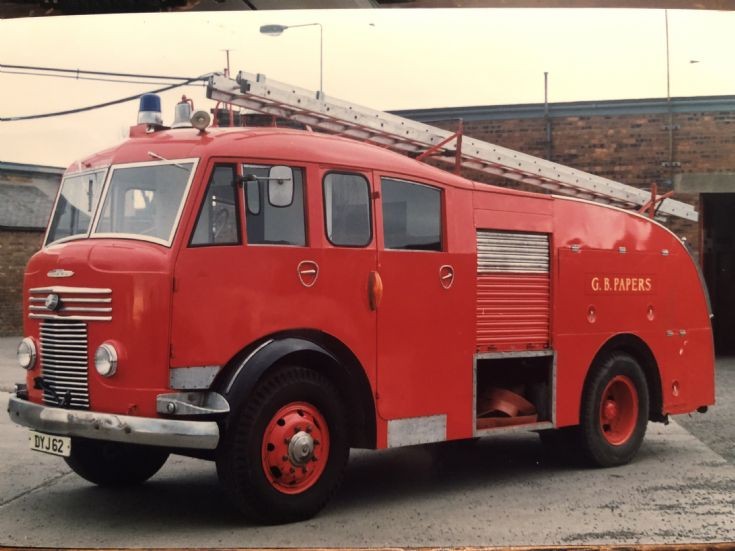
Guardbridge Papers are sadly long gone but the appliance is preserved and survives in good dry storage. I understand it does run but needs work to get it fully roadworthy. The O/S locker configuration is as Rob remembers it, i.e. two forward slam lockers, one above the other. Paper mills need a lot of process water, and the Guardbridge mill stood adjacent to the estuary of the River Eden and one of its tributaries. This resulted in a plentiful open water supply, albeit tidal. It is highly likely the plant had an open water pumping station. Perhaps the N/S roller shutter mod was undertaken by the mill to facilitate the carrying of an LPP?
Added by Keith Richardson on 21 February 2024.
Added by Keith Richardson on 21 February 2024.
Keith Your explanation sounds very likely. Although the Darlington brigade had a large rural response area to the West, neither of their water tenders had a portable pump. This may have been because they were both originally bought as type As, meaning that they had no main pump but towed a trailer pump - which is usually pretty handy if you want to set in to open water. After being updated with main pumps, they were backed up by a Land Rover which towed a light trailer pump, so it was probably thought there was no need for the water tenders to have one. Other pumps with PPs in the fifties often carried them in a transverse locker immediately behind the cab - best exemplified by the famous Green Goddesses issued to the AFS. This was the same idea as the Commer in this photo, after it was modified.
Added by Rob Johnson on 22 February 2024.
Added by Rob Johnson on 22 February 2024.
Rob, our thoughts on the modified N/S/F lockers appear to be correct. Don't know who carried out the alteration to enable the carrying of a Godiva FW. I understand there is no longer a portable onboard, and only the cradle's fixed mounting frame remains in the locker, the sliding carriage having disappeared. The roller shutter is now fully painted, when and by whom I don't know. Interesting why it was only partially painted when the photograph was taken. Was the photo taken 'mid paint job', was the roller a take-out from another appliance and hadn't yet been painted, or was it initially intended (unlikely) to replace only the lower slam locker? I believe the top of the original lower slam locker would have sat almost in line with the crew cab door handle / where the red paint on the roller finishes. Perhaps a bit irrelevant but intriguing? The appliance does have a twin delivery main pump but apparently no manufacturer's branding evident.
Added by Keith Richardson on 15 March 2024.
Added by Keith Richardson on 15 March 2024.
Keith. If it was originally delivered as a type A without a main pump, like RHN999, it would have had its pump retrofitted. As there were loads of many different makes and capacities of fire pumps from older appliances and AFS units around at the time, including no longer needed trailer pumps, almost any pump could have been installed. RHN999 got a Dennis 500 gpm pump from an AFS trailer, while its stable mate - an older but still postwar - Commer Whitson had a 700 gpm pump from a pensioned off prewar Leyland.
Added by Rob Johnson on 18 March 2024.
Added by Rob Johnson on 18 March 2024.
At the time this was built, the Home Office JCDD specification for a water tender type B required a 500 gpm pump, and these almost always had two deliveries. There were several manufacturers back then.
Added by Rob Johnson on 02 July 2024.
Added by Rob Johnson on 02 July 2024.
Carmichael


Still, a very nostalgic photo for those of us who grew up with Commer Carmichaels from the early fifties….
Added by Rob Johnson on 01 February 2024.