
Upload a Picture
About this Site | Links | Random Pic | Advanced Search
Home | Latest Additions | Contributors
| Visitors
Fire Engine Photos
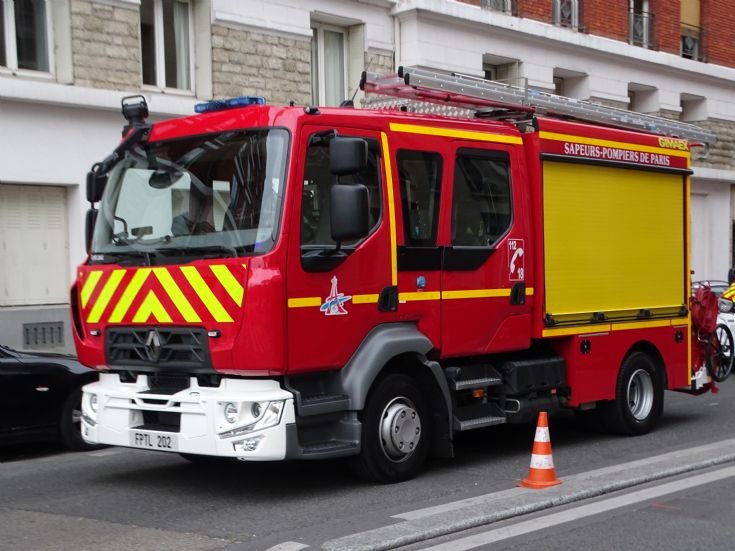
These are often for less commonly used and (hopefully) light weight items, like gas tight hazmat suits, brooms, salvage covers and other odd items. Some units in Paris and other French departments also have several lengths of 110mm LDH stored in a rooftop “coffin” like this. It is carried in pre-connected flaked lengths, so that it can be laid out quickly, and is used to hook up with large capacity hydrants with 110mm outlets or else to relay water from the high capacity water source to another pumper at the fire ground.
Rooftop coffins are widespread in other fire services too. FDNY recently added a rooftop coffin on all their pumpers, which because of the midships pump location and rear hose bed ended up on the cab roof. Not too easily accessible! Each engine company got to decide what to put in there, in addition to their normal equipment load - so each one has different items, based on what they have experienced when responding to incidents.
As fire services continue to have more and more tools of the trade at their disposal, it becomes tempting to make the inventory on every unit as comprehensive as possible, so the coffins are one ready answer. The only drawback is when heavy items are stored up high - this compromises vehicle handling characteristics and increases the danger of crew members getting hurt handling them up on the truck’s roof.
In the Netherlands pumpers all have powered roof racks, which makes unloading and loading items on the roof much quicker, easier and safer. This idea has spread to other countries, but is still by no means universal.
Added by Rob Johnson on 25 July 2023.
Rooftop coffins are widespread in other fire services too. FDNY recently added a rooftop coffin on all their pumpers, which because of the midships pump location and rear hose bed ended up on the cab roof. Not too easily accessible! Each engine company got to decide what to put in there, in addition to their normal equipment load - so each one has different items, based on what they have experienced when responding to incidents.
As fire services continue to have more and more tools of the trade at their disposal, it becomes tempting to make the inventory on every unit as comprehensive as possible, so the coffins are one ready answer. The only drawback is when heavy items are stored up high - this compromises vehicle handling characteristics and increases the danger of crew members getting hurt handling them up on the truck’s roof.
In the Netherlands pumpers all have powered roof racks, which makes unloading and loading items on the roof much quicker, easier and safer. This idea has spread to other countries, but is still by no means universal.
Added by Rob Johnson on 25 July 2023.
The background reason for the Dutch powered roof rack for suction hoses, ladders and other items goes back to the days when their pumpers all carried two extra long suction hoses on the roof, so they could be deployed rapidly to access open water.
Because the Netherlands has lots of easily accessible open water sources, fire brigades routinely set in to canals and ditches rather than needing to use hydrants, so getting the suctions off the roof and in to the water quickly becomes a priority. So - power racks to bring them down ( and reload them) became an obvious solution. And one rack could accommodate ladders and other items too, so they rapidly became standard.
In the US, powered racks for ladders are also very common, and they have been rather slowly adopted by fire services in some other European countries.
Added by Rob Johnson on 04 September 2023.
Because the Netherlands has lots of easily accessible open water sources, fire brigades routinely set in to canals and ditches rather than needing to use hydrants, so getting the suctions off the roof and in to the water quickly becomes a priority. So - power racks to bring them down ( and reload them) became an obvious solution. And one rack could accommodate ladders and other items too, so they rapidly became standard.
In the US, powered racks for ladders are also very common, and they have been rather slowly adopted by fire services in some other European countries.
Added by Rob Johnson on 04 September 2023.
Gimaex


Added by Jacques PETER on 25 July 2023.