
Upload a Picture
About this Site | Links | Random Pic | Advanced Search
Home | Latest Additions | Contributors
| Visitors
Fire Engine Photos
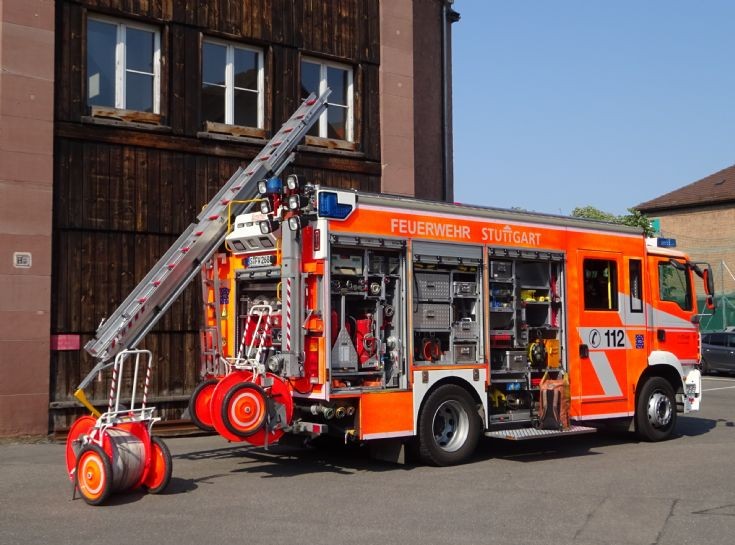
No: 44213 Contributor: Jacques Peter Year: 2023 Manufacturers: Lentner, Mercedes-Benz Country: Germany
Sorry for the typo. German B hose is in fact 75 mm, the largest in daily use in Europe. Until recently German fire services used this on their hose layers, as LDH was not thought to be needed, but after the introduction of the Hytrans system, many brigades now have hose containers with 150 mm.
Added by Rob Johnson on 23 June 2023.
Added by Rob Johnson on 23 June 2023.
In France largest is or was 110mm, 150mm appearing slowly as Rob said. BSPP Paris Fire Brigae just commissioned 2 Hytrans system pods (June 2023)
Added by Jacques PETER on 24 June 2023.
Added by Jacques PETER on 24 June 2023.
Before the introduction of the Dutch Hytrans, which has now been introduced in numerous countries, there was indeed a lot of variation in what different countries’ fire services used when it came to large diameter hose. London retained 3.5 inch (90 mm) for decades while some countries simply didn’t see the need for LDH at all. The British AFS had six inch (150 mm) until it was disbanded, but no local fire brigade took over their equipment.
In the US, the most common LDH is 5 inch (125). This is carried on almost all pumpers in various quantities - usually up to 20O meters - for hydrant connection, as most US pillar hydrants have a 4.5 inch “steamer “ connection. It is also increasingly used when pumpers are supplying water to aerials being deployed as water towers, in light of the high volumes which these can flow, especially when fitted with two monitors.
In addition, US fire departments do regularly customize their pumpers’ hose loads for different purposes, using one inch, 1.5, 1.75, 2.0, 3.0, 3.5, 4.0, 5.0 and sometimes 6.0 inch hoses in various quantities. The semi rigid one inch “booster” reel is still found on some pumpers, but has been replaced by one inch flat hose in many more fire departments.
BTW Hytrans has finally reached New York. The floating pumps are on two axle trailers towed by large pickup trucks, which also carry a few short eight inch hoses. They are associated with FDNY’s new Ferrara “super” pumper, with a 5000 gpm pump and three monitors. With a 1000 gallon foam tank, this is principally meant to be deployed at major hydrocarbon fires. An amazingly leisurely training exercise combining these two new techniques can be viewed on YouTube.
Added by Rob Johnson on 26 June 2023.
In the US, the most common LDH is 5 inch (125). This is carried on almost all pumpers in various quantities - usually up to 20O meters - for hydrant connection, as most US pillar hydrants have a 4.5 inch “steamer “ connection. It is also increasingly used when pumpers are supplying water to aerials being deployed as water towers, in light of the high volumes which these can flow, especially when fitted with two monitors.
In addition, US fire departments do regularly customize their pumpers’ hose loads for different purposes, using one inch, 1.5, 1.75, 2.0, 3.0, 3.5, 4.0, 5.0 and sometimes 6.0 inch hoses in various quantities. The semi rigid one inch “booster” reel is still found on some pumpers, but has been replaced by one inch flat hose in many more fire departments.
BTW Hytrans has finally reached New York. The floating pumps are on two axle trailers towed by large pickup trucks, which also carry a few short eight inch hoses. They are associated with FDNY’s new Ferrara “super” pumper, with a 5000 gpm pump and three monitors. With a 1000 gallon foam tank, this is principally meant to be deployed at major hydrocarbon fires. An amazingly leisurely training exercise combining these two new techniques can be viewed on YouTube.
Added by Rob Johnson on 26 June 2023.
I accidentally missed the most popular generally used attack hose for exterior firefighting and interior attack in large buildings in the US, which is of course the 2.5 inch! It is generally considered to be the heaviest hose line for manual use, typically flowing 325 gpm (1200 LPM).
Added by Rob Johnson on 26 June 2023.
Added by Rob Johnson on 26 June 2023.
Lentner


In Japan, hose carts are almost universal on pumpers ( unless they have large water tanks ). These are both two wheeled and often four wheel, and some are motorized ride on electric carts complete with lights. Unlike the European carts, they carry flaked hose, usually a combination of full size and smaller diameter attack hoses.
In Paris the BSPP carry two small rolls of 45 mm attack hose on each cart, so that if it is deployed in attack mode the lighter hose can be connected very rapidly.
Added by Rob Johnson on 22 June 2023.