
Upload a Picture
About this Site | Links | Random Pic | Advanced Search
Home | Latest Additions | Contributors
| Visitors
Fire Engine Photos
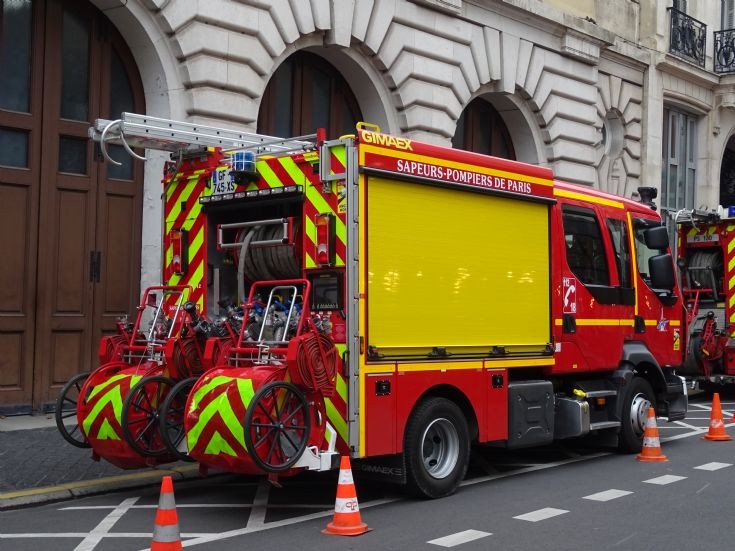
So far 70 FPTL have been recently commissioned in Paris BSPP
Added by PETER JACQUES on 19 December 2022.
Added by PETER JACQUES on 19 December 2022.
Thanks JP. The existing fleet of PS light pump & ambulance combinations used to number around 115, so it seems about two thirds have already been replaced. Quick work!
Do you know if the numbers of VSAV ambulances has been increased to compensate for the disappearance of the PS units?
Added by Rob Johnson on 19 December 2022.
Do you know if the numbers of VSAV ambulances has been increased to compensate for the disappearance of the PS units?
Added by Rob Johnson on 19 December 2022.
Yes numbers of VSAV has been increased, I wouldn't know exactly how many, however every station has now 2 if not 3 in the busier ones. Knowing that there is currently 71 operational FS
Added by PETER JACQUES on 20 December 2022.
Added by PETER JACQUES on 20 December 2022.
I have looked for the specifications of these new light pumps on the Gimaex website, but can’t find it.
I expect the 1500 LPM pump, the Chameleon foam system and most equipment are all carry over from the PS, but the new bodywork offers more space for additional items and presumably also a larger water tank, as the 600 liter tank on the PS was often criticized as being too limited.
This became a particular concern once recent BSPP research indicated that for initial interior attack a line flowing at least 350 LPM was required. This left little time to set into a hydrant if the attack team had only 600 liters before their line dried up….
Added by Rob Johnson on 20 December 2022.
I expect the 1500 LPM pump, the Chameleon foam system and most equipment are all carry over from the PS, but the new bodywork offers more space for additional items and presumably also a larger water tank, as the 600 liter tank on the PS was often criticized as being too limited.
This became a particular concern once recent BSPP research indicated that for initial interior attack a line flowing at least 350 LPM was required. This left little time to set into a hydrant if the attack team had only 600 liters before their line dried up….
Added by Rob Johnson on 20 December 2022.
Latest figures received:
There are 170 VSAV on duty in the BSPP stations.
Additional 40 in reserves and for training.
Added by PETER JACQUES on 21 December 2022.
There are 170 VSAV on duty in the BSPP stations.
Additional 40 in reserves and for training.
Added by PETER JACQUES on 21 December 2022.
According to the net pompiers website, the Paris FPTL has a 2,100 litre tank and 200 litres of class A solution for CAF, which is of course a great improvement over the capacities of the old PS unit. It gives the crew over five minutes of attack line operations before flowing from a hydrant, which is quite an advantage when you have to maneuver the hose cart around traffic and parked vehicles in a narrow street in an older area of the city!
As I surmised, the pump is the same, rated at 150O LPM @ 15 AT with a three meter lift - and capable of moving over 2000 LPM at the same pressure if (as usual) fed from a hydrant.
Added by Rob Johnson on 21 December 2022.
As I surmised, the pump is the same, rated at 150O LPM @ 15 AT with a three meter lift - and capable of moving over 2000 LPM at the same pressure if (as usual) fed from a hydrant.
Added by Rob Johnson on 21 December 2022.
Note the hose cart design. As well as ten 20 metre lengths of 65 mm hose, each one has two 15 meter lengths of 45 mm, a double wye/reducer and an attached variable output branch for up to 450 LPM.
Each cart can be used for a single 65 mm connection heavy branch (rated at up to 950 LPM), or one or two of the more commonly deployed medium branches, which are almost always used in interior fires. Additionally, one can be used to set into the hydrant, while the second is deployed for the attack.
These carts are typical of most French fire services, but in Germany it is often preferred to lay out attack hoses from baskets and to fit one of the hose carts with a standpipe and hydrant tool to expedite water supply connection. For this reason, German fire services carry 75 mm hoses on their carts, and use 75 mm lines to supply their attack lines, reducing working hoses to either 38 or 45 mm for interior structural attack and miscellaneous vehicle and outdoor incidents.
Added by Rob Johnson on 17 January 2023.
Each cart can be used for a single 65 mm connection heavy branch (rated at up to 950 LPM), or one or two of the more commonly deployed medium branches, which are almost always used in interior fires. Additionally, one can be used to set into the hydrant, while the second is deployed for the attack.
These carts are typical of most French fire services, but in Germany it is often preferred to lay out attack hoses from baskets and to fit one of the hose carts with a standpipe and hydrant tool to expedite water supply connection. For this reason, German fire services carry 75 mm hoses on their carts, and use 75 mm lines to supply their attack lines, reducing working hoses to either 38 or 45 mm for interior structural attack and miscellaneous vehicle and outdoor incidents.
Added by Rob Johnson on 17 January 2023.
Gimaex


What was once a brilliant and very effective concept years ago has not stood up to the ageing of the city population, the impact of drugs and violent crime and the extreme stresses of the still ever-present pandemic.
Added by Rob Johnson on 17 December 2022.