
Upload a Picture
About this Site | Links | Random Pic | Advanced Search
Home | Latest Additions | Contributors
| Visitors

Fire Engine Photos

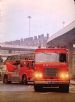
Never knew the pump on these had its own engine, unusual. I assume the pto was fully occupied powering the ladder.
Added by CraigW on 22 October 2022.
Added by CraigW on 22 October 2022.
I think fitting a pump to a TL in the UK may have started with the London Brigade when they bought Metz steel ladders on Leyland chassis around 1936. These were PTO driven, but up to and during WWII several TLs had independent powered pumps, and these continued in London and several other brigades with the postwar AEC Merryweathers. Metz and Magirus ladders were built during this period on a variety of chassis, and some Dennis Magirus combos had a PTO driven pump. Wolverhampton bought a Magirus Leyland Firemaster around 1960, which was a unique TLP built on a mid engined bus chassis with a front mounted pump powered by the vehicle engine. It’s near twin, without a pump, was supplied to Darlington, and is in several photos on this site - now preserved thanks to Dr Barry Hutchinson.
Added by Rob Johnson on 23 October 2022.
Added by Rob Johnson on 23 October 2022.
picture 7091 illustrates the Darlington Firemaster TL. It demonstrates the very high front cowl, which did nothing to help the driver see anything close to the front of the vehicle, but did make for a roomy front mounted pump compartment. This was a giant empty space on 999 MHN, as the brigade did not specify a pump, nor could they think of any alternative use for it! Nor did they ever man up the crew cab, which was enormously spacious too, with two individual front seats and a four person bench in the rear.
Added by Rob Johnson on 23 October 2022.
Added by Rob Johnson on 23 October 2022.
AEC




This enabled the body builder to include separate front doors for the driver and officer, unlike the earlier versions which had a single hinged or sliding entrance door for all the crew members.
It also had the advantage of improving maneuverability a bit, due to the shorter wheelbase.
Otherwise the design was identical, including a separate transverse mounted pump behind the cab. Powered by a BMC Diesel engine (as also used in London’s Austin taxis) this was rated at 450 IGPM at 100 PSI, intended primarily to feed the ladder monitor when the unit was deployed as a water tower.
The idea of fitting a pump to a TL gradually died out in the UK, as did the practice of building these with a crew cab, as most brigades reduced crews from three or four to only one or two riders to concentrate resources on the more often turned out pumping appliances.
Some countries still run ladders with three, four, five or even six riders, but this is very rare anywhere in Europe.
Added by Rob Johnson on 20 October 2022.