
Upload a Picture
About this Site | Links | Random Pic | Advanced Search
Home | Latest Additions | Contributors
| Visitors
Fire Engine Photos
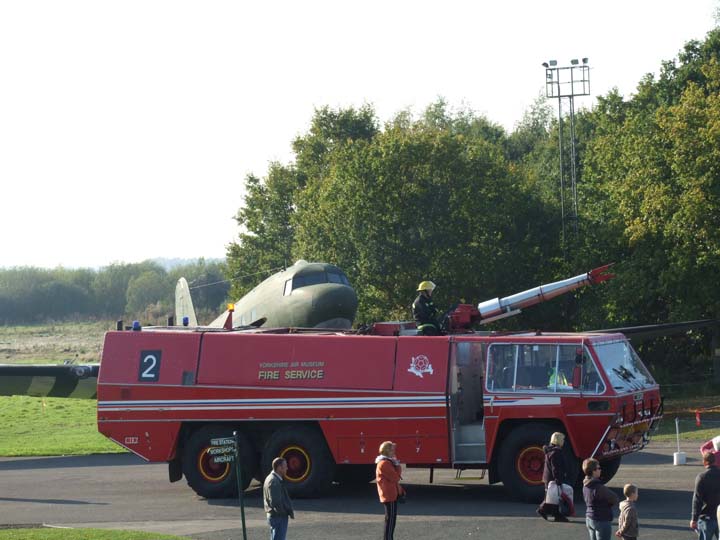
A few years ago the city of York was extensively flooded, the Pathfinder trundled into the city centre and was used for pumping duties.
Added by Barrie Green on 06 August 2008.
Added by Barrie Green on 06 August 2008.
This pathfinder was used for a very short period during the floods of 2000 in the City of York. It was pumping water in the Leeman Road area of the City, close to the river Ouse. The City council replaced it with a large industrial pump, which was looked after by the professional firefighters, who were using their own pumps in the area. The Museum staff also wanted to work during the last Firefighters strike with some sort of cover ( but lets not get political ! )
Added by Paul Warnock on 08 August 2008.
Added by Paul Warnock on 08 August 2008.
this is one of a pair that started service at manchester in 1971, my father was one of the first drivers of these great vehicles, i believe the other one was sold to bristol airport and this one was kept by manchester as a reserve before its transfer to york, i might be the youngest person to have ever driven one at the age of four!!! although i was sat on my dads knees and he worked the peddles.
Added by Dave Hornby on 15 August 2008.
Added by Dave Hornby on 15 August 2008.
the pathfinder was never sold to Bristol, however it was used as a spare supplied by simon's when one of our protectors returned to the factory for major repairs
Added by Will Duffield on 30 November 2008.
Added by Will Duffield on 30 November 2008.
That Foam Monitor is some impressive.
Do we have her Particulars on this 'Site ?
1985 Fire Manchester Airport - Boeing 737-236 Twin-Jet Aircraft G-BGJL, bound Corfu Island, Mediterranean Sea; at 0713 22 Aug 1985, experienced catastrophic fire in No 1 engine, on take-off run. Burning Jet-Fuel from damaged tanks engulfed the cabin - 55 of 137 souls on board lost their lives.
What every Airport Crash Rescue crew dreads happening - just did.
"Googling" produced lots of hits - perhaps a 'Site will have photos of this Truck, or her sister, in action at that crash-scene.
Regards, from Canada,
Pat_R-B
Added by Pat Rivers-Bowerman on 01 December 2008.
Do we have her Particulars on this 'Site ?
1985 Fire Manchester Airport - Boeing 737-236 Twin-Jet Aircraft G-BGJL, bound Corfu Island, Mediterranean Sea; at 0713 22 Aug 1985, experienced catastrophic fire in No 1 engine, on take-off run. Burning Jet-Fuel from damaged tanks engulfed the cabin - 55 of 137 souls on board lost their lives.
What every Airport Crash Rescue crew dreads happening - just did.
"Googling" produced lots of hits - perhaps a 'Site will have photos of this Truck, or her sister, in action at that crash-scene.
Regards, from Canada,
Pat_R-B
Added by Pat Rivers-Bowerman on 01 December 2008.
I understand that this old girl going for respay when the manchester incdent happened & went to the job in masking tape!!
After working with the old girl at the museum providing fire cover she is still going strong thanks to the support team who keep her on the run
Added by Pete White on 15 December 2008.
After working with the old girl at the museum providing fire cover she is still going strong thanks to the support team who keep her on the run
Added by Pete White on 15 December 2008.
Seeing this vehicle, takes me back to January , 81 to January 85 when I out in Saudi Arabia working for Wackenhut on a airport fire contract, where I drove a pathfinder during that time. wow what great times we had,
Added by Michael Pearce on 31 December 2008.
Added by Michael Pearce on 31 December 2008.
Reference comment by Billy Meredith:
I am led to believe that the Chubb Pathfinder JBG 613 P which was based at the Barn Fire station at Liverpool Airport was sold in 1990.As Merseyside fire Brigade had only one of these vehicles there is a great possibility that is part of the brigades museum collection which can be found at the following address.
The Heritage Centre, Crosby Fire Station, Crosby road North, Waterloo, Liverpool L22 0LA. (0151 287 3752 )
Added by Bob Wilton on 05 January 2009.
I am led to believe that the Chubb Pathfinder JBG 613 P which was based at the Barn Fire station at Liverpool Airport was sold in 1990.As Merseyside fire Brigade had only one of these vehicles there is a great possibility that is part of the brigades museum collection which can be found at the following address.
The Heritage Centre, Crosby Fire Station, Crosby road North, Waterloo, Liverpool L22 0LA. (0151 287 3752 )
Added by Bob Wilton on 05 January 2009.
That would make sense Bob, Speke was one of the last airports staffed by local authority men. I believe they privatised in the early nineties
Added by John Stott on 06 January 2009.
Added by John Stott on 06 January 2009.
John Stott:
My friend Colin drove the Pathfinder on on of the Watches until the airport decided to have their own fire service, and he has a couple of photographs of it when it was new and when Concorde payed a visit.He finished up at Belle Vale.
Added by Bob Wilton on 07 January 2009.
My friend Colin drove the Pathfinder on on of the Watches until the airport decided to have their own fire service, and he has a couple of photographs of it when it was new and when Concorde payed a visit.He finished up at Belle Vale.
Added by Bob Wilton on 07 January 2009.
Hi Bob, I never came across any Speke lads at CAA School at Stansted, I don't know if they trained there at all, do you know?
Added by John Stott on 07 January 2009.
Added by John Stott on 07 January 2009.
Hi John,
I have spoken to Colin Roberts and he tells me that they were all trained under licence up to CAA standard by Merseyside Fire Brigade at Banks Road.He was trained both on civil and military aircraft and he was on white watch and covered runway 2709
So it looks like all the Speke lads were all trained locally before the airport introduced their own service.Talking about Banks Road Station I believe it is now converted into flats? When I figure out how to put two pictures of the Pathfinder into the photo gallery I will put them on.
Regards Bob
Added by Bob Wilton on 08 January 2009.
I have spoken to Colin Roberts and he tells me that they were all trained under licence up to CAA standard by Merseyside Fire Brigade at Banks Road.He was trained both on civil and military aircraft and he was on white watch and covered runway 2709
So it looks like all the Speke lads were all trained locally before the airport introduced their own service.Talking about Banks Road Station I believe it is now converted into flats? When I figure out how to put two pictures of the Pathfinder into the photo gallery I will put them on.
Regards Bob
Added by Bob Wilton on 08 January 2009.
Yes Bob, Banks Road is now a block of apartments, still recognisable as a fire station though and it still has the old LFB badge up on the brickwork
Added by Barrie Green on 08 January 2009.
Added by Barrie Green on 08 January 2009.
Hello Bob, thanks for that, I wondered why I never heard a Scouse accent at the School and now I know why!
Added by John Stott on 09 January 2009.
Added by John Stott on 09 January 2009.
Hi John, Liverpool Airport Rescue and Fire fighting Service first became operational at 1900 hrs on the 1st April 1982 (Green Watch)
Added by Billy Meredith on 09 January 2009.
Added by Billy Meredith on 09 January 2009.
Hi John and all.I was an apprentice working at the Chubb Fire factory at Victoria Road Feltham Middx during the 1970, s.I then went on to be one of the test drivers there.I went up to see the Manchester wagon at Yorkshire air museum a few years ago.It was built some time before I joined the firm.We made some brilliant wagons the Pathfinder being just one of the types.That wagon was a very early version of the Pathfinder and the ones that came later were a bit different.Pat Rivers Bowerman made a comment about that monitor on the beast.As I remember it could knock you off your feet with the engine idling.It, s a shame that she could, nt put up a better show in getting that b....y fire out when the 737 went up at Manchester but there were a lot of reasons for that not any of which had anything to do with the wagon from what I can find out.Anyway as a rough guide to it, s capabilities it can run at 70 MPH at nearly 38 tonnes and climb a 1 in 3 hill from a standing start.I, ve had some contact with a few other ex Chubb employees but a lot of them have gone now and it, s probably only the younger ones like me who know much about the wagon, s origins, design and the personalities who built them.
Added by Geoff on 21 February 2009.
Added by Geoff on 21 February 2009.
Hi Geoff, thanks for the information, I was always disappointed the school never had one when I did my courses in the 80s. The biggest I drove was the Mk9 / Nubian which I thought was fast. The thought of this at 70 mph is pretty mind blowing!
Added by John Stott on 21 February 2009.
Added by John Stott on 21 February 2009.
Thanks for your comments John.She, s in a different league to the old Nubian.We used to be asked to provide the fire cover at the Farnborough airshow in the 1970, s.That engine sounds awesome when it, s under full load and even when it, s idling it, s one of the most impressive diesel engine sounds I, ve ever known.It, s even better than the sound which the old leyland two stroke in the chieftan tank made.It, s just a shame it was, nt turbo charged like some other Detroit two strokes.
Added by Geoff on 21 February 2009.
Added by Geoff on 21 February 2009.
Hello all, if i could just clarifie a couple of points raised further up the posts. The fire crew at the Yorkshire air museum are all volunteers, and qualified CAA firefighters , the cover supplied in the floods of 2000 had the team at York and Selby at the request of county fire service .They worked in conjunction with the fire service in both areas .
During the fire strike the team were once again asked by county fire service and other local authorities to provide emergecy cover to support available fire cover through the dispute, at no point was this in breach of any industrial action . Staff from county brigade liased with the museum fire service to advise and help supply additional equipment required for this period .
I must stress this was in support of countys cover through this dispute, not as an independant element .
The Yorkshire air museum fire service does/has on many occasions work alongside Defence fire service and the county fire service, it maintains good working relationships with both .
Stewart.G
Added by Stewart ,G on 23 March 2009.
During the fire strike the team were once again asked by county fire service and other local authorities to provide emergecy cover to support available fire cover through the dispute, at no point was this in breach of any industrial action . Staff from county brigade liased with the museum fire service to advise and help supply additional equipment required for this period .
I must stress this was in support of countys cover through this dispute, not as an independant element .
The Yorkshire air museum fire service does/has on many occasions work alongside Defence fire service and the county fire service, it maintains good working relationships with both .
Stewart.G
Added by Stewart ,G on 23 March 2009.
Hello..Just a comment on the training of fire crews at Liverpool Airport. My dad was stationed at Banks Road when it was L.F.B. The airport was covered by them. My Dads service number was (218). I can recall watching him as a youngster through the fence by Speke Hall, training with crews using foam on an old plane at the end of the airfield. I can also recall a major fire in Speke (Mothax I think) he also attended.
Added by Kevin O'Shaughnessy on 13 August 2009.
Added by Kevin O'Shaughnessy on 13 August 2009.
Further to my comment above. L.F.B took over control of Liverpool Airport on the 1st April 1961. The station and appliances were inside a hanger. They moved into Banks Road in 1965.
Added by Kevin O'Shaughnessy on 13 August 2009.
Added by Kevin O'Shaughnessy on 13 August 2009.
Hi Kevin.Like me the 1960's were before the Pathfinder's time.I was at junior school then and as far as I know Chubb Fire Vehicles Division didn't exist then as it was still the old Pyrene Company before Chubb Fire took the firm over.I think that the Pathfinder was in it's very early design stages as a Pyrene product just before the takeover and is why it had a name beginning with P like the old Protector and others and Chubb's kept the letter P as a title for it's future products.The Manchester wagons were actually badged as Pyrene Pathfinders not Chubb and I've got the original photos which show it.But they didn't exist before the 1970's.I've got some photos of the Pathfinder throwing foam over an old plane on test and you'd have known if it was one of those which you saw as nothing much even now can match it.It's just a shame that the photos are scanned from the original sales brochure and are too big to put on here.One thing's for sure your Dad would probably remember just how heavy those drums of foam compound were to handle.
Added by Geoff on 13 August 2009.
Added by Geoff on 13 August 2009.
I remember a a child doing a project for school (Parrswood High in 1971)and writing to the chief officer. I remember receiving a reply inviting me on a formal visit I had to bring the letter and go to the police post I was treated like royalty driven in an Airport Police Car (Mini or Austin 1100 to the Station where I had a chat with the
SO I was given lunch with the watch then shown all the Machines and all the work area including the Med Centre with its Treatment Area and Major Incident Area (Morgue?) and the Grand Finale was a Ride in one of the Pyrene Pathfinders callsign 1 Fire Charlie around tha Airport for over 20 mins. This included a Speed Run (70 Mph) and I was told how fast the turnout times were and that the had to be anywhere on the airport within 4 mins? and that they were the only level X rated Airport at the time in the UK. The only thing I can remember that the Driver was either a L-FM of a Sub cant remembers how many bars called Alan.
I would love to know if anyone can fill in any missing details?
Added by Paul Crichton on 07 January 2010.
SO I was given lunch with the watch then shown all the Machines and all the work area including the Med Centre with its Treatment Area and Major Incident Area (Morgue?) and the Grand Finale was a Ride in one of the Pyrene Pathfinders callsign 1 Fire Charlie around tha Airport for over 20 mins. This included a Speed Run (70 Mph) and I was told how fast the turnout times were and that the had to be anywhere on the airport within 4 mins? and that they were the only level X rated Airport at the time in the UK. The only thing I can remember that the Driver was either a L-FM of a Sub cant remembers how many bars called Alan.
I would love to know if anyone can fill in any missing details?
Added by Paul Crichton on 07 January 2010.
Many thanks Geoff for your comments and taking the time to post on the site.
Sadly my Dad is not around to tell me the tale.
I cannot remember what the appliance/machine was that was being used on the old aircraft.
I think I was more like being a bighead telling my mates "That's my Dad" as they looked in awe.
I remember going home and them telling everyone they saw that my Dad was putting out a fire from a crashed plane...I never did tell them it was a training exercise.
Kindest regards,
Kevin
Added by Kevin O'Shaughnessy on 08 January 2010.
Sadly my Dad is not around to tell me the tale.
I cannot remember what the appliance/machine was that was being used on the old aircraft.
I think I was more like being a bighead telling my mates "That's my Dad" as they looked in awe.
I remember going home and them telling everyone they saw that my Dad was putting out a fire from a crashed plane...I never did tell them it was a training exercise.
Kindest regards,
Kevin
Added by Kevin O'Shaughnessy on 08 January 2010.
Kevin there was also a kid who also managed to tell his mates a story like that but he managed to get it all on film when he was taken out on a demo in a Pathfinder by the factory and the BBC.He won it as a prize on the old Jim'll Fix It TV programme with Jimmy Saville.Anyway I'd like to ask everyone up at Yorkshire Air Museum if there's any way that they could upload a few minutes video sequence with some good sound reproduction of the Pathfinder running along the runway there at full load and/or at idle and high revs while stationary onto You Tube under the Detroit Diesel subject as even the yanks have'nt got many 16V71 engines posted on there because that engine did'nt get fitted in many,if any,highway trucks.
Added by Geoff on 10 January 2010.
Added by Geoff on 10 January 2010.
The other Manchester Pathfinder was at Kemble Airport in Gloucester, may still be there.
Fire Vehicle Services in Gloucester, own one of the New York Pathfinders.
Added by Simon Gunning on 10 January 2010.
Fire Vehicle Services in Gloucester, own one of the New York Pathfinders.
Added by Simon Gunning on 10 January 2010.
If i remember correctly,the Jim'll fix it was never shown because a real aircraft accident occured at the time the programme was due to be broadcast.
I cannot remember which accident it was,but it could have been the Boeing 737 at Manchester.
Added by Bristol Bob on 11 January 2010.
I cannot remember which accident it was,but it could have been the Boeing 737 at Manchester.
Added by Bristol Bob on 11 January 2010.
Hi Bristol Bob.That Jim'll Fix It programme did get broadcast but I'm sure that it was filmed and broadcast in the 1970's or very early in 1980 at the latest because I was working for them at the time and I left there around Spring of 1980 long before the Manchester accident.But I can remember that there seemed to be a long delay between when it was filmed and when it was shown on the TV but can't remember any air accidents at the time or if it was an air accident which was the reason.Simon I think that Fire Vehicle Services is a firm which is run by some ex Chubb factory staff and I can remember hearing from another ex Chubb driver about an American one being brought back some time ago.By all accounts it was in fantastic condition.I also heard somewhere that one of the other British Pathfinders,not sure if it was a Manchester or a Liverpool one,had a turbocharger conversion done on it's 16V71 motor?.
Added by Geoff on 11 January 2010.
Added by Geoff on 11 January 2010.
Geoff,
Just a slight correction, FVS was formed by ex members of Gloster Saro.
We have been to there workshops on several occasions to collect work they have produced for us, they have a very extensive client base and turn out some excelent products.
Added by Simon Gunning on 12 January 2010.
Just a slight correction, FVS was formed by ex members of Gloster Saro.
We have been to there workshops on several occasions to collect work they have produced for us, they have a very extensive client base and turn out some excelent products.
Added by Simon Gunning on 12 January 2010.
Thanks for that Simon.I might have got that firm confused with one which has got some ex Chubb Fire staff there and I did have a phone conversation with them about helping the team up at Yorkshire Air Museum with any information or spares if they needed any.If I remember rightly one of them was John Toffey who was a technician at Victoria Road when I started with the firm.But I also think that it might have been Gloster Saro which took over the old Chubb Fire Vehicles Division? and moved all subsequent production down to Gloucester from Feltham so there might be some connection there after all?.
Added by Geoff on 12 January 2010.
Added by Geoff on 12 January 2010.
If I am not mistaken isn't the Driving position in the centre? could someone remind me please.
Added by Paul Crichton on 12 January 2010.
Added by Paul Crichton on 12 January 2010.
Paul you're right the driving position is in the centre.It made life even more difficult if you were driving it on the road because it had all of the usual truck blindspots which you get on the passenger side of any truck but on both sides not one and you need to judge the width (a lot because it's 10 feet wide overall)on both sides going through narrow gaps and on single carriageway roads.The one in the photo at Yorkshire Air Museum has had some extra windows put in on it's front corners if you look which probably help those blind spots a bit but they didn't have those in service and they've been put in since.
Added by Geoff on 13 January 2010.
Added by Geoff on 13 January 2010.
I think you are right about the connection Geoff. I know that John Toffey is one of the directors at FVS, but normally we deal with his son John Paul.
What company did you work for Geoff?
Added by Simon Gunning on 13 January 2010.
What company did you work for Geoff?
Added by Simon Gunning on 13 January 2010.
Thanks for that info Simon.If that's right both he and myself worked at Chubb Fire Vehicles Division at Victoria Road Feltham in Middlesex.That's where the Pathfinders were built but the Manchester and Liverpool ones,as I've said,were very early versions built before I started with the firm.Usually the name plates fitted on Chubb Fire Trucks are marked with the old firm's head office address in Sunbury if I remember rightly.
Added by Geoff on 14 January 2010.
Added by Geoff on 14 January 2010.
The center steering has nothing to do with visibility it's there so they can be sold internationally without having to run 2 production lines
Added by Rg on 13 April 2010.
Added by Rg on 13 April 2010.
Rg it's interesting to see a possible answer to the central steering position on the Pathfinder and many other types of airport crashtenders.But it does'nt seem to be consistent with a vehicle which will spend most of it's working life away from the highway and in which the majority of markets are left hand drive?.So would it have been worth all of the engineering required to provide central steering just to satisfy the right hand drive markets when left hand drive would have been ok considering the amount of time that an airport truck spends on the highway? and as anyone knows who's driven a centre drive truck on the road it just makes the same and even more problems of driving a left hand drive truck in a country where they drive on the left and vice versa with the passenger side blindspots being on both sides not just one?.It's a question that I can never remember asking when I was involved with them though so it makes for a good discussion.
Added by Geoff on 14 April 2010.
Added by Geoff on 14 April 2010.
I am an airport fire cadet, that's how I know this plus most second hand crashtenders end up being sold internationally
Added by Rg on 14 April 2010.
Added by Rg on 14 April 2010.
Rg I'm not convinced yet on that one. I'd suggest that maybe it's to provide a more convenient environment for crew accommodation and easy access for a fast exit?. With the Pathfinder that wouldn't have been such a big issue because of it's bigger cab design and door positions but the crew seating was designed for four crew members sitting along each side of the cab facing each other and even on that vehicle it was the best compromise for accommodation and that fast exit but check out the Chubb Fire Patroller or even something like the more modern Barracuda and it's difficult to see how you could provide convenient crew accommodation and fast exit times using both doors if it wasn't centre drive?.
Added by Geoff on 14 April 2010.
Added by Geoff on 14 April 2010.
No I don't agree Rg The RAF Mk 6 had central steering and that had nothing to do with sales or driving on the 'other' side and that goes back to the 1950s
Added by Barrie Green on 14 April 2010.
Added by Barrie Green on 14 April 2010.
Been told that central driving position is for ease of crew egress when attending incidents and also for ease of operating equipment by the driver.
Added by Stevie Murray on 14 April 2010.
Added by Stevie Murray on 14 April 2010.
Re the steering position,i quote from a Chubb Protectot brochure,"THE DRIVERS SEAT CENTRALLY POSITIONED FOR ALL-ROUND VISIBILITY,LEFT HAND DRIVE OPTIONAL".
Added by Bristol Bob on 14 April 2010.
Added by Bristol Bob on 14 April 2010.
I'd agree with those comments Barrie and Stevie.I could post a photo of the driving position and all of the control layout of the Pathfinder from the sales brochure and those controls were made so that the driver could operate most of the fire fighting systems,with the exception of actually running out sideline hoses and branch pipes, by himself in the event that he was alone for whatever reason and it's difficult,if not impossible,to see how those controls could have been laid out in any other way than with a central driving position and that's even before the ease of crew and their equipment accommodation and ease of exit is taken into account.
Added by Geoff on 15 April 2010.
Added by Geoff on 15 April 2010.
The Liverpool/Merseyside pathfinder was in yellow with a white stripe,I believe it was a cancelled export order.I was lucky enough to have a drive of it, went to the barn with the driving school and while the crew were out driver training the Sub Officer asked me if i would like to take the pathfinder out for a spin.Lucky we did as when we stopped on the sapre (side taxyway) told me how to get the monitor to work. Press the buttons Nothing, try again Nothing, up on the monitor dec try to do it manualy again nothing, the main valve to the monitor was solid to we sped back to the station and got control to send the Nubian across from banks Road to cover till workshops could attend.as for the central driving position Barrie is correct it was easy for one person to operate as everything was round the driver, a first class aplliance. it carried 3000 gallons of water and 250 gallons of foam the foam would do for a second tank of water.
Added by Dave Price on 18 April 2010.
Added by Dave Price on 18 April 2010.
It's good to see another positive endorsement for that truck Dave and I'm sure that all of those who were involved with building them,many who are no longer around,would be pleased to read that.The yellow and white stripe colour scheme was used on for the New York and New Jersey Port Authority export order but I'm not sure if that was cancelled or not and/or if that's the one which Liverpool might have got?.It would be interesting to find out.The ironic thing is that Britain's biggest airport (Heathrow),which was just up the road from the factory,did'nt order the Pathfinder during the 1970's and mainly,if not totally?, seem to have relied on a fleet of much smaller RIV's ordered by British Airport Authority.
Added by Geoff on 18 April 2010.
Added by Geoff on 18 April 2010.
The Merseyside Pathfinder was built for them, it wasn't a cancelled order. It was quite different to the New York ones,which had stainless steel water tanks amongst other things. When the chaps from Liverpool came down to see about a pathfinder they were given a demonstration in a New York machine, they liked its colour scheme and decided to specify the same for their vehicle.The Merseyside was also unique in that it was the only pathfinder to be built with windows fitted above the cab doors.
I think the thinking at Heathrow at the time was not to put all their eggs into one basket, in case of breakdown.
Added by Roger Mason on 18 April 2010.
I think the thinking at Heathrow at the time was not to put all their eggs into one basket, in case of breakdown.
Added by Roger Mason on 18 April 2010.
Thanks for clarifying all of that Roger.All of those were orders built before I started with the firm and it's interesting to find out more about them even all these years later.
Added by Geoff on 19 April 2010.
Added by Geoff on 19 April 2010.
Hello All - here at the London Metropolitan Archives we now hold the Chubb archives which includes the film and videos of Chubb - we have footage of the pathfinders, both Pyrene and Chubb and the Jim'll fix it film!! I hope to get up onto YouTube in the near future - will keep you posted when I do! If anyone has memories of working for Chubb then feel free to get in touch - we have film screenings of the collections now and again!
Added by Lydia Pappas on 09 September 2010.
Added by Lydia Pappas on 09 September 2010.
One thing not mentioned above in reference to the Liverpool Pathfinder was when S3 AKA the Barn, recieved 1131, she had the registration GHF753N and in 1975 she was reregistered to JBG513P and served at the barn with 1118 Land Rover FT6/Carmichael ELV514L and 1196 Land Rover/MFB XKB928W.
Added by Andrew Middleton on 09 September 2010.
Added by Andrew Middleton on 09 September 2010.
FAO: Dave Hornby.
Hi Dave, This one was presumably YVU 138M. You speak of Manchester having had two Pathfinders. What was the registration of the other one please - I only have them down as having had one.
Added by Ian Moore on 10 September 2010.
Hi Dave, This one was presumably YVU 138M. You speak of Manchester having had two Pathfinders. What was the registration of the other one please - I only have them down as having had one.
Added by Ian Moore on 10 September 2010.
Thanks for that information Lydia.Maybe if you'd like to get some memories from those of us who worked for the firm at the time we could try to arrange a re union there with everyone who'd be interested?.My memories there are mainly that of being a teenager waiting for the day when I could get out on the road and drive the vehicles instead of being in the factory helping to make them.
Added by Geoff on 10 September 2010.
Added by Geoff on 10 September 2010.
I am now able to shed more light on the training of Airport firemen at Liverpool, As an ex member I asked the question on our forum known as the "codgers" and got replies from ex airport firemen and officers.Station Officers were CAA trained to grade 1&2 AFO at Stansted Airport as they had to have a CAA Certificate. The rest were trained in house at Banks road training school. Hope this solved the query.Banks road also trained Mercheant Navy officers and had the nickname the merch.
Added by Dave Price on 17 September 2010.
Added by Dave Price on 17 September 2010.
Thanks Geoff - If you think people would be interested in comping along to a screening of footage and films of the pathfinders and other fire fighting trucks that Chubb or Pyrene made then I could arrange a screening here in London - you can get in touch with me via the LMA: www.lma.gov.uk
Added by Lydia Pappas on 20 September 2010.
Added by Lydia Pappas on 20 September 2010.
If the Elvington Pathfinder CrT is YVU 138M then it was also based at Lydd-Ashford Airport (LAA) in Kent - I know because I have pics of it there and also because I was lucky enough to have a run out in it in April 1991. It was the LAA crew who fitted the extra hand-line at the front right side of the truck and it was then that the doors were removed too (their other truck was a Nubian Major with the same hand-line mod). On the same day I flew across to Le Touquet in France (HS748, British Indepenndent Airways)and visited the fire section there too (Peugeot VIR & a big old Berliet CrT). I also saw and have have pics of a Polish Pathfindfer at Krakow-Balice, taken in the same year!
Added by G-Tomm on 20 September 2010.
Added by G-Tomm on 20 September 2010.
G-Tomm I'm not exactly sure of what you meant by the Elvington Pathfinder having ''the doors removed'' but being a Manchester vehicle it did'nt seem to have cab doors from new according to the photo in the original sales brochure?.Also I'm not sure but think that the Elvington/Yorkshire Air Museum one has'nt got any connection with Lydd-Ashford ? and if so I think it might have been that other one which I heard of having the turbo charger conversion fitted to it?.
Added by Geoff on 21 September 2010.
Added by Geoff on 21 September 2010.
Geoff, I don't know about the turbo charger but research shows that the Elvington CrT is WNE 371L. As YVU 138M was also originally a Manchester-based truck, it must have been this one that was fitted with doors originally? I remember the Lydd-Ashford crew saying that they'd removed the doors (this same vehicle was also used at the Farnborough Airshow in 1990 to provide extra fire cover). YVU 138M when based at Lyd-Ash was in exactly the same colour scheme as the Elvington truck is now, but with the white '2' lacking a black background. Any idea where is it now? Also, there were 2 x Nubian Majors at Lyd-Ash during my visit: XOG 99J with Carmichael bodywork and an un-reg Pyrene truck in open storage. Incidentally, the Polish Pathfinder I saw was KRD 859H / 3, and I also have pics of the ex-Liverpool Pathfinder JBG 513P on the run at Bristol as 'Fire 1' in yellow but with a broad red cheatline replacing the earlier white one.
Added by G-Tomm on 21 September 2010.
Added by G-Tomm on 21 September 2010.
Pathfinder YVU 138M was in use at East Midlands airport for some time, then went to Kemble airfield
still with East Midlands markings.
It could still be at Kemble but I have not seen it for some time now.
The Pyrene truck at Lydd was ex Luton airport.
Added by Bristol Bob on 22 September 2010.
still with East Midlands markings.
It could still be at Kemble but I have not seen it for some time now.
The Pyrene truck at Lydd was ex Luton airport.
Added by Bristol Bob on 22 September 2010.
WNE 371L and YVU 138M both ex Manchester and neither of them had doors on the sides as new. Just a concertina door to the rear of the cab, which was always kept open. - Thats from a reputable source of a man that drove them from new!
Added by Davey G on 22 September 2010.
Added by Davey G on 22 September 2010.
Thanks G-Tomm.It may have been that the two different Manchester orders were built to different specs in cab design and all of the others I knew of were built with cab doors with a section of panelling above them but obviously with the exception of the Liverpool order which had windows above the doors as explained by Roger Mason.Maybe the Lydd-Ashford crew decided they preferred the WNE 371L ex Manchester cab design without doors assuming that YVU 138M was fitted with them?.Coincidentally Chubb Fire were often invited to provide vehicles for fire cover at the Farnborough airshow even in the 1970's.If I've heard right I think that the Lydd-Ashford ex Manchester vehicle, identified as YVU 138M, was possibly given over to East Midlands airport in the late 1990's and was possibly fitted with a turbo charger conversion around that time? although that's only hearsay at present and maybe based on confusion between a different unknown vehicle and airport.
Added by Geoff on 22 September 2010.
Added by Geoff on 22 September 2010.
Both Manchesters Pathfinders were ordered on the same day to the same spec, but delivered (and registered) at different times
Added by Davey G on 24 September 2010.
Added by Davey G on 24 September 2010.
Hello,
My father in law's Dad, Frank dew was a key member of the development team for the pathfinder. He was the bloke who starred in the jim'll fix it programme. I have photos of him testing the bare chassis off road during the early stages, and getting very wet in the process! Amazing V16 engine.
Added by Gary on 26 December 2010.
My father in law's Dad, Frank dew was a key member of the development team for the pathfinder. He was the bloke who starred in the jim'll fix it programme. I have photos of him testing the bare chassis off road during the early stages, and getting very wet in the process! Amazing V16 engine.
Added by Gary on 26 December 2010.
Gary that's interesting.There's also a photo of the Griffin chassis under test for a Commercial Motor magazine artcle in the original sales brochure which I've got.You're right about that engine but it would have been interesting to have seen what it's performance might have been like if they'd have developed it using the even larger capacity 16V92 with turbocharging and around 900 HP instead of the naturally aspirated 16V71?.
Added by Geoff on 27 December 2010.
Added by Geoff on 27 December 2010.
Hi all, I worked for Gloster Saro/Simon Gloster Saro from 1989 through to its closure in 1997/8. I worked in the repair shop which was managed by John Toffi. When we lost our jobs it was then that John started FVS (Fire Vehicle Services) of his own back. I was lucky to be asked, along with 5 other Saro ex employees to work with John at the small unit on Eastern Avenue in Gloucester. As we became more and more busier we the moved to its present home at Waterwells.
The centre steering was as far as I know to allow the fire crew to exit the cab as fast as possible while the driver set up the vehicle in pump mode.
Added by Ian on 17 February 2011.
The centre steering was as far as I know to allow the fire crew to exit the cab as fast as possible while the driver set up the vehicle in pump mode.
Added by Ian on 17 February 2011.
Hi all, just stumbled across this blog and think the enthusiasm and information across submissions is astounding.
My dad (Bobby) Robert Collins was actually Chief Fire Officer of Liverpool Airport Fire Service during 1989/1990 onwards (and possibly a year prior to this) and part of the LFB before this.
It feels like yesterday that the yellow pathfinder with white stripe stood outside the station and I would ask for a ride around the runway or then tiny terminal. I've got boxes of photographs of a blue pathfinder that once visited the now JLA aswell. I have a backlog of incidents and training exercises during this period in photographs.
My dad sadly passed away in 2001 but would probably love this forum even more than I but it's great to know there's such interest in the machines they were using back then.
Even having the old police helicopter (white paint job with orange and yellow stripe and badge similar to squad cars) now seems somewhat nostalgic in comparison to the now navy/yellow version we see across the skyline.
Great forum! Keep it up. If anyone knew my dad it would be great to hear from you.
Cheers, Robbie
Added by Robbie Collins on 27 June 2011.
My dad (Bobby) Robert Collins was actually Chief Fire Officer of Liverpool Airport Fire Service during 1989/1990 onwards (and possibly a year prior to this) and part of the LFB before this.
It feels like yesterday that the yellow pathfinder with white stripe stood outside the station and I would ask for a ride around the runway or then tiny terminal. I've got boxes of photographs of a blue pathfinder that once visited the now JLA aswell. I have a backlog of incidents and training exercises during this period in photographs.
My dad sadly passed away in 2001 but would probably love this forum even more than I but it's great to know there's such interest in the machines they were using back then.
Even having the old police helicopter (white paint job with orange and yellow stripe and badge similar to squad cars) now seems somewhat nostalgic in comparison to the now navy/yellow version we see across the skyline.
Great forum! Keep it up. If anyone knew my dad it would be great to hear from you.
Cheers, Robbie
Added by Robbie Collins on 27 June 2011.
Hey Ian what exactly was the horrific aircraft fire of 1985? with thanks from Tiger.
Added by Tiger on 28 June 2011.
Added by Tiger on 28 June 2011.
Tiger, the 22nd August 1985, British Airtours flight 28M to corfu caught fire on manchesters runway.
53 Passengers, 2 Cabin Crew died. 78 passengers and 4 crew managed to escape.
If you google it there are a fair few articles on the subject.
Added by Davey G on 28 June 2011.
53 Passengers, 2 Cabin Crew died. 78 passengers and 4 crew managed to escape.
If you google it there are a fair few articles on the subject.
Added by Davey G on 28 June 2011.
I read with great interest all the various comments on this thread mainly because I worked for Chubb Fire at Feltham from 1974 until the sale of the vehicle division in 1985, in both the accounts and design offices. I was contacted by someone in Australia recently who is attempting to restore a couple of the surviving Pacesetters that evidently ended their working lives at a uranium mine! Hopefully, by pointing him in the direction of FVS he's been able to get hold of some of the info he needed. Although I never got to ride in any of the vehicles built, it's a great joy to see some of them still surviving. I wonder sometimes how many of those really great people that I worked with there have managed to do the same.
Added by Frank Ingall on 22 September 2011.
Added by Frank Ingall on 22 September 2011.
Robbie,
You should send in some of your photo's to the site and I would also be very interested in old uniforms from before 1973 as that was my Dads final year of service in the LFB. He finished at Storrington Avenue Training School (Sub 218 - Black Jack). Sadly he passed away late 2000. I am also sure the Merseyside Fire & Rescue, Old Codgers Site would welcome you as they did myself, being a Firemans Son.
Added by Kevin O'Shaughnessy on 10 October 2011.
You should send in some of your photo's to the site and I would also be very interested in old uniforms from before 1973 as that was my Dads final year of service in the LFB. He finished at Storrington Avenue Training School (Sub 218 - Black Jack). Sadly he passed away late 2000. I am also sure the Merseyside Fire & Rescue, Old Codgers Site would welcome you as they did myself, being a Firemans Son.
Added by Kevin O'Shaughnessy on 10 October 2011.
Hi Robbie, I joined the Fire Service at Liverpool Airport the same time as your dad and I am still there. I have kept lots of photo's and paperwork, I am currently transposing the photo's onto a DVD and would love to borrow any you have. Are you still at Wrayburn close.
cheers Billy Meredith
Added by Billy Meredith on 11 October 2011.
cheers Billy Meredith
Added by Billy Meredith on 11 October 2011.
Hi All I worked at Manchester Airport Fire Service from 1971 until 1999 and spent alot of time with the two Pathfinder foam tenders so I do know a fair bit about them.The first one to arrive was WNE371L one wet night at about 21.30 and as we were on night shift we all had to leather it off and make sure it was clean for the CFO to view the next morning!!! I was also the one who drove it onto the low-loader for it's trip to the Yorkshire Air Museum.
At the time we did all our own maintinance and each watch had its own engineer who worked under the brigade engineer sothat there was always 24hr cover in case of any minor breakdowns and for several years I was the watch engineer for Green Watch.
The reason that our pathfinder was slightly different to the other ie.no side doors was that the brigade engineer thought it would just be something that would be easily damaged and so opted to have the folding doors a the back of the cab, after much begging from Chubb he allowed the gab to be bridged by the bit of bodywork you can see in the photos so that the "line" of the vehicle would be kept, this worked well and entry and exit was very easy. The central driving position posed no problems at all either on the airfield or on the road (we took one to Barton Airshow)and there wasn't a problem with blind spots bcause you were too high up.
We had a very strict maintenance routine which in volved an engine oil change every three months and gearbox and axle oils every six, routine greasing and servicing was done every month.One problem we did have was the monitor valve sticking when the weather was hot and it had been sat in the sun for any length of time, this was cured by pumping about a thousand gallons of water through it!! The other thing was tyre wear, the two rear tyres would wear out first because as you turned a corner they would ten to drag so we used to replace the front with new tyres the older tyres would go on the middle axle and the middle axle tyres to the rear they used to cost £1000 pound each.
I was on the British Airways 737 job but I was driving an RIV which was a Carmichel range Rover and I can confirm that one of the Pathfinders was in the worshop hangar for a respray but we had planned for this and it was on the scene only shortly after the other appathfinder was a great machine but became a little out-dated and they were both replaced with more mdern machines
Added by Roger Sheppard on 29 December 2011.
At the time we did all our own maintinance and each watch had its own engineer who worked under the brigade engineer sothat there was always 24hr cover in case of any minor breakdowns and for several years I was the watch engineer for Green Watch.
The reason that our pathfinder was slightly different to the other ie.no side doors was that the brigade engineer thought it would just be something that would be easily damaged and so opted to have the folding doors a the back of the cab, after much begging from Chubb he allowed the gab to be bridged by the bit of bodywork you can see in the photos so that the "line" of the vehicle would be kept, this worked well and entry and exit was very easy. The central driving position posed no problems at all either on the airfield or on the road (we took one to Barton Airshow)and there wasn't a problem with blind spots bcause you were too high up.
We had a very strict maintenance routine which in volved an engine oil change every three months and gearbox and axle oils every six, routine greasing and servicing was done every month.One problem we did have was the monitor valve sticking when the weather was hot and it had been sat in the sun for any length of time, this was cured by pumping about a thousand gallons of water through it!! The other thing was tyre wear, the two rear tyres would wear out first because as you turned a corner they would ten to drag so we used to replace the front with new tyres the older tyres would go on the middle axle and the middle axle tyres to the rear they used to cost £1000 pound each.
I was on the British Airways 737 job but I was driving an RIV which was a Carmichel range Rover and I can confirm that one of the Pathfinders was in the worshop hangar for a respray but we had planned for this and it was on the scene only shortly after the other appathfinder was a great machine but became a little out-dated and they were both replaced with more mdern machines
Added by Roger Sheppard on 29 December 2011.
I was stationed at the old fire stations, Essex St & Belvidere Rd. I used to do detached duties at the airport from 1959 onwards.O happy days.
Added by William Glover 689. on 12 February 2012.
Added by William Glover 689. on 12 February 2012.
hi all... followed these machines all over the world since my dad worked for chubb's. we used to enter a pathfinder into hounslow & hanworth carnival & won trophy's in both new york pathfinders among others. in 1976 they asked my dad to put a show on & spray water at a transit van full of hippies that was circling us on hanworth air park, this nearly went bad because the delivery on that monitor put the transit van (& a load of frightened hippies) up on two wheels for 100 yards away !!
p.s. YUV 138M ex manchester is on EBAY right now so lets someone see her a good home !!!
Added by Rob Mason on 19 July 2012.
p.s. YUV 138M ex manchester is on EBAY right now so lets someone see her a good home !!!
Added by Rob Mason on 19 July 2012.
In response to William Glover 689.
Hi,
I am wondering if you know my Dad "Black Jack" John (Jack)O'Shaughnessy 218. He was stationed at both the stations you mention and also at the Airport Banks Road.
Added by Kevin O'Shaughnessy on 19 July 2012.
Hi,
I am wondering if you know my Dad "Black Jack" John (Jack)O'Shaughnessy 218. He was stationed at both the stations you mention and also at the Airport Banks Road.
Added by Kevin O'Shaughnessy on 19 July 2012.
Comment removed at request of Commentor
For those interested in the Chubb Fire Trucks (chassis made by Reynolds Boughton) there's a promo video showing the testing etc on youtube.
www.youtube.com/watch?v=MDUxLjOJrIE
Added by Scooby on 25 January 2014.
www.youtube.com/watch?v=MDUxLjOJrIE
Added by Scooby on 25 January 2014.
Only just today stumbled across the above mentioned promo video. Brought back some great memories of the Feltham factory floor and the Design Office where I worked for a few years. I actually recognised quite a few of the people in the office, aside from the man in the immediate foreground working at Derek Wooden's board. If the guy had stepped back a pace, he would have fallen over my own desk!
Added by Ashley F Ingall on 17 October 2014.
Added by Ashley F Ingall on 17 October 2014.
The video seems to have been made after I'd gone from Victoria Road in 1980.Having seen the video from memory most/all of the testing shown doesn't seem to have been at the MVEE at Chobham which Feltham usually used and I couldn't recognise the factory settings or people as what/who I knew of the factory at Feltham.Although the drawing office scene does look familiar looking through the windows out into the yard from the small anount of time I needed to go in there.I'm wondering if it most of it might have been shot after the move from Feltham ?.At the time I don't remember any engine/trans installations being carried out at Feltham for example.All that being done at TTB's plants at Winkleigh or Amersham.Or at S and D at Letchworth.Or at Scammell's plant at Tolpits Lane.Depending on type.With the chassis brought in as finished driveable assemblies at that time.The vehicle in the video seems to be a Protector 2 which from memory was a Scammell chassis fitted with the Cummins 903 V8 as opposed to the usual Detroit engines which most of the larger Chubb Fire products were fitted with.However the video shows a Detroit 8V92 engine being fitted assuming that is the vehicle type being referred to so possibly a later change in design after it was first introduced in the late 1970's?.One thing is certain the video certainly doesn't contain any shots of the Patroller or Pathfinder as stated in the title either on test or in the factory shots.Which would usually have been common in the factory during my time from 1975-80.
Added by Geoff on 22 October 2014.
Added by Geoff on 22 October 2014.
I think the video may have been shot toward the end of CFV at Feltham, Geoff. I was among the last few to leave after the sale of the company and I recognise a lot of the people in the video (so it may have been a year or so prior to the sale.
The possible reason for the engines and gearboxes appearing may have been because CFV did actually build a few Protectors from scratch toward the end. I can certainly recall chassis being assembled at Feltham, and it may even have been an in-house design as I vaguely recollect something about it having a lower step at the front end to allow for easier access to the cab.
Added by Ashley F Ingall on 22 October 2014.
The possible reason for the engines and gearboxes appearing may have been because CFV did actually build a few Protectors from scratch toward the end. I can certainly recall chassis being assembled at Feltham, and it may even have been an in-house design as I vaguely recollect something about it having a lower step at the front end to allow for easier access to the cab.
Added by Ashley F Ingall on 22 October 2014.
I believe the protector in the video is the Chubb built chassis on test Ashley so you may well be right.
Added by Rob Mason on 23 October 2014.
Added by Rob Mason on 23 October 2014.
Thanks for that Information Ashley and Rob.Assuming the video shows chassis assembly at Feltham would certainly make it after I'd gone in 1980.While in that case it might be understandable that the factory layout probably would have changed beyond some recognition from that time as part of that.As for the Protector 2 I can certainly remember that entering its first production at Feltham towards the end of the 1970's'/80.At that time it was a Scammell built chassis with the Cummins V8 not Detroit.I can remember moving it from its work station in the factory to the yard for one of the jobs that used to be carried out outside like tank fitting etc by the big gantry crane.It had a diaboliocal air actuated accelerator set up that had a delay between operating it and the engine answering.Assuming that the spec was changed to the 8V92 later that would have provided a great increase in power output over the 903.Which leaves the interesting question did Pathfinder production end at that time and/or with the end of the Feltham factory or did it carry on after the move?.I'm also guessing that the other drivers Roger and Brian had possibly gone at the time of the video or later ?.
Added by Geoff on 23 October 2014.
Added by Geoff on 23 October 2014.
As far as I recollect, Geoff, Pathfinder and Patroller production finished quite a while before the sale to Glouster Saro. Aside from perhaps completing a few outstanding orders, Glouster Saro didn't continue production of any of the Chubb vehicles (even though one of theirs looked remarkably like a Protector clone).
I do vividly remember that there was a marked lull in forthcoming orders around 6 months' ahead of the announcement of the sale which had all of the staff decidely uneasy at the time. I think there were a few incomplete Protectors on the shop floor then, but that was about all.
Those last few weeks that a few of us spent at Browells Lane wandering around an increasingly deserted factory floor were pretty depressing!
A lot of the names mentioned here ring bells though and I do know that quite a few stayed to the end and then went on to Glouster with the sale. Also I discovered that, some years later, a few of them got together and set up a 'spares and repair' company. (I'm guessing that they aquired whatever remained of the CFV stock). Though I can't remember the name of the company offhand, I did find their premises on Google at the time and streetview showed an ageing Pathfinder parked outside which I believe they hired out.
I recognised most of their names, so I imagine there may well still be a few of the old gang around somewhere!
Added by Ashley F Ingall on 24 October 2014.
I do vividly remember that there was a marked lull in forthcoming orders around 6 months' ahead of the announcement of the sale which had all of the staff decidely uneasy at the time. I think there were a few incomplete Protectors on the shop floor then, but that was about all.
Those last few weeks that a few of us spent at Browells Lane wandering around an increasingly deserted factory floor were pretty depressing!
A lot of the names mentioned here ring bells though and I do know that quite a few stayed to the end and then went on to Glouster with the sale. Also I discovered that, some years later, a few of them got together and set up a 'spares and repair' company. (I'm guessing that they aquired whatever remained of the CFV stock). Though I can't remember the name of the company offhand, I did find their premises on Google at the time and streetview showed an ageing Pathfinder parked outside which I believe they hired out.
I recognised most of their names, so I imagine there may well still be a few of the old gang around somewhere!
Added by Ashley F Ingall on 24 October 2014.
Geoff, Roger is my Dad. everyone stayed till Racall suddenly closed Feltham after promising a rosey future. there were two pathfinders & a handful of smaller appliances from an unfinished Saudi order that were completed under the Gloucester roof.
Added by Rob Mason on 24 October 2014.
Added by Rob Mason on 24 October 2014.
Thanks Ashley and Rob for clarifying those details of the last days and end of the Pathfinder's production.I can remember the shock when I was finished during what seemed to be a first round of redundancies in the lead up to what obviously then took place later.At that time in the Spring of 1980 there seemed to be no problems in regards to plenty of orders for all types and resulting work in progress.Rob give my regards to your dad he'll probably remember me during the time when I was working with him.I learn't a lot about driving large vehicles from him which I then put to good use driving everything from an old 1940's Matador and 1960's/early 70's six wheeler Atkis and 1980's Fodens on the local council, to artics and finally A frame drawbar outfits on long haul trunking.Before a serious back problem put me out of the job some years ago.
Added by Geoff on 30 October 2014.
Added by Geoff on 30 October 2014.
thanks Geoff I shall forward your regards, he'll be pleased. he's still in touch with some of the original Chubb guys and I do believe Martin Spiller was possibly planning a Chubb re-union if any others may be interested ? it was the funny stories of engineers experimenting with dry powder, foam, massive Detroit engines and amazing vehicles that my dad brought home that inspired me to be an engineer and buy my own BAA Chubb Spearhead to restore. if I get any confirmation of a gathering I shall post it on here Geoff, meanwhile get on facebook and join "Chubb Fire Crash Tenders" there's a lot of enthusiasts following, a couple ex employee's and a lot of photo's from Feltham, best regards ... Rob
Added by Rob Mason on 03 November 2014.
Added by Rob Mason on 03 November 2014.
Thanks for that information Rob.I'll look out for that possible re union.I can remember working with Martin and I think it was Les and some others for a while at the test/dem ground at Minimax.The RIV restoration project sounds interesting.If I remember correct there were different types either with the Rolls B80/1 or big Chrysler V8.I can remember us collecting one or more V8's shipped back to Tilbury from Australia.Having had some overheating issues which needed sorting which might have been connected with the side radiator set up on the V8 type ?.
Added by Geoff on 06 November 2014.
Added by Geoff on 06 November 2014.
hi Geoff, the side mounted radiator was the Pursuer, I've heard about them having problems which is no surprise for a country that hot and an aluminium box ! luckily mine is rear mounted radiator which is odd as it's the same chassis. I've just replaced my rad for something new and a little more efficient as the 7.2 V8 demands a hell of a lot of cooling. I'm still amazed I can find all the parts I need for refurb, I guess Chubbs designers certainly put a lot of thought into parts availability !
Added by Rob Mason on 10 November 2014.
Added by Rob Mason on 10 November 2014.
Thanks Rob.Having had to spend some ( very boring ) time working in the old spares dept sorting, labelling and racking parts of all sorts at the factory you're right about the parts back up.At least as I knew it in the day which has obviously helped all this time later.The spares dept was on the opposite side of the yard from the drawing office.In the case of a V8 RIV with a rear radiator set up I'd guess that might possibly have been the solution reached after the side set up's cooling issues but I can't remember all the details clearly.From memory I think the side set up also involved a hydraulically driven fan of all things too !.Your dad might remember a bit more and he might be able to provide a clearer picture of all that.
Added by Geoff on 14 November 2014.
Added by Geoff on 14 November 2014.
ah.... after consulting the oracle (he sends his regards Geoff) the side mounted radiator was the Rolls Royce B81 engine appliance ! being a straight 8 it was about 3ft longer than the V8 and occupied the whole rear end, hence the rad in the side. it was apparently the chrysler V8 that had cooling issues, the recall was for a larger rad some 8 inches thick !
Added by Rob Mason on 17 November 2014.
Added by Rob Mason on 17 November 2014.
Thanks for sorting out that confusion Rob.I could remember it was the V8 that had the overheating problems but I've forgotten all the differences in the relative radiator set ups. That knowledge will be of great help in looking after the engine in your project.
Added by Geoff on 20 November 2014.
Added by Geoff on 20 November 2014.
yeah, pursuer fans were plastic and the pitch was also an issue. luckily mine is steel and resembles the prop on the titanic ! I had to calculate what radiator I needed by converting hp to kw and multiplying it by volume/area, two teas and a pinch of guesswork. Marston radiators helped a bit and I settled for a massive scania radiator which works fantastic ! apart from more efficient it must be twenty (plus) stone lighter than the old brass/steel unit !
Added by Rob Mason on 24 November 2014.
Added by Rob Mason on 24 November 2014.
The vehicle shown was initially named the PYRENE PATHFINDER, later re-named Chubb Pathfinder after the Pyrene Co was purchased by Chubb.I demonstrated the Pyrene unit in USA @ San-Antonio IAFC Convention Sept 1976.L.Carter AFSM, Rural Fire Service.(ex NSW Manager Pyrene/Chubb Australia)
Added by Leonard Carter AFSM EFO BSc. on 26 September 2015.
Added by Leonard Carter AFSM EFO BSc. on 26 September 2015.
Hello! My name is Thorsten Corbin and I live in Marion, IA. I have read your blog post about Fire Engines Photos - Yorkshire Air Museum Fire Service Crashtender and I want to say that I am quite impressed with your professionalism on the subject!
Added by Enlilkylymn on 10 January 2016.
Added by Enlilkylymn on 10 January 2016.
Fascinating thread , surprised no one has mentioned the massive Corgi model of this which can't of being far of the weight of the real thing !
Added by Craigw on 12 April 2016.
Added by Craigw on 12 April 2016.
With regards to the RIV V8 cooling problem the exhaust system silencers were either side of the radiator originaly, keeping it nice and warm.along with the bigger radiator they were put underneath.
Added by A.J.Alexander on 26 April 2016.
Added by A.J.Alexander on 26 April 2016.
Greatest fire vehicle ever and no other company could have designed or built it better. Pyrene/ Chubb were in the fire protection market and Reynolds Boughton well established but I don't think they were fire vehicle makers. A former R-Boughton employee has said that in development the Pathfinder engine was initially intended to be in the middle of the vehicle; also that it was seen to accelerate faster than a Jaguar car. Does anyone know if any established fire engine makers originally bid for the development contract, or was it a unilateral Pyrene project?
Added by Neil-benn on 06 June 2021.
Added by Neil-benn on 06 June 2021.
I overhauled the 16V 71 Detroit in the Chubb crash truck at Liverpool airport in the late 80's new pistons liners and heads.
Added by on 13 August 2023.
Added by on 13 August 2023.
Neil Firstly I think that the Pathfinder's R/B Griffin chassis was a dedicated Pyrene/Chubb Fire project none of the other major players like Carmichael or Gloster Saro used it. I'd also doubt that it was ever envisaged to be mid engined because even if the 16v71 and Allison could have been packaged in that configuration the resulting weight distribution caused by rear mounting the massive tank would at least have over loaded the rearmost of the 3 axles. Also from what I could make out there was possibly a lot of Scammell involvement in the supply of the chassis components including the chassis rails.I think I heard possibly based on the Contractor chassis. In keeping with the British made theme the Scammell Commander's RR CV12 and Allison package might have made an interesting option. But the V16 Detroit really sounded awesome echoing and bellowing along Feltham High Street.
Added by Geoff on 07 October 2023.
Added by Geoff on 07 October 2023.
Chubb


I have been a Firefighter at Liverpool john Lennon Airport for 26 years, when I started we had a Chubb Pathfinder it was a fantastic bit of kit, I would love to know where it is now?
Added by Billy Meredith on 21 March 2008.