
Upload a Picture
About this Site | Links | Random Pic | Advanced Search
Home | Latest Additions | Contributors
| Visitors
Fire Engine Photos
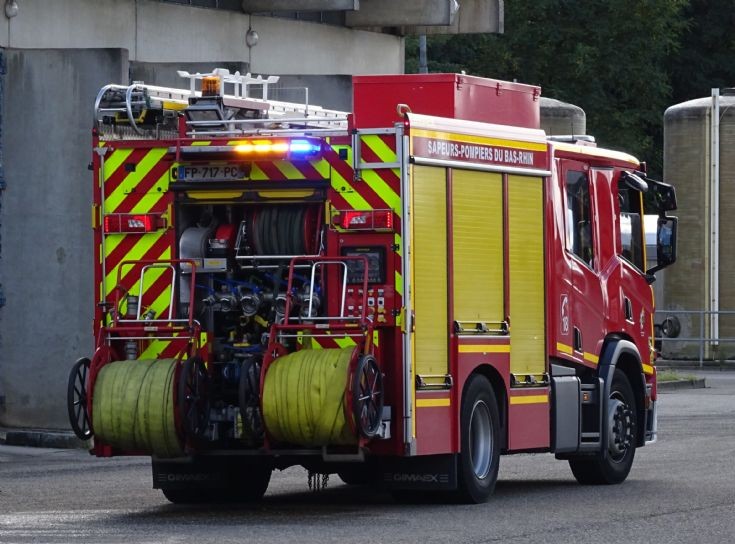
This example also has a short length of 110 mm hose stored next to the high pressure reel above the pump, which is used to access the high output connection fitted to some French hydrants. These deliver a minimum of 2000 LPM compared to 1000 for the standard hydrant design. In areas where they are commonplace it is the practice to carry some 110 mm hose on pumpers. This example MAY have additional LDH in the “coffin” on the roof, as this is a favorite location for storing these hoses for cases where the pump cannot get in close to the hydrant. The extra lengths are also often used by the supply pump and/or the receiver pump if it becomes necessary to relay water.
The advantages of using LDH to move large volumes of water over long distances are well known. Although German fire services still mainly use 75 mm, the French 110 is still smaller than both the common North American 125 and the 150 which was pioneered by the Dutch Hytrans system and is now commonly used along with Hytrans in more than twenty countries.
Added by Rob Johnson on 17 January 2023.
Gimaex


Note the single 23mm hose reel. In France - and several other European countries - these are nowadays never used for interior fire attack, and the idea of having two reels is seen as superfluous. French fire services use 38mm or 45mm hoses for interior fires, often with CAF, and the BSPP recommend a minimum water flow of 380 LPM.
The FPTSR pumps like this example carry a minimum of 2900 litres, so can sustain one attack line for around seven minutes before needing to be dependent on a hydrant.
These units are staffed by either six or eight, depending on the requirements of each Departmental fire service.
Although locally built Renaults dominate the scene, MAN, Mercedes and Scanias like this example are increasingly commonplace.
Added by Rob Johnson on 02 November 2021.