
Upload a Picture
About this Site | Links | Random Pic | Advanced Search
Home | Latest Additions | Contributors
| Visitors
Fire Engine Photos
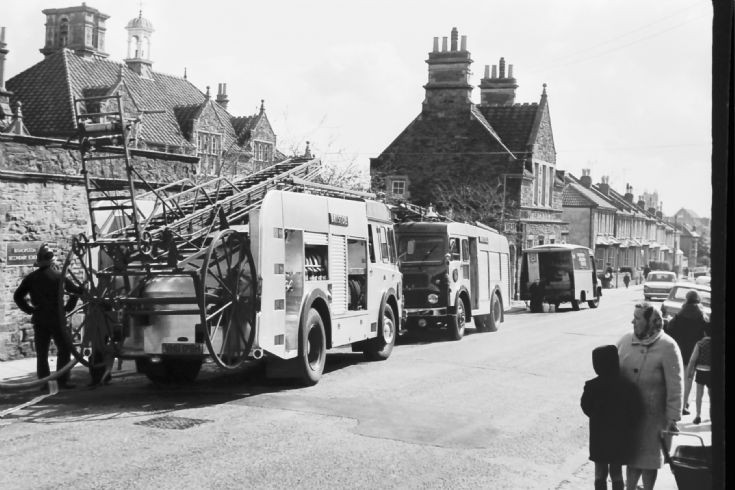
No: 42894 Contributor: Bristol Bob Year: 1975 Manufacturers: Bedford, ERF, HCB Angus Country: United Kingdom
This photo is one of only a few on this site which shows the carriage of the famous Merryweather steel 15 meter escape ladder in detail. Although the firm started building both 15 and 18 meter steel ladders in the 1930s, they did not become really popular until the 1960s, when they replaced a lot of (sometimes very) old wood ones. The wheeled wooden escapes were introduced in the UK in the 1800s, first as two section 12 meter ladders, and were simply pushed to the fire. By the 1890s, they were mounted on "ladder vans" drawn by pair of horses and by the mid 1920s they were carried on petrol or occasionally battery electric chassis - soon to followed by the pump escape.
In the same period, a third extension was added to make a 15 meter ladder the standard, although a few 18 meter ladders were made too.
The steel ladder was much lighter and easier to handle, and did not require highly skilled wood craftsmen to maintain or repair. Because it was so light, it made it easier to fit a larger water tank to the pump escape, which was quite an advantage for some fire brigades. With their introduction, it became commonplace for pump escapes to carry up to 1800 liters instead of only 450 on previous generations.
Wheeled escapes were very gradually replaced by 13.5 meter light alloy ground ladders after 1960, but some were still in use as late as 1990. The main manufacturers of wooden wheeled escape ladders were Ajax and Bailey in addition to Merryweather. Outside of Britain, they were also used in some Commonwealth countries. A similar steel wheeled 18 meter ladder was used in France, manufactured by Gugumus and usually carried on a dedicated small Renault Galeon truck. Wheeled ladders disappeared by the 1930s in most other European countries in favor of small turntable ladders between 18 and 24 meters, which were mainly built by Magirus, Metz, Geesink and Riffauld.
Added by Rob Johnson on 11 October 2021.


Added by Peter Matten on 17 September 2021.