
Upload a Picture
About this Site | Links | Random Pic | Advanced Search
Home | Latest Additions | Contributors
| Visitors
Fire Engine Photos
Comment removed at request of Commentor
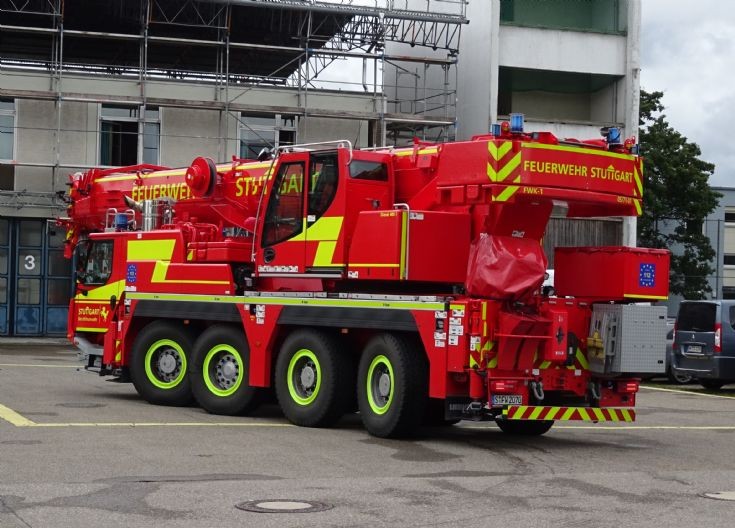
In picture 102 there is a discussion of the heavy crane fleet in German fire services, which is an effort to explain their prevalence there.
I should also mention that the Stuttgart units do have a primary response area which extends into a metropolitan area well beyond the city boundaries.
The underlying explanation for German fire services having these - and a lot of other rarely needed equipment - are I think mainly:
- The country has much larger budgets for emergency services
- Only 3% of German firefighters are paid; the other 97% are unpaid volunteers, numbering over a million active firefighters. This means that payroll expense, which accounts for 80% of the costs in British fire services, is negligible - so comparatively vast sums are available for fire stations, vehicles and equipment.
- For 45 years German was quite literally on the front line of the Cold War, and had first hand memories of recent wartime destruction on a massive scale.
As it turns out, fire services in many other European countries have started adding heavy cranes in quite large numbers in recent years, but they continue to be much more common in Germany than anywhere else.
Added by Rob Johnson on 16 August 2021.
I should also mention that the Stuttgart units do have a primary response area which extends into a metropolitan area well beyond the city boundaries.
The underlying explanation for German fire services having these - and a lot of other rarely needed equipment - are I think mainly:
- The country has much larger budgets for emergency services
- Only 3% of German firefighters are paid; the other 97% are unpaid volunteers, numbering over a million active firefighters. This means that payroll expense, which accounts for 80% of the costs in British fire services, is negligible - so comparatively vast sums are available for fire stations, vehicles and equipment.
- For 45 years German was quite literally on the front line of the Cold War, and had first hand memories of recent wartime destruction on a massive scale.
As it turns out, fire services in many other European countries have started adding heavy cranes in quite large numbers in recent years, but they continue to be much more common in Germany than anywhere else.
Added by Rob Johnson on 16 August 2021.
My only comment would be that Stuttgart is located on a huge highway crossing network leading to East Europe and West Europe countries, thousands of lorries are passing daily
Added by Jacques PETER on 17 August 2021.
Added by Jacques PETER on 17 August 2021.
Seeing three or four maximum weight truck trailers smashed together - along with a handful of passenger cars jammed under them - in a high speed Autobahn traffic accident does indeed rapidly justify the existence of these kinds of cranes, as J-P suggests. German fire services excel with often providing highly specialized rescue vehicles and equipment, for all kinds of accidents involving tramcars, trains, underground railways, tunnels, water, diving and flood rescues as well as high angle rope and cliff rescue jobs - and I am sure I have missed something!
Added by Rob Johnson on 17 August 2021.
Added by Rob Johnson on 17 August 2021.
The Frankfurter Kreutz junction of the ten lane A3 autobahn, the A5, the B43 and the international airport access roads has a daily traffic load of 335, 000 road vehicles, including of course around 100, 000 heavy trucks.
In addition, the complex includes a multiple rail tunnel system on different levels with eighteen high speed, passenger and freight lines.
Added by Rob Johnson on 18 August 2021.
In addition, the complex includes a multiple rail tunnel system on different levels with eighteen high speed, passenger and freight lines.
Added by Rob Johnson on 18 August 2021.
Comment removed at request of Commentor
Andy: If you search "feuerwehrkran" on Youtube you should be able to find videos of some of these in operation. You will also be able to see how German drivers routinely leave an "emergency lane" open on the Autobahn for police, fire, rescue and EMS units to access the incident, whether it us an RTA, a law enforcement incident, a medical emergency or a vehicle fire. This is a legal requirement, and any driver who does not comply will be fined and banned from driving, so compliance is pretty much 100%.
There may still be some HGV RTA videos on Youtube, but German police are very good at keeping bystanders well away. In addition, Youtube have stopped broadcasting some of the more explicit older videos, because of the disturbing nature of some of the content.
You may be able to dig up some training videos, as well, of course. There are also a few of cranes being used as water towers as well as one high angle rope rescue video with a crane and aerial platforms, where numerous victims are rescued from a very large Ferris wheel!
Fortunately I personally only ever witnessed one multiple HGV accident in Germany on the Autobahn, near Heidelberg in 1963, when I was a hitch-hiking student. One truck trailer crossed the median at speed, crashed through the barrier, hit three cars and then two other truck trailers. The car I was in was undamaged and we were able to continue on our way, unhurt but very shaken.
But I am told these accidents are increasingly common, not only in Germany but elsewhere in Europe. One reason seems to be a major influx of maximum GTW trucks from Eastern and Central European countries - where safety checks are less prevalent and where drivers may be inclined to drive much longer hours than legally permitted, with increased risks of distracted driving.
My very limited personal knowledge of exactly how cranes are used at RTAs like this suggests that they are not used alone, but as part of a coordinated approach along with other rescue units and equipment. Their usefulness at these incidents is not in question, however, give the numbers that are in use in Germany.
BTW, they were also extensively deployed in a variety of roles after the recent major flooding events in Germany, along with THW equipment and even military engineers' units.
Added by Rob Johnson on 19 August 2021.
There may still be some HGV RTA videos on Youtube, but German police are very good at keeping bystanders well away. In addition, Youtube have stopped broadcasting some of the more explicit older videos, because of the disturbing nature of some of the content.
You may be able to dig up some training videos, as well, of course. There are also a few of cranes being used as water towers as well as one high angle rope rescue video with a crane and aerial platforms, where numerous victims are rescued from a very large Ferris wheel!
Fortunately I personally only ever witnessed one multiple HGV accident in Germany on the Autobahn, near Heidelberg in 1963, when I was a hitch-hiking student. One truck trailer crossed the median at speed, crashed through the barrier, hit three cars and then two other truck trailers. The car I was in was undamaged and we were able to continue on our way, unhurt but very shaken.
But I am told these accidents are increasingly common, not only in Germany but elsewhere in Europe. One reason seems to be a major influx of maximum GTW trucks from Eastern and Central European countries - where safety checks are less prevalent and where drivers may be inclined to drive much longer hours than legally permitted, with increased risks of distracted driving.
My very limited personal knowledge of exactly how cranes are used at RTAs like this suggests that they are not used alone, but as part of a coordinated approach along with other rescue units and equipment. Their usefulness at these incidents is not in question, however, give the numbers that are in use in Germany.
BTW, they were also extensively deployed in a variety of roles after the recent major flooding events in Germany, along with THW equipment and even military engineers' units.
Added by Rob Johnson on 19 August 2021.
If you visit the Liebherr website and go to the product pages you can see examples of their "feuerwehrkran" products, as well as a pictorial of various options to address the different roles they can be called on to fill in fire service duties.
The firm has been building custom cranes for fire services in Germany and abroad for forty years now, and boasts a very high rate of repeat purchases.
Added by Rob Johnson on 19 August 2021.
The firm has been building custom cranes for fire services in Germany and abroad for forty years now, and boasts a very high rate of repeat purchases.
Added by Rob Johnson on 19 August 2021.
Liebherr


Added by Rob Johnson on 11 August 2021.