
Upload a Picture
About this Site | Links | Random Pic | Advanced Search
Home | Latest Additions | Contributors
| Visitors
Fire Engine Photos
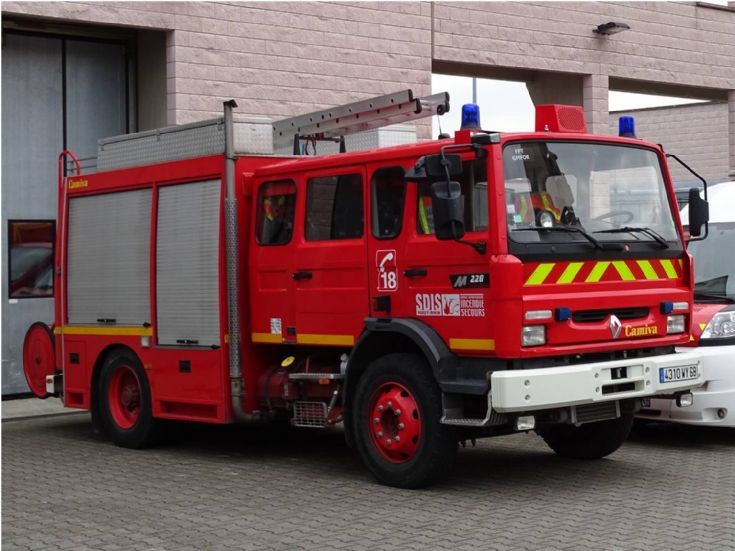
I should add that all French pumps for structural firefighting have a single, rear mounted, 23mm first aid hose reel. BSPP research recently recommended that these should not be used on interior structure fires, but a 45mm hose line with the variable branch outlet set at a minimum 350 LPM for initial attack - unless a CAFS line is available. This follows existing practice in Russia and both Germany and the Netherlands, and of course 25mm "booster" reels have disappeared altogether from most US pumpers. Spain, Italy and the UK are among countries where first aid high pressure hoses are routinely used on interior structure fires, but it seems the trend is towards relying less and less on them...
Added by Rob Johnson on 28 January 2021.
Added by Rob Johnson on 28 January 2021.
Further research indicates that in these and other countries the increasing use of hydrocarbon based synthetic materials in furniture, fixtures, carpets and curtains has dramatically increased fire loads, temperatures and toxic smoke emissions to the point where a typical 120-150 LPM discharge - even at 40 AT - is no longer considered a safe initial attack for firefighters in interior spaces. These conclusions follow scientific testing resulting from firefighter fatalities in Germany, the Netherlands and now France.
It had been thought that the use of concrete, brick and block structural elements (instead of wood, as in North America) would have impeded fire progression. The reality seems to be that these do tend to confine a fire, but also cause temperatures to rise in the fire's immediate environment and smoke conditions to intensify too...
Added by Rob Johnson on 30 January 2021.
It had been thought that the use of concrete, brick and block structural elements (instead of wood, as in North America) would have impeded fire progression. The reality seems to be that these do tend to confine a fire, but also cause temperatures to rise in the fire's immediate environment and smoke conditions to intensify too...
Added by Rob Johnson on 30 January 2021.
Camiva


Hydrants in France at rated at either 1000 or 2000 LPM minimum output, usually with either two 65mm outlets or one 110mm, or sometimes both. Underground hydrants are the most common, but pillar hydrants are preferred in many places. They can be between 100 and 200 meters apart, depending on the jurisdiction and the assessed level of fire risk. The "coffins" on this pumper may carry 100mm supply hose for use with high capacity hydrants, but not all pumps necessarily carry these. This pumper seems to have only one rather short extension ladder - but ladders up to 15 meters are not unusual, and hook ladders are still in daily use, especially in Paris...
Added by Rob Johnson on 27 January 2021.