
Upload a Picture
About this Site | Links | Random Pic | Advanced Search
Home | Latest Additions | Contributors
| Visitors
Fire Engine Photos
Rob,
much more interesting than the piercing tool is using the appliance that you talked about as a water tower instead of an ALP or a TL with a monitor on the basket. RB UK has a video on Twitter from recent fire. Link via PM, if required.
Added by Martin Siegel on 20 May 2017.
much more interesting than the piercing tool is using the appliance that you talked about as a water tower instead of an ALP or a TL with a monitor on the basket. RB UK has a video on Twitter from recent fire. Link via PM, if required.
Added by Martin Siegel on 20 May 2017.
Martin:
It occurs to me that fire services in every country face the problem of trying to cope with industrial fires in modern steel buildings, which often have no windows, unsafe roofs and are hard to ventilate.
This type of piercing nozzle with high pressure water or CAFS jet or spray, combined with an infrared camera, might just end up being a much safer and quicker way of killing incipient fires - before they become violent enough to make a total loss inevitable.
These piercing nozzles can penetrate their lightweight steel walls and roof panels, and the range and cooling effect of the jet or spray is quite impressive.
It is admittedly not how things are done right now, but the classic cut, pray and spray approach is often very ineffective!
I think these types of trucks might be part of our future, and not just a passing fad like so many other innovations.
Added by Rob Johnson on 23 May 2017.
It occurs to me that fire services in every country face the problem of trying to cope with industrial fires in modern steel buildings, which often have no windows, unsafe roofs and are hard to ventilate.
This type of piercing nozzle with high pressure water or CAFS jet or spray, combined with an infrared camera, might just end up being a much safer and quicker way of killing incipient fires - before they become violent enough to make a total loss inevitable.
These piercing nozzles can penetrate their lightweight steel walls and roof panels, and the range and cooling effect of the jet or spray is quite impressive.
It is admittedly not how things are done right now, but the classic cut, pray and spray approach is often very ineffective!
I think these types of trucks might be part of our future, and not just a passing fad like so many other innovations.
Added by Rob Johnson on 23 May 2017.
Rob,
I'm completely with you concerning the idea behind the design but I fear that thinning budgets will put the trucks to some central stations from where it will be difficult to reach a location in time to stop a fire before it gets violent. Still there is a long road to go before people will be convinced.
Added by Martin Siegel on 08 June 2017.
I'm completely with you concerning the idea behind the design but I fear that thinning budgets will put the trucks to some central stations from where it will be difficult to reach a location in time to stop a fire before it gets violent. Still there is a long road to go before people will be convinced.
Added by Martin Siegel on 08 June 2017.
Martin - I have to agree, especially because there will inevitably be extra costs involved.
Perhaps we can hope that fire services will try to position them at stations which cover industrial and/or distribution business zones as a first priority, to get "the most bang for their buck"
Added by Rob Johnson on 09 June 2017.
Perhaps we can hope that fire services will try to position them at stations which cover industrial and/or distribution business zones as a first priority, to get "the most bang for their buck"
Added by Rob Johnson on 09 June 2017.
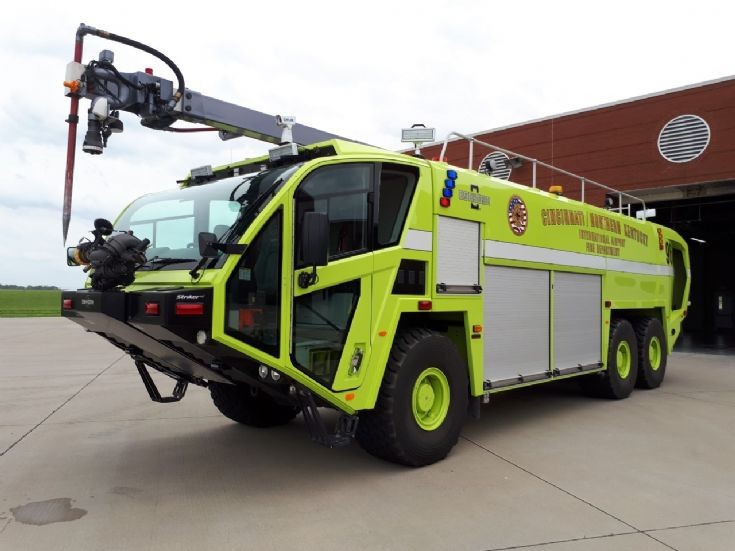
Oshkosh


Although designed only to pierce an airplane fuselage, these can penetrate a frangible roof covering like slate or tile, and also get through some industrial steel buildings' roofs and wall structures.
Let's see how successful they are at structure fires!
Added by Rob Johnson on 18 May 2017.