
Upload a Picture
About this Site | Links | Random Pic | Advanced Search
Home | Latest Additions | Contributors
| Visitors
Fire Engine Photos
Comment removed at request of Commentor
Andy:
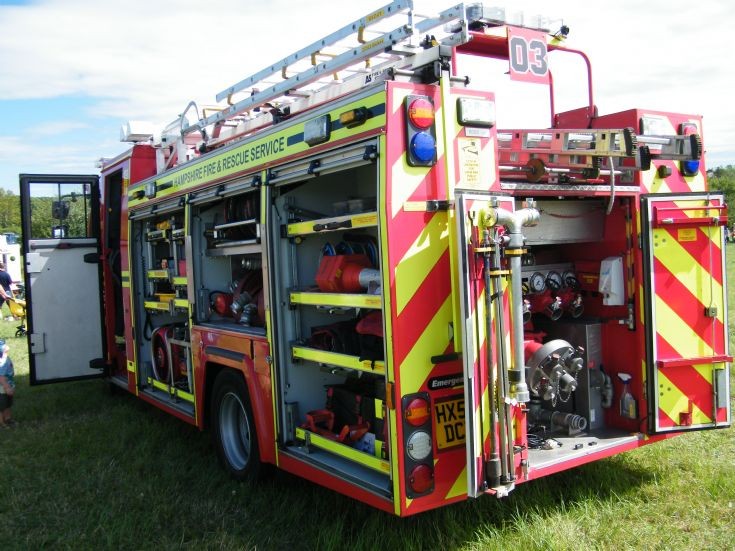
Thanks, I did not know it was common for pumps to carry an extra standpipe around with them - they do take up a lot of space. This appliance looks like it already has a pretty full complement of equipment in the lockers we can see in the photo.
Perhaps an argument for pillar hydrants, which are universal here in the Americas and pretty common in some European countries too?
High capacity pumps like this are relatively uncommon in UK county brigades these days, it seems, and even London has reverted to having only two inlets on their 750 gpm rated pumps.
I have also noticed that some urban fire brigades no longer bother to carry hard suction hoses at all. If this appliance is in fact carrying any hard suctions I can't figure out where they are - very well hidden!
Added by Rob Johnson on 20 June 2018.
Rob, hard suction will be carried behind the metal panel above the pump bay, a common feature of the Emergency One (UK) build.
Added by Andy on 22 June 2018.
Added by Andy on 22 June 2018.
Comment removed at request of Commentor
Comment removed at request of Commentor
Thanks Andy:
Very helpful!
It is quite true that fire departments here do use a variety of up to eleven hose sizes and equip their appliances very differently to respond to special needs in their response areas. But some basic requirements are actually standardized by the NFPA on a national level and others are mandated at the State level by various State regulations.
Similar situations exist in Japan, Germany, France and Spain as well as in Belgium, the Netherlands and most Scandinavian and Central European countries, as far as I have been able to research the subject.
Total standardization in every detail of specifications and equipment seems to be confined only to national fire services, such as the VdF in Italy and the National Fire Protectorate in Israel. Although Poland also has a national fire service, there are some quite wide variations in appliance specification from one place to another.
On the subject of hydrant designs, I live in Chicago, which is only one of a huge number of North American cities which has long months of sub zero temperatures, and - like the others - our hydrants are all above ground.
They rarely freeze, unless the drainage system gets blocked up! The valve mechanism is underground, even though the barrel is exposed, and remains dry until the valve is opened. To give you an idea of how uncommon this is, FDNY operate 198 engine companies but have only five Thawing Units to deal with frozen hydrants. Chicago, even colder, has 98 engines but only one Thawing Unit...
Added by Rob Johnson on 22 June 2018.
Latest Pics


Added by Rob Johnson on 17 June 2018.