
Upload a Picture
About this Site | Links | Random Pic | Advanced Search
Home | Latest Additions | Contributors
| Visitors
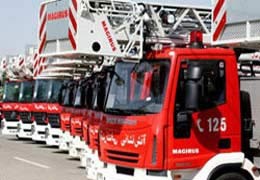
Fire Engine Photos
Well as someone who has been working with Tehran fire service and also having experience with European and Canadian fire brigades, I have to say that I totally agree with you about the Grenfell Tower fire, but in terms of number of aerials, in Tehran, they receive a very high number of calls on daily basis, many of which require aerials to be deployed to the scenes, and that is solely the reason why the FD possess such large number of aerial vehicles.I would say for them is about the volume.
Added by Amir Moradian on 07 January 2020.
Added by Amir Moradian on 07 January 2020.
Amir:
Thanks for your comment.
It seems the UK fire services rarely send aerials to fires unless they are obviously required, while other countries routinely dispatch them in case they may be needed.
You may have noticed that the London Chef Fire Officer was recently dismissed, as a result of the amazing way the Brigade failed to respond adequately to the Grenfell fire and manage the evacuation of residents.
But, although the CFO has been replaced, it still seems the "revised" London response to night time high rise residential building fires continues to be around half of the equipment and personnel which most other cities in other countries dispatch.
Stay safe!
Added by Rob Johnson on 21 January 2020.
@Rob Johnson Agreed.
Also, as result of the catastrophic Grenfell Tower fire, LFB has purchased 3* Magirus 64m aerials, which are going to entirely revolutionize how they tackle high-rise fires in the near future.
Stay Safe!
Added by Amir Moradian on 23 January 2020.
Also, as result of the catastrophic Grenfell Tower fire, LFB has purchased 3* Magirus 64m aerials, which are going to entirely revolutionize how they tackle high-rise fires in the near future.
Stay Safe!
Added by Amir Moradian on 23 January 2020.
As an armchair commentator maybe you should acquaint yourself with all the facts before posting. Dany Cotton was due for retirement this year and she decided to leave slightly earlier. She was not dismissed. If you had seen the overwhelming support she has from long time serving and retired firefighters you might appreciate her position. It's very easy to sit back and pick holes - if you'd ever served you might have a far better understanding!
Added by on 26 January 2020.
Added by on 26 January 2020.
Comment removed at request of Commentor
Agreed, we will never know if one of London's 13 30 meter aerials responding with the first attendance to the Grenfell fire might have been successfully deployed to overcome the vertical extension of the fire in the exterior cladding above the fourth floor.
But the record shows that none was dispatched on the first alarm. The first one to attend got there more than a half hour later!
The fact that LFB changed their high rise fire response to include an aerial a few days after the fire suggests that somebody - maybe even Cotton - thought the same way. It may also have provoked the decision to buy a few longer aerials which Amir mentioned.
In the past fifty years I have often talked with senior officers and working chiefs in many fire services in different countries about how they respond to high rise fires, and they take them very seriously.
For the most part, first alarm response is around twice the levels which seem to be prevalent in the UK, in terms of both numbers of personnel responding as well as equipment - including one, more often two - and sometimes three aerials.
I live in a high rise building in Chicago, and when we had a fire in our trash compactor the CFD response included four engines, two aerials, a snorkel, a heavy rescue, an ambulance and three chief officers - a total of around 44 personnel...
Added by Rob Johnson on 06 February 2020.
@Amir Moradian the three 64m aerials will not revolutionize how they tackle high rise building fires. The U.K. cities are so overcrowded that parked cars prevent such large appliances getting close enough to be deployed in a meaningful time frame. At Grenfell, even standard pumps could not park outside the building, the 64m TTLs are a gesture, not a solution.
Added by Alan Woodward on 07 February 2020.
Added by Alan Woodward on 07 February 2020.
Alan - I totally agree!
Not only are you right about the problems of access for these monsters, we have to think about response times for a mere three units in a city the size of London - with high rise structures dispersed across so many boroughs.
Added by Rob Johnson on 14 February 2020.
Not only are you right about the problems of access for these monsters, we have to think about response times for a mere three units in a city the size of London - with high rise structures dispersed across so many boroughs.
Added by Rob Johnson on 14 February 2020.
Comment removed at request of Commentor
Totally agree!
But the fire service is expected to deal with situations where things have gone wrong, by definition.
Added by Rob Johnson on 11 March 2020.
But the fire service is expected to deal with situations where things have gone wrong, by definition.
Added by Rob Johnson on 11 March 2020.
Comment removed at request of Commentor
Andy.
It is all about probabilities. My point is that UK fire services could learn from existing practices in most other countries. High rise fires are by no means uncommon in many countries all over the World - much more common than multiple airplane crashes!
Sadly, the definitive Bain report, which is being used to spearhead the gutting of the British fire service, spent ZERO time discussing ANY existing best practices in ANY other countries.
Instead, it concentrated instead on making the case that the UK needed fewer fire stations, fewer firefighters and less equipment.
If you read any British fire service annual report, you will see that the focus is now exclusively on finding cost savings wherever possible.
What the LFB learned after Grenfell (within three days!) was that dispatching an aerial on the first alarm to an occupied highrise at night was a wise precaution - exactly what was already long since known in dozens of other countries.
In addition to ths long overdue change, I see that LFB's response is now to be further upgraded to eight pumps plus an aerial if four or more calls are received for the same address.
Let us learn from others, not try to defend traditional practices, especially when the lesson comes at such a high cost!
Added by Rob Johnson on 13 March 2020.
Comment removed at request of Commentor
Alan:
The main reason so many aerials respond to high rise fires here is that the response calls for 30 to 40 firefighters. Given that the nearest fire stations respond, this means that the response will always include at least two to four aerials.
LFB have changed their response protocol from four to eight pumps for the same reason, as high rise fires inevitably require a lot more manpower.
For some reason, however, this increased LFB first alarm response is only dispatched if four or more calls are made from the affected premises!
My point about aerial attendance was not however limited to the Americas. It seems that cities almost everywhere in the world respond to high rise fires with at least one aerial, if not two or three, as well as four or more pumpers and often additional rescues and/or specials.
I agree that the gutting of the UK fire service is scandalous, but I think the main problem is that the public just don't know it is happening.
If the press were to uncover the kinds of practices you describe, there could be the beginnings of some public pressure to improve things - but if nothing happens it will just get worse.
I remember seeing a British Prime Minister saying on TV some years ago that "there are fewer fires at night, so we need fewer firefighters on duty at nighttime" ??
Added by Rob Johnson on 24 March 2020.
Bronto Skylift



Not quite as good coverage as most large European cities, but dramatically better than London with thirteen.
As pointed out in various press reports, London were not even able to dispatch a single aerial to the infamous Grenfell Tower fire on the first alarm.
Amazing that a major capital city in Europe would fail to send even one aerial to an occupied 24 floor night time building fire, even if the reported incident was "only" on the fourth floor. The first response was four pumps, without a senior officer or rescue unit either....
Because each London aerial has an average response area of something like 40 square miles, the one that was eventually dispatched on a subsequent alarm was not on scene until at least 30 minutes later - while if it had been there originally it may have been able to mitigate the external vertical extension of the fire in the illegal cladding, which in the event went entirely unchecked.
LFB have since changed their first response to occupied high rise towers to include one aerial, which should have been in place years ago! It should be noted that this is STILL behind many other US and European cities, which usually dispatch two and quite often three. The latter include Moscow and Warsaw, among others.
Added by on 25 November 2018.