
Upload a Picture
About this Site | Links | Random Pic | Advanced Search
Home | Latest Additions | Contributors
| Visitors
Fire Engine Photos
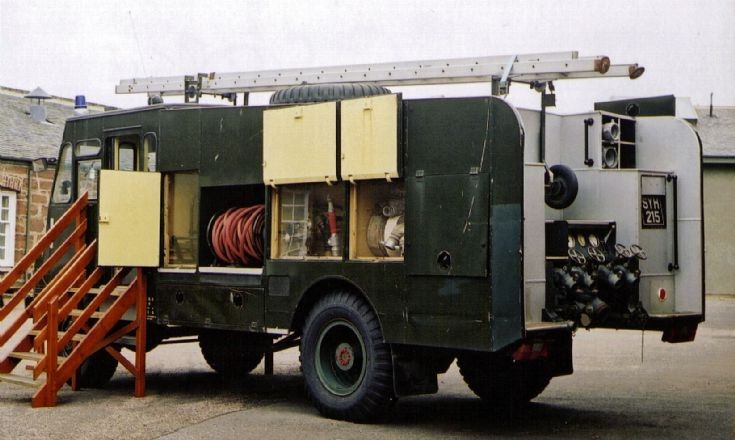
Hi Rob, I believe it was to do with axle size, drive shaft position and weight limits. Never the most stable of machines the 4x4 was quite capable off road.
No doubt someone with greater knowledge could enlighten us more!
Added by John Stott on 12 June 2014.
No doubt someone with greater knowledge could enlighten us more!
Added by John Stott on 12 June 2014.
Hi Rob, I can't find any given reason in any of my books, ("In Time of War or Crisis, The Green Goddess Story" by Graham R.Hand, "The Green Machine" by Barry R.Holliss & John C.Thompson and "Manual of Fire Appliances for Mobile Fire Columns" Home Office & Scottish Home Department), All of which mention and describe the differences between the RLHZ 4x4 and the SHZ 4x2, but don't say why. At a guess it's to do with weight distribution as the tank on the RLHZ is central, and towards the rear on the SHZ, and the hose reel's moved accordingly.
Added by Chris Stone on 12 June 2014.
Added by Chris Stone on 12 June 2014.
Thanks, John and Chris. I think you are both right, because the AFS RL had single rear wheels, which probably helped traction but reduced the maximum weight on the rear axle. Moving the hose reels seems less easy to understand, unless it was meant to increase the angle of departure?
When I was a student at Cambridge, I lived almost next door to the fire station on Parker's Piece in 1964. They had an RL tanker back then with a 1000 gallon tank. If the GGs were prone to roll, I can only imagine what this tanker must have been like! The county also ran f few coventional pump water tenders with 400 gallon tanks and an ET on the same RL chassis, so they must have either had very good drivers or very protracted response times...
Added by on 17 June 2014.
When I was a student at Cambridge, I lived almost next door to the fire station on Parker's Piece in 1964. They had an RL tanker back then with a 1000 gallon tank. If the GGs were prone to roll, I can only imagine what this tanker must have been like! The county also ran f few coventional pump water tenders with 400 gallon tanks and an ET on the same RL chassis, so they must have either had very good drivers or very protracted response times...
Added by on 17 June 2014.
Bedford


Added by Rob Johnson on 11 June 2014.