
Upload a Picture
About this Site | Links | Random Pic | Advanced Search
Home | Latest Additions | Contributors
| Visitors
Fire Engine Photos
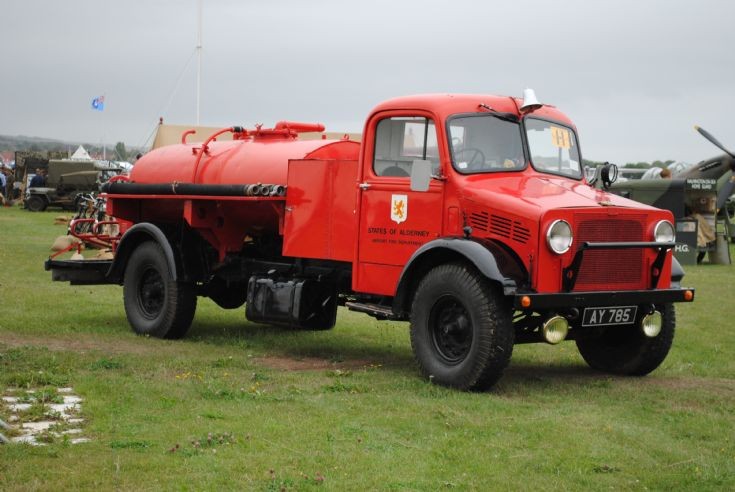
The rear part reminds of the 1940' Opel Blitz water tanker.
Added by Jacques PETER on 04 January 2014.
Added by Jacques PETER on 04 January 2014.
I'm mildly puzzled - does this vehicle carry its Alderney registration on the UK highway or just when on diplay off road - (AY 785 looks just like a Leicestershire number from the past)
Added by Peter Goodall on 06 January 2014.
Added by Peter Goodall on 06 January 2014.
Peter,
The Channel Isles were not included in the mainland registration system but have their own numbering system which varies between the islands.
Guernsey just uses numbers, Jersey uses the Prefix J and Alderney the prefix AY. So the number plate on this appliance is genuine.
In the UK system J was issued by Durham and, as you point out above, AY was Leicestershire.
Regards,
Steve
Added by Steve Prosser on 06 January 2014.
The Channel Isles were not included in the mainland registration system but have their own numbering system which varies between the islands.
Guernsey just uses numbers, Jersey uses the Prefix J and Alderney the prefix AY. So the number plate on this appliance is genuine.
In the UK system J was issued by Durham and, as you point out above, AY was Leicestershire.
Regards,
Steve
Added by Steve Prosser on 06 January 2014.
JP - I think you will find that almost all WWII tankers in the combatant countries had either round or oval sectional tanks. These were easier to weld and needed thinner sheet steel than rectangular tanks, which were important considerations in wartime. The German TLF tanker had A 2400 liter tank and was quite widespread. In the UK, the NFS used few tankers, and had a large fleet of money-saving "Mobile Dam Unit" appliances instead. This had a 2275 liter capacity rectangular canvas container with a steel frame on the back of an otherwise standard commercial truck. These and the German TLFs were used extensively in urban firefighting in both countries, as water mains were all too often broken by bombing and structure collapses, rendering hydrants useless.
Added by Rob Johnson on 06 January 2014.
Added by Rob Johnson on 06 January 2014.
Rob, The original Dam Lorries were mostly clapped out second hand taken from trade as mobilisation grew more of a reality. I have copies of a host of Home Office documents and reports and by 1941 these vehicles were becoming an increasing burden. By 1941 orders were being placed for what was to be several hundred MDUs fitted with square or rectangular steel tanks on Fordson 7V, Austin K4 and Dodge Kew chassis. most carried 500gal some carried 1000gal. As these were delivered the original dam lorries were retired. In the original configuration a dam lorry was reclassified a Mobile Dam Unit if it had an on board pump or towed a Trp. Tanks were often open topped as spillage was minimal with a 20mph operating speed and water contamination was not an issue.
The type of tanker which is the subject of this thread was build in 2 versions for transporting drinking water- 350 and 500 gal and used by all branches of the UK military; All 3 branches converted some of them towards the end of the war to domestic fire tenders towing a trailer pump. The RAF & RN converted a further number to support the 1944/45 monitor type crash tenders. A further number were transferred to the Ministry of Civil Aviation in 1945 as crash tender support vehicles with most being equipped with a demounted Lt Trailer pump plumbed- in mounted at the rear; some on very minor airfields carried a supply of foam and foam making equipment; The reason these tankers- when originally built had closed oval tanks was to prevent spillage when operating on rough tracks etc and more importantly as they were drinking water tankers to prevent airborne contamination.
Having been a vehicle/ support equipment engineer in the RAF for nearly 40 years I can tell you it is far cheaper and speedier to build a square or rectangular tank, and horizontal faces can be constructed with fairly thin walled material by subjecting them to swaging- thise are the diagonal indentations you can often see on such tanks. but thats another story .
regards TED
Added by Ted Angus on 08 January 2014.
The type of tanker which is the subject of this thread was build in 2 versions for transporting drinking water- 350 and 500 gal and used by all branches of the UK military; All 3 branches converted some of them towards the end of the war to domestic fire tenders towing a trailer pump. The RAF & RN converted a further number to support the 1944/45 monitor type crash tenders. A further number were transferred to the Ministry of Civil Aviation in 1945 as crash tender support vehicles with most being equipped with a demounted Lt Trailer pump plumbed- in mounted at the rear; some on very minor airfields carried a supply of foam and foam making equipment; The reason these tankers- when originally built had closed oval tanks was to prevent spillage when operating on rough tracks etc and more importantly as they were drinking water tankers to prevent airborne contamination.
Having been a vehicle/ support equipment engineer in the RAF for nearly 40 years I can tell you it is far cheaper and speedier to build a square or rectangular tank, and horizontal faces can be constructed with fairly thin walled material by subjecting them to swaging- thise are the diagonal indentations you can often see on such tanks. but thats another story .
regards TED
Added by Ted Angus on 08 January 2014.
Thanks Ted, an interesting update.
The Manual of Firemanship and most contemporary accounts seem to focus on the canvas MDU, so it is interesting to know that quite a few metal tank versions were placed into NFS service during WWII.
The rectangular water tank was quite common in Germany as early as 1920, but many other countries built round or oval tanks on pump appliances well into the 1950s, including some Dennis F8s illustrated on this site.
Modern tanks are often quite complicated shapes, to maximize capacity and lower the center of gravity, and of course these designs are made feasible by thermoplastic and resin technologies.
Even so, carrying a large load of water, which is inherently very heavy and unstable, remains a dangerous business. Here in the US, fire service tanker accidents are three or four times as common as other apparatus incidents, and quite often include total rollovers.
Added by Rob Johnson on 09 January 2014.
The Manual of Firemanship and most contemporary accounts seem to focus on the canvas MDU, so it is interesting to know that quite a few metal tank versions were placed into NFS service during WWII.
The rectangular water tank was quite common in Germany as early as 1920, but many other countries built round or oval tanks on pump appliances well into the 1950s, including some Dennis F8s illustrated on this site.
Modern tanks are often quite complicated shapes, to maximize capacity and lower the center of gravity, and of course these designs are made feasible by thermoplastic and resin technologies.
Even so, carrying a large load of water, which is inherently very heavy and unstable, remains a dangerous business. Here in the US, fire service tanker accidents are three or four times as common as other apparatus incidents, and quite often include total rollovers.
Added by Rob Johnson on 09 January 2014.
Hi Rob. in the 1944 edition Pt 2 of the Manual, their are 2 examples of MDUs, firstly one with a requisitioned lorry with the original steel framed canvas dam & Trp and the second an Austin K4 with 2 x 500 gal square tanks plumbed to a demounted Beresford Stork Lt Pump. - which is an excellent reminder I have the bits gathered together to model the latter - must add it to the trucks to build list. keep warm Rob
regards TED
Added by Ted Angus on 10 January 2014.
regards TED
Added by Ted Angus on 10 January 2014.
The roll over problem Lancs went on to 220gall tanks. The Brigade Transport Officer at the time had "pick up the pieces" after a fireman was killed when a Bedford TK rolled and went on fire.
Added by Neal Glover on 10 January 2014.
Added by Neal Glover on 10 January 2014.
Interesting thread. Any machine will roll if driven in a careless manner. Thats what driver training is about. Anybody who drove an old RAF Mk 5 or 5a could tell stories!
We had an Angloco 4wd foam tender at Leeds Bradford in the early eighties, auto box with a Rolls B81, the school at Stansted had the prototype. How either of them were never rolled still puzzles me to this day.
Tacr 2 Range Rovers were notorious for body roll, South Yorks CFO at the time of the 77 strike pleaded with the RAF firemen to slow down answering calls. He had followed us and what he saw scared him witless.
My point, its safe if driven within limits. Luckily most drivers in fire services are well trained and given a chance to test their machines to the limit.
Added by John Stott on 11 January 2014.
We had an Angloco 4wd foam tender at Leeds Bradford in the early eighties, auto box with a Rolls B81, the school at Stansted had the prototype. How either of them were never rolled still puzzles me to this day.
Tacr 2 Range Rovers were notorious for body roll, South Yorks CFO at the time of the 77 strike pleaded with the RAF firemen to slow down answering calls. He had followed us and what he saw scared him witless.
My point, its safe if driven within limits. Luckily most drivers in fire services are well trained and given a chance to test their machines to the limit.
Added by John Stott on 11 January 2014.
John,
A great point very well made, in many aspects of life equipment design gets blamed for poor or inadequate training and/or gross misuse.
People, in all walks of life, have the nasty habit of pushing equipment beyond its design limits, which sometimes results in injury or death.
I was once told that nothing can be made foolproof as fools can be ingenious.
Regards,
Steve
Added by Steve Prosser on 11 January 2014.
A great point very well made, in many aspects of life equipment design gets blamed for poor or inadequate training and/or gross misuse.
People, in all walks of life, have the nasty habit of pushing equipment beyond its design limits, which sometimes results in injury or death.
I was once told that nothing can be made foolproof as fools can be ingenious.
Regards,
Steve
Added by Steve Prosser on 11 January 2014.
All true! I think a big part of the problem here is that a lot of US tankers are very large and heavy (12, 000 liters and up), used in rural conditions with winding and hilly roads, and driven by volunteers. I have great respect and admiration for anyone who volunteers, but - too often - they get very few opportunities to drive fully laden trucks of this weight and size under emergency response conditions, and this is when accidents happen.
Added by Rob Johnson on 13 January 2014.
Added by Rob Johnson on 13 January 2014.
Bedford


Added by Pete Matten on 04 January 2014.