
Upload a Picture
About this Site | Links | Random Pic | Advanced Search
Home | Latest Additions | Contributors
| Visitors
Fire Engine Photos
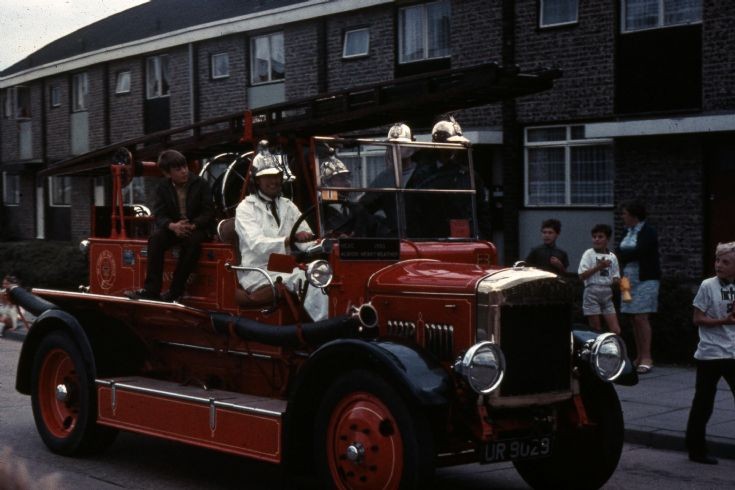
No: 36797 Contributor: Coiln Humphrey Year: 1970 Manufacturers: Albion, Merryweather Country: United Kingdom
Les, it varied but usually a leather one, arranged in a webbed pattern, although I have seen some with canvas.
Added by John Stott on 04 December 2013.
Added by John Stott on 04 December 2013.
The one we had that hung in our hall had a leather lining - it also served as King Prius's helmet at the "Siege of Troy" - Me - Junior School 1952 !! After my Father died it disappeared! my Mother had "given the THING away" - 3 furious sons!! Seen them on offer at £350/£450 depending on metal and condition. Oh Hum!!
Added by Ian Lisseman on 05 December 2013.
Added by Ian Lisseman on 05 December 2013.
Les, I have an old brass helmet, it has a heavy leather frame sewn at the rear but attached to the actual sides of the helmet by the brass bosses which are tightened by the fingers on the outside. Over the outside of the harness is sewn a soft cow hide leather which comes together inside the head of the helmet and is fastened together by a leather thong threaded through holes in the cowhide and tied off to suit the wearers head height. I believe these helmets came in only one or two sizes and it was the adjusting of the thong and the knee in the helmet panel beating that gave the eventual comfort to the wearer. Mind you, it is as heavy as hell being made of brass but the firies polishing the jolly things every day on shift made them almost paper thin and good for appearance value only!
But, boy didn't they look spectacular!!??
Added by Pav on 06 December 2013.
But, boy didn't they look spectacular!!??
Added by Pav on 06 December 2013.
Thanks Guys! Ian, I would be mad too.
Pav, Thank you for your answer to my question.
Added by Les Davis on 06 December 2013.
Pav, Thank you for your answer to my question.
Added by Les Davis on 06 December 2013.
Does anyone know when these magnificent helmets were replaced by the leather or leasther-covered cork ones? I know the AFS and then the NFS were all issued with military-style "tin hats" shortly before and during WWII, but I believe most brigades had already replaced the traditional brass ones before then I have also seen a few very old photos, which suggested that some British brigades always favoured leather and never adopted brass ones.
Do we have any helmet historians out there?
Added by Rob Johnson on 06 December 2013.
Do we have any helmet historians out there?
Added by Rob Johnson on 06 December 2013.
You are correct in what you say Rob, LFB went over to cork lids before WW2' some brigades used leather until the 1970s in fact all the Scots brigades used the leather Hendry's not surprisingly they were a Glasgow firm! The standard AFS issue was a metal helmet until the AFS was disbanded, some brigades also issued 'normal' lids to auxiliary's when they did 'shadowing' shouts with the full time crews.
Added by Barrie Green on 07 December 2013.
Added by Barrie Green on 07 December 2013.
Could anyone tell me about the cork helmet construction? I have never seen one up close to be able to tell how it is put together.
Added by Les Davis on 07 December 2013.
Added by Les Davis on 07 December 2013.
Barrie - here in the US the old-fashioned Cairns leather helmet is still very common, particularly in the north-east and midwest. Most south American fire services also use leather. Big city departments like Boston, New York, DC, Chicago, Philadelphia, San Francisco and many others have tested the new thermoplastic designs and still stick to leather - despite the fact they are quite heavy.
A few departments have bought plastic helmets, which are actually styled to look exactly like the iconic leather design, but I do not think they have become very popular.
LA city and county are two of the relatively few departments who wear a more European style, like the old Italian VdF helmet.
In Europe, many German fire services still use the old military-style steel helmet, with an added leather neck guard. But these are gradually giving way to the French Gallet, which is now very commonplace all over Europe.
Added by Rob Johnson on 07 December 2013.
A few departments have bought plastic helmets, which are actually styled to look exactly like the iconic leather design, but I do not think they have become very popular.
LA city and county are two of the relatively few departments who wear a more European style, like the old Italian VdF helmet.
In Europe, many German fire services still use the old military-style steel helmet, with an added leather neck guard. But these are gradually giving way to the French Gallet, which is now very commonplace all over Europe.
Added by Rob Johnson on 07 December 2013.
Les I believe they were moulded out of layered cork. Cromwell made some of the best, very light and comfortable. I wore both old style high ridge and the more modern sleeker Cromwells during my service. They offered very good protection, particularly as they were none conductive.
My favourite was the civil aviation type with full face visor, it gave great protection to the face and neck.
I have tried the French model, hated it, luckily my last brigade left retained men alone with our old fashioned kit until after I left.
Added by John Stott on 08 December 2013.
My favourite was the civil aviation type with full face visor, it gave great protection to the face and neck.
I have tried the French model, hated it, luckily my last brigade left retained men alone with our old fashioned kit until after I left.
Added by John Stott on 08 December 2013.
John - is it true that the Cromwell hemets had a joneycomb balsa wood comb, to take the initial impact if a heavy object were to fall on the wearer's head?
Added by Rob Johnson on 08 December 2013.
Added by Rob Johnson on 08 December 2013.
Rob, yes in the older ones pre seventies, the ridge was very high. My newer ones, say from around the eighties on were a low profile affair. These seemed to incorporate some kind of bonding, whether it was fibreglass or a plastic I am not sure. They worked well though. Many North American brigades were using them at that time too, a boast not missed by Cromwells advertising at the time.
I do not feel as secure in the modern offerings. On make ups where LFB were present, who at the time sported maroon tunics and Gaul helmets, they referred to us as hillbillies. Given the choice I would pick my old Cromwell and lancer tunic any day :)
Added by John Stott on 09 December 2013.
I do not feel as secure in the modern offerings. On make ups where LFB were present, who at the time sported maroon tunics and Gaul helmets, they referred to us as hillbillies. Given the choice I would pick my old Cromwell and lancer tunic any day :)
Added by John Stott on 09 December 2013.
UR9029 Albion Merryweather ex Ware
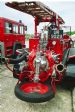
very interesting story here of its saving by Essex Carriers of Benfleet
www.benfleethistory.org.uk/content/browse-articles/areas/tarpots-area/essex_carriers_ltd-3
Added by Petros on 04 January 2023.
very interesting story here of its saving by Essex Carriers of Benfleet
www.benfleethistory.org.uk/content/browse-articles/areas/tarpots-area/essex_carriers_ltd-3
Added by Petros on 04 January 2023.
Looking at the size, weight and complexity of this piston pump, it is not surprising that the centrifugal pump very quickly became the favored choice for fire pumpers. However they did survive quite a long time and I believe the last of them was delivered shortly after WWII! As well as size, weight and general complexity, the other disadvantage of the reciprocating pump was that it could only deliver its rated capacity at its rated pressure, while the centrifugal pump could use the incoming pressure from a hydrant and usually flow around 30% to 50% above its vacuum lift rated gpm.
Added by Rob Johnson on 04 January 2023.
Added by Rob Johnson on 04 January 2023.
Albion


Added by Les Davis on 04 December 2013.