
Upload a Picture
About this Site | Links | Random Pic | Advanced Search
Home | Latest Additions | Contributors
| Visitors
Fire Engine Photos
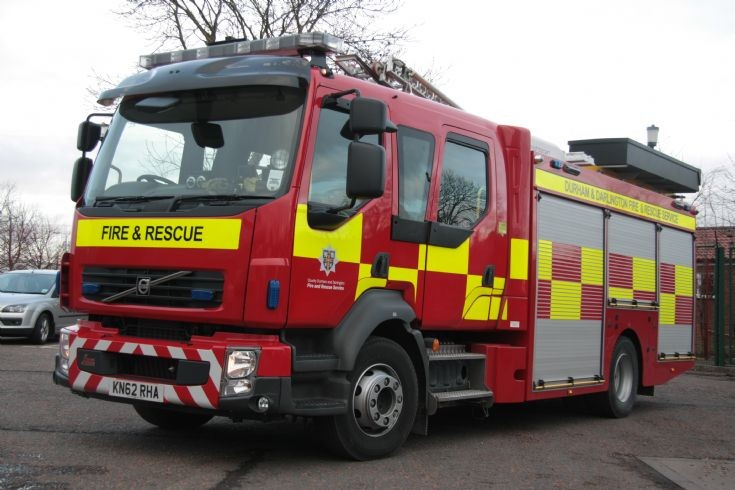
No: 36151 Contributor: Graham Mitchell Year: 2013 Manufacturers: Bence, Volvo Country: United Kingdom
If this unit had a European style body with full height lockers, folding steps and an electric roof rack to carry ladders and suction hoses horizontally, there would be plenty of locker space for chemical suits and probably quite a lot of other additional equipment besides.
If we look at Dutch, Swedish, German and French pumpers on this site in "lockers-open" mode, there are plenty of excellent examples of very comprehensive equipment and ladder stowage solutions. Many of these were developed decades ago.
The British fire service deserves a bit more effort on the part of UK bodybuilders to supply better solutions which are, after all, not brain surgery!
Added by Rob Johnson on 01 October 2013.
If we look at Dutch, Swedish, German and French pumpers on this site in "lockers-open" mode, there are plenty of excellent examples of very comprehensive equipment and ladder stowage solutions. Many of these were developed decades ago.
The British fire service deserves a bit more effort on the part of UK bodybuilders to supply better solutions which are, after all, not brain surgery!
Added by Rob Johnson on 01 October 2013.
Our european friends do not carry as much if indeed any water and do not have to carry a 135/10 m ladder plus other smaller /roof ladders , I think you do our bodybuilders a misservice , I am sure if it was specified when new another stowage method would have been suggested , I agree there are better solutions and I agree that we lag behind on some things but we are up there with the best when it comes to ingenuity and problem solving , and of course some brigades do not want to pay for this type of bodywork, there are also weight issues with electric gantries , all in all I am sure if they were needed they would have been specified
Added by Alan Ramsay on 02 October 2013.
Added by Alan Ramsay on 02 October 2013.
Having served as a Firefighter in the UK and now serving as a Firefighter in Canada, believe me the UK know how to utilise locker space. Some North American departments would do well to take note on use of the lockers to their full potential with better organization.
Added by Adrian Chambers on 02 October 2013.
Added by Adrian Chambers on 02 October 2013.
Rob,
I also think that you do British bodybuilders a bit of injustice. Like all fire engine builders they can can only build within local regulations and standards. This means that many of the solutions you find in Germany, Austria and many other countries in mainland Europe are simply not possible because of e.g. Health & Safety regulations in the UK. Foldable steps below the lockers are not allowed, equipment over a certain weight (I think 15 kg?) is not allowed to be manipulated over shoulder height and many more. So these things limit the bodybuilders and dictate certain designs not commonly seen outside the UK (and countries having similar standards).
I believe they do the best they can within these limits.
Alan,
also here in Austria fire engines often carry between 2000 and 4000 litres of water plus a lot of equipment but I agree with you that those usually do not carry that much ladders. Maybe we have here more variations in types - depending on local needs and what neighboring stations have.
So I think the general organisation of fire fighting services which is based on certain traditions (different ones in different regions) plus local regulations and standards effect the design of a fire engine a lot. One can only specify inside those regulations. Just like it says in the old Rolling Stones song: "You can't always get what you want" (and with budget cuts all over the world a fire fighter must often be happy to get what he needs).
So let's just be happy that there is no single best solution and that we can enjoy such a diversity of fire engines here.
Added by Martin on 03 October 2013.
I also think that you do British bodybuilders a bit of injustice. Like all fire engine builders they can can only build within local regulations and standards. This means that many of the solutions you find in Germany, Austria and many other countries in mainland Europe are simply not possible because of e.g. Health & Safety regulations in the UK. Foldable steps below the lockers are not allowed, equipment over a certain weight (I think 15 kg?) is not allowed to be manipulated over shoulder height and many more. So these things limit the bodybuilders and dictate certain designs not commonly seen outside the UK (and countries having similar standards).
I believe they do the best they can within these limits.
Alan,
also here in Austria fire engines often carry between 2000 and 4000 litres of water plus a lot of equipment but I agree with you that those usually do not carry that much ladders. Maybe we have here more variations in types - depending on local needs and what neighboring stations have.
So I think the general organisation of fire fighting services which is based on certain traditions (different ones in different regions) plus local regulations and standards effect the design of a fire engine a lot. One can only specify inside those regulations. Just like it says in the old Rolling Stones song: "You can't always get what you want" (and with budget cuts all over the world a fire fighter must often be happy to get what he needs).
So let's just be happy that there is no single best solution and that we can enjoy such a diversity of fire engines here.
Added by Martin on 03 October 2013.
I think the generalization about tank capacities is a bit misleading, because design preferences in Europe understandably vary quite a lot from country to country. Although some pumpers do have smaller tanks, on full-size appliances they are usually either 1500 or 1600 liters - and are often combined with a 200 liter foam tank, so in practical terms they are using about as much space as a UK 1800 liter tank.
But many European pumpers do in fact have tanks of 2, 000 to 3, 000 liters, or more - even stretching to 4, 000 liters in Poland.
Regarding the 13.5 meter ladder, I agree such long extensions are not as common, but Paris for example has a 15 meter extension on their FPT, which is an Atego with a 3000 liter tank. It also carries a wide selection of other ladders, including hook ladders, which the BSPP still use!
Many European pumpers do actually carry a 12 or 14 meter extension ladder. Admittedly, these are a lighter design than the British version, but they still work! The light weight of these ladders makes it unnecessary to carry an additional 9 meter ladder, as it just duplicates the role of the longer one. Another reason that the 12/14 ladders are not on every pumper is that aerial ladders are much more commonplace than in the UK, and a lot safer to operate.
The Dutch invented the electric gantry system, which gets at the lighter weight equipment, such as ladders and suctions, up on the roof, while making accessing and restowing this gear very quick and easy. It also avoids making the crew climb up on to the roof to access other items. The full utilization of the entire roof for these items provides more space in the side lockers and frees up additional stowage space behind the tank and above the pump.
The system is widespread now in Germany and northern Europe and is of course very popular on north American pumpers with side-mounted lowering systems. Although not universal, these have been around for thirty years.
I have not looked at Canadian designs, but I do agree many US trucks do not have very well thought-out stowage. Perhaps this is because the apparatus are already quite large and space is not at such a premium. But as they too are called on to perform more tasks, I think we are seeing some improvements. Firms like Rosenbauer in the US are offering some more innovative ideas, because they were and still are the design pioneers in Europe - and have lots of great solutions.
I do not know who W H Bence are, but they are not a fire appliance builder I have heard about, and I agree this bodywork looks as if it was designed down to a cost. Still, it is an improvement on the Leyland Comet which went to Newton Aycliffe when the station first opened! (They started with a brand new Bedford but wrote it off very soon after they began responding to calls!)
Added by Rob Johnson on 03 October 2013.
But many European pumpers do in fact have tanks of 2, 000 to 3, 000 liters, or more - even stretching to 4, 000 liters in Poland.
Regarding the 13.5 meter ladder, I agree such long extensions are not as common, but Paris for example has a 15 meter extension on their FPT, which is an Atego with a 3000 liter tank. It also carries a wide selection of other ladders, including hook ladders, which the BSPP still use!
Many European pumpers do actually carry a 12 or 14 meter extension ladder. Admittedly, these are a lighter design than the British version, but they still work! The light weight of these ladders makes it unnecessary to carry an additional 9 meter ladder, as it just duplicates the role of the longer one. Another reason that the 12/14 ladders are not on every pumper is that aerial ladders are much more commonplace than in the UK, and a lot safer to operate.
The Dutch invented the electric gantry system, which gets at the lighter weight equipment, such as ladders and suctions, up on the roof, while making accessing and restowing this gear very quick and easy. It also avoids making the crew climb up on to the roof to access other items. The full utilization of the entire roof for these items provides more space in the side lockers and frees up additional stowage space behind the tank and above the pump.
The system is widespread now in Germany and northern Europe and is of course very popular on north American pumpers with side-mounted lowering systems. Although not universal, these have been around for thirty years.
I have not looked at Canadian designs, but I do agree many US trucks do not have very well thought-out stowage. Perhaps this is because the apparatus are already quite large and space is not at such a premium. But as they too are called on to perform more tasks, I think we are seeing some improvements. Firms like Rosenbauer in the US are offering some more innovative ideas, because they were and still are the design pioneers in Europe - and have lots of great solutions.
I do not know who W H Bence are, but they are not a fire appliance builder I have heard about, and I agree this bodywork looks as if it was designed down to a cost. Still, it is an improvement on the Leyland Comet which went to Newton Aycliffe when the station first opened! (They started with a brand new Bedford but wrote it off very soon after they began responding to calls!)
Added by Rob Johnson on 03 October 2013.
Also a lot of British brigades are now carring cutting equipment on pumps and ceasing to use specialist rescue tenders
Added by Ian mc on 03 October 2013.
Added by Ian mc on 03 October 2013.
There is already a lot of evidence that fire services worldwide have gradually adopted many of each others' solutions, when they are improvements over "home grown" ideas, and I believe this will continue - to the benefit of firefighters and the public they serve.
Added by Rob Johnson on 03 October 2013.
Added by Rob Johnson on 03 October 2013.
Martin - regarding regulations, I expect these will become more standardized as the EU introduces more common legislation in the future.
But there are no obstacles right now to British fire services buying modern fire trucks with bodies by firms like Rosenbauer, which include all of the features I mentioned. There are a few such British examples on this site, and my belief is that there have not been more of these purchased in the UK because of cost, not regulation.
Ian - concerning the addition of rescue equipment on pumps, the rescue pumper was first developed in Berlin almost twenty years ago, and rescue pumpers have been standard in German city fire services for a very long time. They usually have a 2000 liter tank and a 12 meter ladder. In other countries, rescue pumps come with tanks up to 3200 liters, as well as a full compliment of hoses, ladders and firefighting equipment. There are several examples on this site.
My real concern is that the British fire service seems slow to innovate and unwilling to learn from others' experience, and part of this problem does seem to be linked to a reluctance of authorities to provide adequate funding.
Modern two-axle European fire truck chassis come with a GVW of up to 18 tons and engines up to 330 BHP, so weight is not a major concern - maximizing the practical useable space is the key issue.
Added by Rob Johnson on 04 October 2013.
But there are no obstacles right now to British fire services buying modern fire trucks with bodies by firms like Rosenbauer, which include all of the features I mentioned. There are a few such British examples on this site, and my belief is that there have not been more of these purchased in the UK because of cost, not regulation.
Ian - concerning the addition of rescue equipment on pumps, the rescue pumper was first developed in Berlin almost twenty years ago, and rescue pumpers have been standard in German city fire services for a very long time. They usually have a 2000 liter tank and a 12 meter ladder. In other countries, rescue pumps come with tanks up to 3200 liters, as well as a full compliment of hoses, ladders and firefighting equipment. There are several examples on this site.
My real concern is that the British fire service seems slow to innovate and unwilling to learn from others' experience, and part of this problem does seem to be linked to a reluctance of authorities to provide adequate funding.
Modern two-axle European fire truck chassis come with a GVW of up to 18 tons and engines up to 330 BHP, so weight is not a major concern - maximizing the practical useable space is the key issue.
Added by Rob Johnson on 04 October 2013.
Bence


Added by Rob Johnson on 30 September 2013.