
Upload a Picture
About this Site | Links | Random Pic | Advanced Search
Home | Latest Additions | Contributors
| Visitors
Fire Engine Photos
Veteran firefighters may also be smiling to see the hook ladder. These were invented in France in the 1820s and are still standard equipment on many French pumpers, including every pumper in the BSPP fleet in Paris. They continue to be used because many older buildings have courtyards which are difficult to access with extension ladders and impossible for aerial ladders or platforms.
Indeed, BSPP report two lives saved by separate rescues using hook ladders as recently as this month, so it seems likely they will continue to be on every Paris pumper well into the future.
Added by Rob Johnson on 27 June 2014.
Indeed, BSPP report two lives saved by separate rescues using hook ladders as recently as this month, so it seems likely they will continue to be on every Paris pumper well into the future.
Added by Rob Johnson on 27 June 2014.
Hi Rob! SOP with german one-hose cart is the same! What I dont understand, is why they dont connect the hose to the pump, and then to the hydrant!
Anders F.Sweden.
Added by Anders Fallström on 28 June 2014.
Anders F.Sweden.
Added by Anders Fallström on 28 June 2014.
Anders. The French SOP is to connect the hose to the pump inlet, roll to the hydrant, test the hydrant for flow, then connect the hose to the hydrant. The next length is then connected to the second hydrant outlet or standpipe T outlet and the cart is rolled back to the pump and the second supply hose is connected. Sometimes the hydrant or standpipe design permits the first supply line to be charged before the second supple line is fully connected. Othersise, they are charged at the same time.
Added by Rob Johnson on 04 July 2014.
Added by Rob Johnson on 04 July 2014.
Berliet




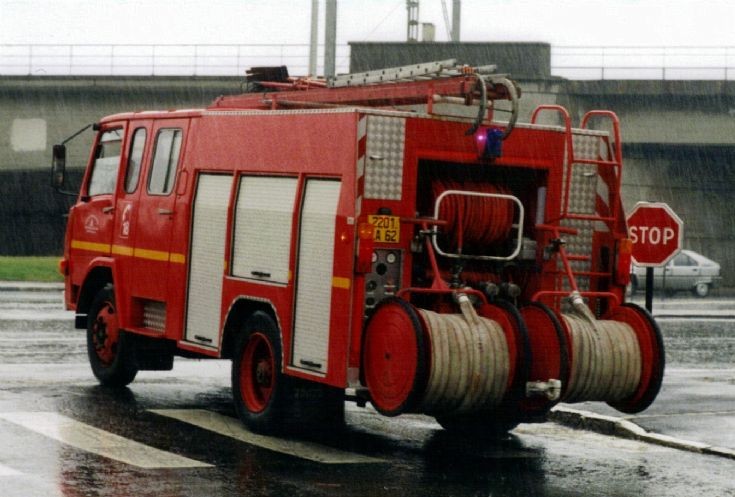
The SOP for hydrant connection is to run one cart to the hydrant, connect to both outlets, and then run it back to the pump to provide dual supply lines. (Unless of course it is a single outlet pillar type), At the same time, another crew member can run out the first attack line with the other cart.
Similar carts are used in Belgium, Germany, the Netherlands, Monaco, Austria, Switzerland, Chile and many former French colonies. In Japan, a four wheeled cart is favored, which carries flaked hoses: some of the larger ones are electrically-powered ride-on versions complete with lights and their own warning horns.
Added by Rob Johnson on 13 June 2014.