
Upload a Picture
About this Site | Links | Random Pic | Advanced Search
Home | Latest Additions | Contributors
| Visitors
Fire Engine Photos
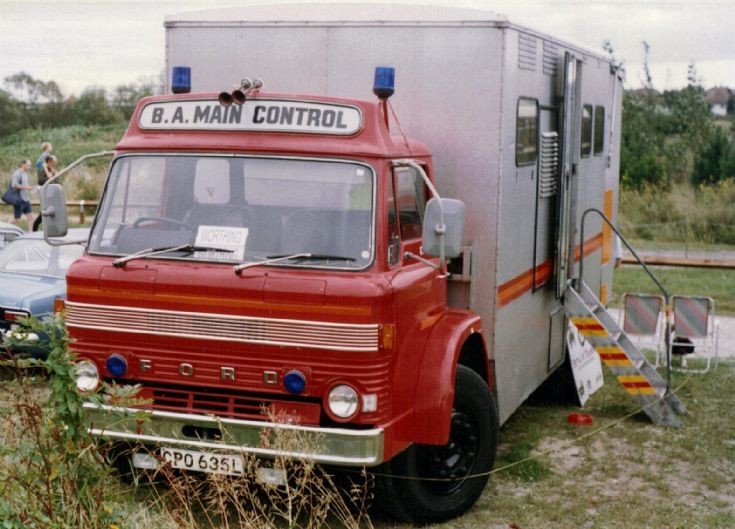
Its a D2817, there was a Mobile BA Training Unit, which it towed to RDS Stations for training purposes, there was three of
these BACUs, CPO 635-7L.
Added by M.west on 25 April 2019.
these BACUs, CPO 635-7L.
Added by M.west on 25 April 2019.
Ford nomenclature designated the GVW in the first two letters and BHP in the second two. The maximum permitted GVW in the UK when this was built was 16 tons, and these had the Perkins V8 170 BHP engine - hence 1617.
I worked in sales and marketing in Ford of Britain Truck Division at the time, so I do know whereof I speak, as the saying goes. By the way, I also worked on the D series fire appliance SVO program and sold the first D series fire appliances to Gloucestershire. These, with HCB Angus bodies, are in several photos on this site, and had the older original D600 nomenclature, which indicated a 6 ton payload, rather than GVW, which was originally 10, then either 13 or 16 on later versions.
Added by Rob Johnson on 25 April 2019.
The plate on the OIC Door says D2817 Custom Cab, i rode on CPO 637L many times, i have a photo which shows the D2817 badge.
Added by M.west on 29 April 2019.
Added by M.west on 29 April 2019.
I wonder how that badge got there? It was only supposed to be factory installed on tractor units, as I already explained. The newly introduced 1967 16 ton "D 1000" indicated a 10 ton payload on that chassis - which was just about possible, depending of course on the bodywork.
Lancashire bought a lot of D1617 water tenders, but we then offered the Perkins V8 in a 13 ton variant as our principal SVO water tender fire appliance chassis (D1317), and it largely replaced both the 1617 and the 1014, which had the Ford 300 CID turbo diesel engine. A few 1617 were still supplied for aerial appliances, foam pumpers and tankers, as well as some other specials.
The same Perkins V8 was also used in fire appliance chassis by Dennis, Dodge, ERF and Shelvoke at the same time as well as by Ford.
My point was that - regardless of the weird badge - a 16 ton chassis was a comparative heavyweight in the role of a BA tender back in those days.
Added by Rob Johnson on 30 April 2019.
Hi Rob, Been reading your threads regarding the West Sussex Fire Brigade BACUs. Yes you obviously know your onions so to speak being a Ford representative. These were indeed D2817 chassis and payload. The reason these were specified on this payload was as Mr West suggested they towed a heavy Duty smoke training trailer, l understand the brigade had five of which were by special order three Breathing Apparatus Control Units and two Mobile Workshops Units. I, like yourself wondered about the payload being Sixteen ton but Ron Hall corrected me and said they were special orders on this rigid chassis hence D2817 The mobile Workshops were a very similiar specification but l believe slightly longer chassis. This was done also for their towing capacity as they could be used for breakdown recovery of appliances, and if my memory serves me correct towed in a Hydraulic Platform at one breakdown! I did work in Workshops at one stage and being the anorak l am used to collect memorabilia and l do have the Workshop TMO Slips which gives spec on the vehicles and other intimate details. I will photo them when l have a moment if it satisfactorily concludes this minor difference regards.....
Added by BOB CARVER on 29 August 2020.
Added by BOB CARVER on 29 August 2020.
28 tons refers to the gross train weight, which is the combination of the maximum truck gross weight plus the maximum gross weight of the trailer. The actual truck itself had a gross vehicle weight of 16 tons, with a further allowance of 12 tons for the trailer. All D1617s had the ability to tow a maximum of 12 tons, but were not normally badged 2817, as this designation was reserved for articulated tractors.
Added by Rob Johnson on 29 August 2020.
Added by Rob Johnson on 29 August 2020.
Thank you Bob Carver for clearing this up!
Added by on 31 August 2020.
Added by on 31 August 2020.
Have you considered that this may be a conversion from artic to rigid, by an specialist firm?, hopefully Mr Carver may find the documentation.
Added by M.West on 31 August 2020.
Added by M.West on 31 August 2020.
as I can remember it was a long time ago, they were indeed an artic unit with two speed axle all capable of heavy towing workshops the same
Added by J Clevett on 01 September 2020.
Added by J Clevett on 01 September 2020.
Thanks for that, i thought they had a 2 speed rear axle, but it was a long time ago, when I rode on the Chichester machine, do you remember Boyd at Worthing had one of MWS, also the other was at Horsham, cannot remember his name, had a beard always wore a flat cap, think the registrations where HOR 998N & GCR 991N?
Added by M.West on 02 September 2020.
Added by M.West on 02 September 2020.
hi folks the other fitter at 01 a div was john bishop, small piece of info on the compressor side it had duel drive electric motor for station use on a power line and hydraulic drive from gearbox power take off for out on the jobs,
Added by J Clevett on 02 September 2020.
Added by J Clevett on 02 September 2020.
As I suspected there was a 28 ton rigid drawbar option. From the excellent Commercial Motor Archive online-
"The recent legislation allowing single manning of drawbar units by a Class III hgv licence holder has prompted Ford to market in the UK its 28-ton drawbar package which has been available on the Continent for some time.
Two models have been introduced, by the company's Special Vehicle Orders Department at Langley; they are based on the D1616 four-wheeled 16-ton rigid vehicle with the engines and running gear taken from the 28-ton tractive units.
The D2817 is fitted with the Perkins 8-511 170 bhp engine while the D2818 has the Cummins 504 engine developing 177 bhp. Both options are available in wheelbase lengths of 159in., 179in., 206in. and 226in. and all feature the Ford 8-570-S eight-speed, all-synchromesh transmission, Eaton 9800 type 225 rear axle and front towing jaw and pin. In addition, the towing equipment comprises a Neate jaw or hook and the necessary air-brake and electrical connections.
The drawbar units can be ordered in the normal way through Ford truck specialist dealers, quoting SVO Option No. 2793."
Added by CraigW on 04 September 2020.
Forgot to say the Commercial Motor article on D2817 rigid drawbar was dated 14th January 1972
Added by CraigW on 04 September 2020.
Added by CraigW on 04 September 2020.
Well done CraigW, so the chaps at Langley, did not fit the wrong badge after all.
Added by M.West on 05 September 2020.
Added by M.West on 05 September 2020.
No they did not, surprising how much debate a badge can generate but very interesting all the same. I do take Robs point that 28 tons gross is a big spec. For a BA tender! However the comments above explain why. I do think the Ford D Series gets a bit overlooked in the classic world, possibly because of their ubiquity but believe they were a good truck in their time.
Added by CraigW on 06 September 2020.
Added by CraigW on 06 September 2020.
Ford


Added by Rob Johnson on 22 April 2019.