
Upload a Picture
About this Site | Links | Random Pic | Advanced Search
Home | Latest Additions | Contributors
| Visitors
Fire Engine Photos
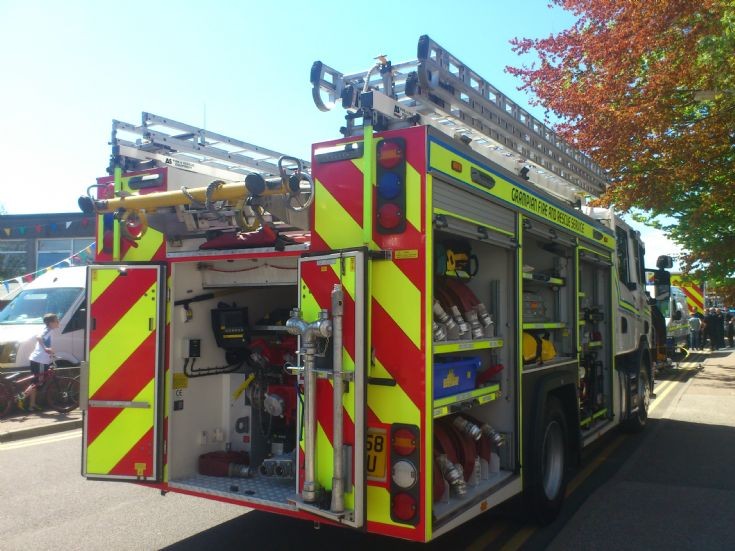
Grampian FRS Scania SV58ASU
All on show! Ellon open day 25/5/13.
See also

All on show! Ellon open day 25/5/13.
See also
This picture is in the following groups
Grampian Fire and Rescue Services, United Kingdom
Grampian Fire and Rescue Services, United Kingdom
For decades it has been usual to mount the hose reel at the rear above the pump, in cases where a truck was equipped with only a single reel. This made it easier and faster to deploy the reel to either side or to the rear. In Sweden, even pumps with dual reels usually have have them installed at the rear. It seems odd that this service did not follow suit.
Added by Rob Johnson on 18 June 2013.
Added by Rob Johnson on 18 June 2013.
In Tayside all our newer Scania Rp's, the hosereels are in the middle top lockers with the hose underneath execept for the latest 2 62 plates which have only 1 hosereel in the nearside middle locker with the offside empty so they can carry water rescue gear. Both are 1st aways at Station 11 Dundee (Kingsway East)and Staion 21 Perth which both are the water rescue Stations.
Iv'e still to get photos of both.
Added by Grant Melville on 19 June 2013.
Iv'e still to get photos of both.
Added by Grant Melville on 19 June 2013.
A powered roof rack for the 13.5 meter ladder would free up space above the pump for the inclusion of a hose reel in the pump bay. This is because the ladder does not need to be angled down at the rear to facilitate access.
This arrangement is common practice in many European fire services, leaving extra space in both side lockers for any other useful equipment which needs to be carried. It also allows space for a larger tank if needed - some are as much as 3600 liters.
It is also common practice for the secondary ladders to be included on the rack, so everything can be more easily accessible and quicker to restore.
Added by Rob Johnson on 08 July 2013.
This arrangement is common practice in many European fire services, leaving extra space in both side lockers for any other useful equipment which needs to be carried. It also allows space for a larger tank if needed - some are as much as 3600 liters.
It is also common practice for the secondary ladders to be included on the rack, so everything can be more easily accessible and quicker to restore.
Added by Rob Johnson on 08 July 2013.
Humberside tried with their first batch of Rapiers to have the 13.5m ladder flat on the roof on a beam gantry - albeit it was 'mandrolic' as opposed to powered and resulted in a very ugly back end and the ladder was a nightmare to ship and unship - you don't seem to take into account Rob, the centre of gravity issues of stowing kit high up or carrying half as much water again ?
Everything nowadays seems to have to be 'high tec' - powered gantrys are fine when and if they work - just like electronic tank contents gauges but, when they fail, or one second show quarter full and the next empty they are a liability - whats wrong with 'low tech' ? such as ladders that are on rollers and ping pong balls in a tube of water ?
Added by Rick Loudon on 08 July 2013.
Everything nowadays seems to have to be 'high tec' - powered gantrys are fine when and if they work - just like electronic tank contents gauges but, when they fail, or one second show quarter full and the next empty they are a liability - whats wrong with 'low tech' ? such as ladders that are on rollers and ping pong balls in a tube of water ?
Added by Rick Loudon on 08 July 2013.
Rick - the powered roof racks for ground ladders and suction hoses have been used for around twenty years now in Germany and the Netherlands without any known reliability problems, to the point where they are standard now.
As for tanks, reinforced polyethelene plastics now enable them to be shaped and baffled, so that the center of gravity can be concentrated as low as possible. Regarding gauges, it is now commonplace to have multicolored "idiot lights" on pumpers here in the US, so that the company officer, the nozzle man, the pump operator and anyone else who is interested can see how fast the tank is emptying out.
Regarding high stowage, European fire services routinely place all heavy equipment low down in the lockers, on slide out trays, so that lots of the lighter items like ladders can go high up on the roof. A Rosenbauer 14 meter ladder weighs 89 KG, which is not much weight to put on the top of a truck with a GVW of typically 14 tons.
Almost all European and British pumpers are 14 ton GVW these days, and many are 18 tons. This compares with the 10 ton GVWs of most fire pumps in the 1960s and 1970s They are actually designed to carry much more weight - but the 1800 liter "pump water tender" tank specification goes all the way back to 1949, when the new generation of fire engines like the Bedford and Commer were designed for a gross weight of around nine tons!
Added by Rob Johnson on 08 July 2013.
As for tanks, reinforced polyethelene plastics now enable them to be shaped and baffled, so that the center of gravity can be concentrated as low as possible. Regarding gauges, it is now commonplace to have multicolored "idiot lights" on pumpers here in the US, so that the company officer, the nozzle man, the pump operator and anyone else who is interested can see how fast the tank is emptying out.
Regarding high stowage, European fire services routinely place all heavy equipment low down in the lockers, on slide out trays, so that lots of the lighter items like ladders can go high up on the roof. A Rosenbauer 14 meter ladder weighs 89 KG, which is not much weight to put on the top of a truck with a GVW of typically 14 tons.
Almost all European and British pumpers are 14 ton GVW these days, and many are 18 tons. This compares with the 10 ton GVWs of most fire pumps in the 1960s and 1970s They are actually designed to carry much more weight - but the 1800 liter "pump water tender" tank specification goes all the way back to 1949, when the new generation of fire engines like the Bedford and Commer were designed for a gross weight of around nine tons!
Added by Rob Johnson on 08 July 2013.
Oh Rick music to my ears! Lets go the whole hog and let folk climb up on the machines roof again. There has got to be a limit to the amount of gadgetry. And room for tried and tested, cheaper methods of appliance design and usage.
I would love to see, though I doubt it will ever happen, a modern day crew slip a wheel escape, or use a hook ladder. Then realise actually what good pieces of kit they were and how effective.
Whilst all for safer and more efficient methods, I agree gadgets have taken over. As have appliances that resemble Christmas trees and sound like constipated elephants. Showing my age? Yes, I drove machines with bells :)
Added by John Stott on 08 July 2013.
I would love to see, though I doubt it will ever happen, a modern day crew slip a wheel escape, or use a hook ladder. Then realise actually what good pieces of kit they were and how effective.
Whilst all for safer and more efficient methods, I agree gadgets have taken over. As have appliances that resemble Christmas trees and sound like constipated elephants. Showing my age? Yes, I drove machines with bells :)
Added by John Stott on 08 July 2013.
No matter what shape it is or level its carried at.....half as much more water still weighs half as much again ! yes heavy equipment should be carried lower down on the vehicle - ladders are not particulary heavy as you say - but there is nothing more simpler than sets of rollers and gravity (which is free) to unship a ladder - 'idiot lights'? I 'm not sure thats the right terminology to use ? - they regularly fail or, as I said in my previous post one second show quarter full and the next empty ! - again with a ball in a tube of water a pump operator with 30 years experience or one hours worth could tell immediatly the contents left in the appliance tank !
I agree appliances of today are built to carry more weight (and in some cases more crew - maxi pumps) - generally because they are an adapted commercial chassis - as were Bedfords and Commers - as for the 'JCDD' specs they are being eroded away/removed and where previously manufacturers automatically knew what had to be mandatorily adhered to such as tank capacity - maximum weight with crew and equipment is now being forgotten (The CARPS were an example in S Yorks and Humberside weighing in at the maximum on delivery but no one thought about water, crew and equipment being added later - this resulted in excuses - blame and expensive alterations ! )
Dare I suggest that these 'expensive gadgets' tank gauges. powered gantrys, etc etc are built in by the manufacturer 'as standard' so the cost is in the price - if a transport officer dares to question the neccessity of them ? the answer will be 'well its standard fitment and it will cost you more to remove that electronic tank system and retro fit a ball in a tube' so the end result is you get an appliance delivered that the crews are not comfortable with and is failing more often than not ?
I'm not a dinosaur and am all for change but please let it be change for the good and not change solely to put money in the manufactures bank account !
Finally I recently spoke to one of the few remaining proper brigade engineers - a very well respected man - he said 'Rick - with the manual handling regs I'm waiting for someone to suggest we fit a set of 'Big wheels' to a 13.5 m ladder to make it easier for crews to move them around safely !'
Added by Rick Loudon on 09 July 2013.
I agree appliances of today are built to carry more weight (and in some cases more crew - maxi pumps) - generally because they are an adapted commercial chassis - as were Bedfords and Commers - as for the 'JCDD' specs they are being eroded away/removed and where previously manufacturers automatically knew what had to be mandatorily adhered to such as tank capacity - maximum weight with crew and equipment is now being forgotten (The CARPS were an example in S Yorks and Humberside weighing in at the maximum on delivery but no one thought about water, crew and equipment being added later - this resulted in excuses - blame and expensive alterations ! )
Dare I suggest that these 'expensive gadgets' tank gauges. powered gantrys, etc etc are built in by the manufacturer 'as standard' so the cost is in the price - if a transport officer dares to question the neccessity of them ? the answer will be 'well its standard fitment and it will cost you more to remove that electronic tank system and retro fit a ball in a tube' so the end result is you get an appliance delivered that the crews are not comfortable with and is failing more often than not ?
I'm not a dinosaur and am all for change but please let it be change for the good and not change solely to put money in the manufactures bank account !
Finally I recently spoke to one of the few remaining proper brigade engineers - a very well respected man - he said 'Rick - with the manual handling regs I'm waiting for someone to suggest we fit a set of 'Big wheels' to a 13.5 m ladder to make it easier for crews to move them around safely !'
Added by Rick Loudon on 09 July 2013.
I love the old kit too - but I live in a home with central heat and airconditioning, two HD TVs a microwave, a dishwasher, a PC, a Bose radio, I-phones, an I-Pad and a Kindle.
When I had my heart attack, it took 45 minutes to put in a stent and I went home the next day!
Oh how I pine for my cold walk-up flat, black and white TV, red phone boxes (with broken phones) and the chances for good old-fashioned open-heart surgery.
Added by Rob Johnson on 09 July 2013.
When I had my heart attack, it took 45 minutes to put in a stent and I went home the next day!
Oh how I pine for my cold walk-up flat, black and white TV, red phone boxes (with broken phones) and the chances for good old-fashioned open-heart surgery.
Added by Rob Johnson on 09 July 2013.
I see both sides to this argument, BUT in each case of "improvement" it should come down to which method allows the Fire Fighter to either rescue a person quicker or put out a fire faster. That is what should dictate equipment/design used.
Added by Andy on 22 July 2013.
Added by Andy on 22 July 2013.
Agreed, Andy.
Lets also include firefighter safety. An injured firefighter cannot get the job done and may often divert other members from the primary task at hand.
As traffic conditions and the widespread use of hydrocarbons and toxic chemicals have made the job so much more dangerous, a lot of new ideas to improve safety have emerged - and we should all hope these innovations will continue to be embraced as quickly as possible by fire aithorities everywhere.
Added by Rob Johnson on 23 July 2013.
Lets also include firefighter safety. An injured firefighter cannot get the job done and may often divert other members from the primary task at hand.
As traffic conditions and the widespread use of hydrocarbons and toxic chemicals have made the job so much more dangerous, a lot of new ideas to improve safety have emerged - and we should all hope these innovations will continue to be embraced as quickly as possible by fire aithorities everywhere.
Added by Rob Johnson on 23 July 2013.
Rob
I think your comparison of 'open heart surgery or a stent being fitted' is a liitle severe ! of course there are always improvements that can be (and are) made - but it is a foolish 'surgeon' who would fit something into a human body knowing its not as reliabe as earlier methods until proven ! (thats why we have things called 'clinical trials'in this country!) - a lot of the 'gadgetry' thats fitted nowadays is without any consultation with the 'end user' in your terms ! hence the reason why things are either not liked or mistrusted - because they are not reliable !
Its a fact though - two things that I can see no reason to change are both reliant on the laws of gravity (which again will never change) i.e rollers to ship/unship ladders and a ping pong ball in a tube of water ! - they hardly ever fail, give a far better indication of the tank contents and, in the event of failure can be fixed with the brigade mechanic with such high tech tools as, a big hammer , a tin of oil, and a rag on a bit of hose wire - oh and maybe at great expense a new ping pong ball !
But yes , lets go the whole hog and grow beards to stuff in our mouths - so we can do away with breathing apparratus and get rid of motor appliances and go back to horses !
Added by Rick Loudon on 23 July 2013.
I think your comparison of 'open heart surgery or a stent being fitted' is a liitle severe ! of course there are always improvements that can be (and are) made - but it is a foolish 'surgeon' who would fit something into a human body knowing its not as reliabe as earlier methods until proven ! (thats why we have things called 'clinical trials'in this country!) - a lot of the 'gadgetry' thats fitted nowadays is without any consultation with the 'end user' in your terms ! hence the reason why things are either not liked or mistrusted - because they are not reliable !
Its a fact though - two things that I can see no reason to change are both reliant on the laws of gravity (which again will never change) i.e rollers to ship/unship ladders and a ping pong ball in a tube of water ! - they hardly ever fail, give a far better indication of the tank contents and, in the event of failure can be fixed with the brigade mechanic with such high tech tools as, a big hammer , a tin of oil, and a rag on a bit of hose wire - oh and maybe at great expense a new ping pong ball !
But yes , lets go the whole hog and grow beards to stuff in our mouths - so we can do away with breathing apparratus and get rid of motor appliances and go back to horses !
Added by Rick Loudon on 23 July 2013.
No-one has suggested we should embrace technology that does not work. My point is that some of the innovations seen on appliances from overseas have actually been proven to work well for a decade or more.
Think about a rescue job at night when half the first due pump crew are on a ladder and the other half are inside with a hosereel. If the OIC can see the tank contents in the dark from fifty feet away, why have the DPO - who is needed to foot the ladder - standing around the pump panel peering at a ping pong ball?
Added by Rob Johnson on 23 July 2013.
Think about a rescue job at night when half the first due pump crew are on a ladder and the other half are inside with a hosereel. If the OIC can see the tank contents in the dark from fifty feet away, why have the DPO - who is needed to foot the ladder - standing around the pump panel peering at a ping pong ball?
Added by Rob Johnson on 23 July 2013.
If by DPO you mean designated pump operator - then I really need to go no further ! thats the job of a pump operator - not to foot ladders ! I would NEVER leave a pump with a crew committed in a fire situation - as I also previously said one minute the lights on showing quarter full the next its off and hey presto no water !! - what is the oic going to do from 50 yards away when a pump delivery needs shutting down immediatly because a branch has gone out of control for example ? - which delivery is feeding who ?? hence the 'designated pump operator' who has been monitoring the situation !
Added by Rick Loudon on 23 July 2013.
Added by Rick Loudon on 23 July 2013.
Modern pumps have automatic controls and modern firemen have radios. More dratted hi-tech!
Added by Rob Johnson on 23 July 2013.
Added by Rob Johnson on 23 July 2013.
sorry to butt in, but if "half of the crew are inside with the hose reel "I would consider it rather foolish to leave a pump without an operater I have experianced several jobs with myself and crew members being caught out with air locks and burst couplings and without an operater to rectify these problems as soon as they occur that is when firefighters are lost ! I agree with a lot of the new inovations in machine design but not when good firemanship is thrown out with the old designs !I have to agree with the fact the simple deigns are the best as there is less to go wrong and all designs should be run passed the operational firefighters before they are rubber stamped .This could have avoided the debacle of the CARPS (in several counties )and saved the tax payers millions
Added by Dave Elms on 23 July 2013.
Added by Dave Elms on 23 July 2013.
The other analogy was the method of obtaining the correct priming speed on the old (F7 F8 F12) pumps. A metal bracket with a circular disc fixed to the throttle lever....to get priming speed all you had to do was to press on the disc which caused the throttle to open so far...thus setting the priming speed.....a foolproof idea which worked well.....now a microprocessor does a similar job ... a glitch in the system an you are goosed !!!!!
Added by Barrie Green on 23 July 2013.
Added by Barrie Green on 23 July 2013.
The danger of unmanned pump controls? For Tacr 1 familiars, the horrible rear seat meant most RAF crews operating these with a crew of two. Men refused to ride these machines in the rear seat, "Crash 1" traditionally had a crew of two anyway. The pump engaged both crew would run out lines and engage in rescue and firefighting. The hand throttle was an in cab affair, held at given revs by no more than a hacksaw blade type of gadget. Vibration often meant the hand throttle disengaged whilst pumping. Result, two men committed and no medium at the branch. a rare occurrence? No. Moral obvious to me. Pump operator stays with pump controls, whatever the situation. That man is crucial, his role the most important on a fire ground.
I could go on, I actually left retained service when it was "deemed" safe to man a pump with three crewmen. That was the final straw for me. I saw two fire strikes, Glasgow in 1973, then the national in 1977. The risks taken by all were unacceptable, even to my eyes.
We get branded as luddites, as Dave rightly points out, Carps are an example, a good one. Tradition is founded on experience IMHO. A well known southern brigade spent £5000 a pop having pump cab roofs sprayed white a few years ago, then starts closing retained stations for budget reasons. The list is endless. Keep it simple, risk is a part of the job, it always will be, there is no reason to keep reinventing the round wheel.
Added by John Stott on 24 July 2013.
I could go on, I actually left retained service when it was "deemed" safe to man a pump with three crewmen. That was the final straw for me. I saw two fire strikes, Glasgow in 1973, then the national in 1977. The risks taken by all were unacceptable, even to my eyes.
We get branded as luddites, as Dave rightly points out, Carps are an example, a good one. Tradition is founded on experience IMHO. A well known southern brigade spent £5000 a pop having pump cab roofs sprayed white a few years ago, then starts closing retained stations for budget reasons. The list is endless. Keep it simple, risk is a part of the job, it always will be, there is no reason to keep reinventing the round wheel.
Added by John Stott on 24 July 2013.
Thankfully others are seeing my side of the argument Rob, - I'm not trying to be deliberately argumentative nor am I a 'dinosaur or luddite' as mentioned but not implied by John - simply some things are best left as they are - whilst many warrant improvement ! - however your comments about 'modern firemen and modern pumps are possibly a little provocative ??
You seem to be talking from a'salesmans position' whilst I (and others) are the 'end users' in your parlance !
I was a 'modern fireman' serving 32 years and retiring in 2008 on a busy station - 3 pumps, ET, TL or HP and at one stage a Foam Tender and Rescue tender as well - we embraced much modern kit - some was asked for but a great amount was pushed towards us with absolutley no consultation with the crews that were expected to use them !
You quote 'modern firemen and modern pumps' - how many 'modern firemen' stand with a leg against an incoming pressure fed supply hose monitoring by feel the incoming supply ? and able to detect and react immediatly to any change of pressure up or down ? but modern pumps have 'idiot lights 'as tank gauges and LED displays that you cannot read when the sun or water or dirt is on the screen ! - you quote radios as 'dratted high tech'- really !!!
I reiterate its my belief much is being pushed by manufacturers ' as standard fitment' and 'too expensive to retro fit rollers and sight tubes' - lets be honest - the manufacturers are in it to make money nothing more nothing less !
I really would like to close this discussion at this point before the eds tell us 'to continue by private email' That is however, the choice of other contributors (and the eds)
Added by Rick Loudon on 24 July 2013.
You seem to be talking from a'salesmans position' whilst I (and others) are the 'end users' in your parlance !
I was a 'modern fireman' serving 32 years and retiring in 2008 on a busy station - 3 pumps, ET, TL or HP and at one stage a Foam Tender and Rescue tender as well - we embraced much modern kit - some was asked for but a great amount was pushed towards us with absolutley no consultation with the crews that were expected to use them !
You quote 'modern firemen and modern pumps' - how many 'modern firemen' stand with a leg against an incoming pressure fed supply hose monitoring by feel the incoming supply ? and able to detect and react immediatly to any change of pressure up or down ? but modern pumps have 'idiot lights 'as tank gauges and LED displays that you cannot read when the sun or water or dirt is on the screen ! - you quote radios as 'dratted high tech'- really !!!
I reiterate its my belief much is being pushed by manufacturers ' as standard fitment' and 'too expensive to retro fit rollers and sight tubes' - lets be honest - the manufacturers are in it to make money nothing more nothing less !
I really would like to close this discussion at this point before the eds tell us 'to continue by private email' That is however, the choice of other contributors (and the eds)
Added by Rick Loudon on 24 July 2013.
Rick - there really is no arguement, so lets do just that. I only suggested that "a powered roof rack would free up space" on this rig and thereby facilitate a more logical location for the hose reel - or possibly enable two reels to be installed, as on most British pump appliances.
As you mentioned, "powered gantries are fine if and when they work", and I completely agree with you. Of course I would not suggest intentionally installing a feature which would not work and had not already been tested in everyday use by hundreds of firefighters for well over ten years in several different European countries.
On the broader question of changes in technology, I have not at any time suggested anything should be adopted by fire services anywhere which is not practical, helpful, useful, reliable and already fully tested.
I am not selling anything. For the record, the last fire engines I sold were the eleven Ford D Series sold to Gloucestershire in 1966! But there is actually quite a lot of innovative technology which is becoming everyday in various places - and I am always interested to see how fire services take advantage of new ideas.
If you don't like the way fire trucks are being built and used in places like Europe or the US, that's perfectly fine. Not everything they do translates into being appropriate for conditions in the UK, but that is not what I am advocating.
By the way, I am also an "end user", although not a voluntary one! Some years ago, I needed to help pull a 1.75 inch crosslay around the back of my own house, after trying to douse a fire with two dry powder extinguishers and a garden hose - and the local volunter department finally showed up with one engine crewed by three men.
Added by Rob Johnson on 25 July 2013.
As you mentioned, "powered gantries are fine if and when they work", and I completely agree with you. Of course I would not suggest intentionally installing a feature which would not work and had not already been tested in everyday use by hundreds of firefighters for well over ten years in several different European countries.
On the broader question of changes in technology, I have not at any time suggested anything should be adopted by fire services anywhere which is not practical, helpful, useful, reliable and already fully tested.
I am not selling anything. For the record, the last fire engines I sold were the eleven Ford D Series sold to Gloucestershire in 1966! But there is actually quite a lot of innovative technology which is becoming everyday in various places - and I am always interested to see how fire services take advantage of new ideas.
If you don't like the way fire trucks are being built and used in places like Europe or the US, that's perfectly fine. Not everything they do translates into being appropriate for conditions in the UK, but that is not what I am advocating.
By the way, I am also an "end user", although not a voluntary one! Some years ago, I needed to help pull a 1.75 inch crosslay around the back of my own house, after trying to douse a fire with two dry powder extinguishers and a garden hose - and the local volunter department finally showed up with one engine crewed by three men.
Added by Rob Johnson on 25 July 2013.
Editor : And with this last comment we will end the discussion.
Added by Marcel Sloover on 25 July 2013.
Added by Marcel Sloover on 25 July 2013.
Scania


Added by Mark whiteley on 18 June 2013.