
Upload a Picture
About this Site | Links | Random Pic | Advanced Search
Home | Latest Additions | Contributors
| Visitors
Fire Engine Photos
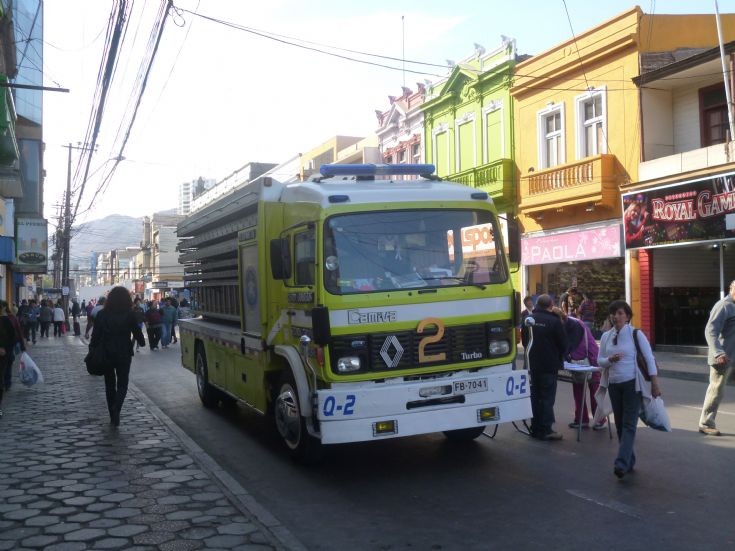
No: 34614 Contributor: Francisco Perez Flores Year: 2013 Manufacturers: Camiva, Renault Country: Chile
They are still buying them. Rosenbauer supplied one to Chile on an American chassis last year. The mystery is that most Chilean pumpers now carry a European-style complement of ground ladders, so you would think these rigs are superfluous.
I think their disapperance from the US was at least partly influenced by NFPA. They give a department credit for having an aerial, but not for having a city service ladder truck. Quite a few small departments operate aerials (often very old second-hand units) which they don't really ever use as aerials, just to meet the NFPA criterion.
Added by Rob Johnson on 02 May 2013.
I think their disapperance from the US was at least partly influenced by NFPA. They give a department credit for having an aerial, but not for having a city service ladder truck. Quite a few small departments operate aerials (often very old second-hand units) which they don't really ever use as aerials, just to meet the NFPA criterion.
Added by Rob Johnson on 02 May 2013.
Interesting comment about NFPA. I remember reading (on this site?) about a regulation in Germany that requires an aerial device in any town with any buildings over a given height. Many German towns have no tall buildings at all, except for the church steeple. These towns, of course, must have aerial devices. (Comment: This must provide lots of turntable-ladder revenue to Metz and Magirus...)
Added by Michael Feldman on 02 May 2013.
Added by Michael Feldman on 02 May 2013.
The only German long extension ladders, comparable to the British 50-foot "escape", were very cumbersome 15 to 18 meter trailer ladders, which required up to eight men to operate.
In the 1920s and 1930s Metz and Magirus were very aggressive selling aerials to departments to replace these, and they had a lot of success. A lot of these earlier aerials were 18, 22, 25 or 27 meters (58 to 88 feet).
Step two in the marketing effort was to replace this generation of ladders after WWII with 30 or 32 meter ladders, although recently some German departments have gone back to specifying shorter ones because they are more manuverable.
German fire services are organized separately in each State ("Land"), so the laws governing what apparatus has to show up vary somewhat. The basic rule for any structure fire is 16 members (same as NFPA requirement) within 12 minutes.
Most large city departments include an aerial in all structure first alarm assignments, but I do not know if it legislation or more a matter of custom. Few Geram pumps carry any ground ladder over 12 meters (39 feet) and most are only 8 or 10.
Added by Rob Johnson on 03 May 2013.
In the 1920s and 1930s Metz and Magirus were very aggressive selling aerials to departments to replace these, and they had a lot of success. A lot of these earlier aerials were 18, 22, 25 or 27 meters (58 to 88 feet).
Step two in the marketing effort was to replace this generation of ladders after WWII with 30 or 32 meter ladders, although recently some German departments have gone back to specifying shorter ones because they are more manuverable.
German fire services are organized separately in each State ("Land"), so the laws governing what apparatus has to show up vary somewhat. The basic rule for any structure fire is 16 members (same as NFPA requirement) within 12 minutes.
Most large city departments include an aerial in all structure first alarm assignments, but I do not know if it legislation or more a matter of custom. Few Geram pumps carry any ground ladder over 12 meters (39 feet) and most are only 8 or 10.
Added by Rob Johnson on 03 May 2013.
I have said on here before that at least in Santiago they ladder the fire building with a lot more ladders than most of the world. I think if you check these "Q" units carry more ground ladders than North American Ladder Trucks do.
One advantage is more of the smaller ladders that do not take more than two or three people to carry and set up.
Added by Les Davis on 03 May 2013.
One advantage is more of the smaller ladders that do not take more than two or three people to carry and set up.
Added by Les Davis on 03 May 2013.
I have seen these Santiago videos, too. The mystery is why they festoon every building with so many ground ladders?
All of the videos I have seen involve firefighters piling numerous ladders against the sides of single and two story buildings, most of which are not being used, nor likely to be.
Its almost as if they have an SOP, whch may make sense if you have a three or four floor multi-occupancy structure fire in the middle of the night. But is not very relevant if you have a fire in a single story bodega which is already venting, and it just diverts members from contributing to actual firefighting.
Older Chilean urban pumpers carried very few gound ladders - just as in the US - but pictures of units currently in operation show that most carry two or three, meaning that a typical structure fire first assignment would seem to be sufficiemtly well provided for. Personally I think it is no more than a longstanding tradition, although I have noticed some of the newer ladder carriers are lettered "rescate" - implying a rescue equipment content and a rescue function - and carry fewer ladders.
I think what we are seeing is a gradual transition to a fleet composition, which is trending towards a mix of capabilities which is more like most European countries - where the dedicated ladder carrier is long since gone.
Added by Rob Johnson on 04 May 2013.
All of the videos I have seen involve firefighters piling numerous ladders against the sides of single and two story buildings, most of which are not being used, nor likely to be.
Its almost as if they have an SOP, whch may make sense if you have a three or four floor multi-occupancy structure fire in the middle of the night. But is not very relevant if you have a fire in a single story bodega which is already venting, and it just diverts members from contributing to actual firefighting.
Older Chilean urban pumpers carried very few gound ladders - just as in the US - but pictures of units currently in operation show that most carry two or three, meaning that a typical structure fire first assignment would seem to be sufficiemtly well provided for. Personally I think it is no more than a longstanding tradition, although I have noticed some of the newer ladder carriers are lettered "rescate" - implying a rescue equipment content and a rescue function - and carry fewer ladders.
I think what we are seeing is a gradual transition to a fleet composition, which is trending towards a mix of capabilities which is more like most European countries - where the dedicated ladder carrier is long since gone.
Added by Rob Johnson on 04 May 2013.
Camiva


Added by Michael Feldman on 02 May 2013.