
Upload a Picture
About this Site | Links | Random Pic | Advanced Search
Home | Latest Additions | Contributors
| Visitors
Fire Engine Photos
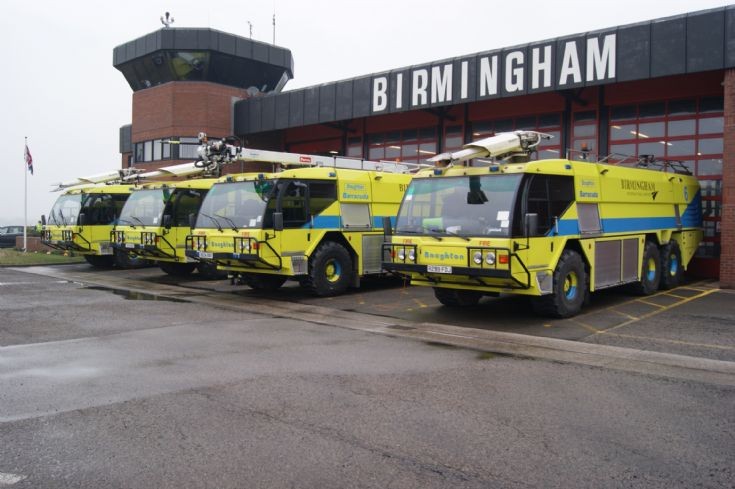
A first for a UK airport to purchase American fire trucks. Most airports that can spend money seem to prefer the Rosenbaur Panthers, although what this implies about British Airport Fire Truck manufacturing (Carmichael, etc.) is not good.
Added by Sean Yeates on 09 March 2013.
Added by Sean Yeates on 09 March 2013.
In this situation it was a final contest between Rosenbauer and Oskosh as they were the only two manufacturers who could deliver appliances with HRET within the required timeframe. In this case Oshkosh must have had the better deal.
The problem with Carnichael is that they don't have any 'new-generation' crash tenders on sale - the Carmichael Cobra 2 is a 90s design whereas the Panther and Global Striker use new technologies, composite materials, have enhanced firefighter safety and more efficient engines. What Carmichael needs to do is develop a new model (Cobra 3 maybe?) in order to properly compete.
Added by Michael Penny on 09 March 2013.
These are actually a British company that built Airport fire trucks before financial difficulty set in
Added by Bob ewing on 09 March 2013.
Added by Bob ewing on 09 March 2013.
Carmichael was sold by its owners (a nice windfall to see them through the rest of their lives) to a Malaysian company and production in the UK was closed. The Malaysian owners still making these "old-fashioned but relatively cheap" fire engines for East Asian markets. Britain doesn't make things anymore (why bother when you foreign competitors will buy your firm to remove a competitor and grab your customers) then you and your family can live the rest of your lives in luxury (bank accounts in the Channel Isles and holiday home in the Caribbean).
Added by James Stockport on 23 June 2013.
Added by James Stockport on 23 June 2013.
James, your comments brought a wry smile to my face. A fact in play for a long time now has been that chestnut globalisation. Exchange rates have played as much a part in these deals as much as anything. Company buyouts are nothing new. Price will always lead an accountant to make the decisions.
Many great British companies wanted to continue providing fire engine designs. Fact is they could not secure investment because of the banking crisis. Banks will not lend money, period. Ironic after being bailed out by tax payers money. Also EU regulation plays a big part. Tenders have to be accepted from a wider area, hence the plethora of cheap commercial chassis we see in service.
Our biggest domestic disaster, in my humble opinion, is Dennis. From Rapier and Sabre we have "evolved" to Scania et al. The Carp fiasco is another example, heck the examples go on and on.
What I strongly believe in and have done for a long time, is that standardisation and interchangeability needs to be our priority.
National Fire Service? Yes, including airports. As for the older designs, well the RAF has refurbished the MFV. As an example it is a good one to me. The sheer amount of money wasted in previous years beggars belief.
I always maintain that in times of national emergency, standard appliance design, for whatever role, is a necessity.
When your workshops are awaiting a part from the other side of the world, well, then the hard truths set in.
Added by John Stott on 24 June 2013.
By World standards, the UK is a relatively small market for custom fire trucks, both airfield and municipal. Neither Carmichael, Chubb, Dennis, S&D, nor ERF were able to remain viable building custom fire truck chassis, because they all relied on selling almost exclusively to the UK market.
If any of them had made a stronger effort to build up business in major export markets, then there is a real chance that one or more of them might still be with us.
Sadly, this is just a microcosm of what happened to the entire UK automotive industry. An arrogant and insular mentality of "we know best" and "foreigners are stupid", which resulted in the death and dismemberment of what was once Britain's leading industrial sector.
Added by Rob Johnson on 24 June 2013.
Other


Added by Michael Penny on 08 March 2013.