
Upload a Picture
About this Site | Links | Random Pic | Advanced Search
Home | Latest Additions | Contributors
| Visitors
Fire Engine Photos
The green colour served 2 purposes:- To make them less prominant whilst in mobile columns proceding to major bombing incidents. To differentiate them from local authority machines, although they could be and were hired to cover for defective LA appliances.
Added by Neal Glover on 22 January 2013.
Added by Neal Glover on 22 January 2013.
Neal: I know the rationale, but it makes no sense.
The mobile columns were supposed to use roads, whenever roads were passable, not to head off over the open fields, stopping every few minutes to open the gates or smash through the hedges. But roads are grey, not dark green. (If they really wanted to camouflage against aircraft, and thought dark green was the answer, they should have painted the ladders to match the bodywork, but they were shiny unpainted aluminium.)
As far as avoiding red, my local brigade did use their Goddess occasionally as a backup, and the lads thought it would have been far safer if it had been instantly recognizable as a fire appliance. They did fit an additional electric bell, because the standard hand bell was next to useless, but always drove it extra slowly because they were conscious that other drivers simply did not realize that it was actually a fire engine!
The same is true when the military had to use them during the infamous firefighters' strikes, and when fire services employed them at major flood events and brush fire disasters.
Added by Rob Johnson on 23 January 2013.
The mobile columns were supposed to use roads, whenever roads were passable, not to head off over the open fields, stopping every few minutes to open the gates or smash through the hedges. But roads are grey, not dark green. (If they really wanted to camouflage against aircraft, and thought dark green was the answer, they should have painted the ladders to match the bodywork, but they were shiny unpainted aluminium.)
As far as avoiding red, my local brigade did use their Goddess occasionally as a backup, and the lads thought it would have been far safer if it had been instantly recognizable as a fire appliance. They did fit an additional electric bell, because the standard hand bell was next to useless, but always drove it extra slowly because they were conscious that other drivers simply did not realize that it was actually a fire engine!
The same is true when the military had to use them during the infamous firefighters' strikes, and when fire services employed them at major flood events and brush fire disasters.
Added by Rob Johnson on 23 January 2013.
The tops were brown lino with the cab roofs black. It could be that green weathers better than grey seems to so that could have been a consideration.
Added by Neal Glover on 23 January 2013.
Added by Neal Glover on 23 January 2013.
All a bit confusing! Dark green paint, black cab roof, brown body top, shiny silver ladders - it does not seem to add up to a very meaningful attempt at camouflage. In addition, the green paint was high gloss, and our local AFS members always had their two Goddesses waxed to a dazzling shine! Hardly inconspicuous.
In any case, I would have thought that it was more important to have other traffic recognize the beloved Goddesses as actual fire engines, rather than to worry about them being attacked by enemy aircraft. A bell is not much use if civilian drivers cannot identify which vehicle is the one demanding priority.
Regardless of color, they were still a great design and proved very capable on the rare occasions when they were pressed into service. Many are still in use in various corners of the World - up to sixty years after they were built, although of course they mostly had a very quiet life in the years up until the AFS was disbanded.
In many countries, especially here in the US, where I live now, older front-line machines are often held in reserve for a few years. Although these are also used to replace front-line units when these are being serviced or repaired, their main role is to be available for recalled off-duty firefighters to man if the duty watch and front-line equipment are fully or heavily committed.
Now that full-time firefighters are working shorter hours, cities have substantial manpower (oops, person-power!) available for recall. Most US municipalities require firefighters to live within the city boundaries, so a significant force can be assembled within 30 minutes to an hour, to provide cover for additional alarms. A few also employ volunteers to provide supplemental coverage, which is also the common practice in France, Germany and Spain. Some of these also keep their assigned trucks for a very long time!
Added by Rob Johnson on 25 January 2013.
In any case, I would have thought that it was more important to have other traffic recognize the beloved Goddesses as actual fire engines, rather than to worry about them being attacked by enemy aircraft. A bell is not much use if civilian drivers cannot identify which vehicle is the one demanding priority.
Regardless of color, they were still a great design and proved very capable on the rare occasions when they were pressed into service. Many are still in use in various corners of the World - up to sixty years after they were built, although of course they mostly had a very quiet life in the years up until the AFS was disbanded.
In many countries, especially here in the US, where I live now, older front-line machines are often held in reserve for a few years. Although these are also used to replace front-line units when these are being serviced or repaired, their main role is to be available for recalled off-duty firefighters to man if the duty watch and front-line equipment are fully or heavily committed.
Now that full-time firefighters are working shorter hours, cities have substantial manpower (oops, person-power!) available for recall. Most US municipalities require firefighters to live within the city boundaries, so a significant force can be assembled within 30 minutes to an hour, to provide cover for additional alarms. A few also employ volunteers to provide supplemental coverage, which is also the common practice in France, Germany and Spain. Some of these also keep their assigned trucks for a very long time!
Added by Rob Johnson on 25 January 2013.
The AFS came under the umbrella of the Civil Defence...and the corporate colour of the CD was green....hence the AFS vehicle were that colour.
Added by Barrie Green on 27 January 2013.
Added by Barrie Green on 27 January 2013.
this goddess here me and my dad now own it - its now green and we have had it for nearly 17 years.
Added by Jennifer Wilkinson on 08 March 2022.
Added by Jennifer Wilkinson on 08 March 2022.
So glad it has survived. They were an important part of fire service history in Britain - even if I personally think they should all originally have been painted good old fire engine red!
Added by Rob Johnson on 08 March 2022.
Added by Rob Johnson on 08 March 2022.
Bedford


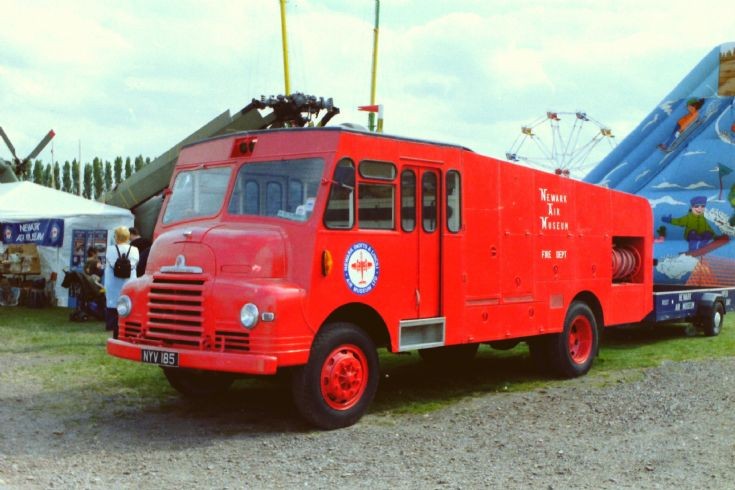
How much more impressive they look in real fire engine red! The original muddy dark green chosen for these AFS trucks made them look like they had strayed away from an army base and got lost. It was supposed to be camouflage, but these trucks were meant for serious urban fifefighting, not grass fires, so the camouflage color should have probably been grey, as it was for the AFS and NFS in WWII.
If the enemy could have seen the fires they started (which I expect they could), then seeing the fire engines would be a secondary problem in any case! So they really could and perhaps should have started their career as "red godesses".
Added by Rob Johnson on 22 January 2013.