
Upload a Picture
About this Site | Links | Random Pic | Advanced Search
Home | Latest Additions | Contributors
| Visitors
Fire Engine Photos
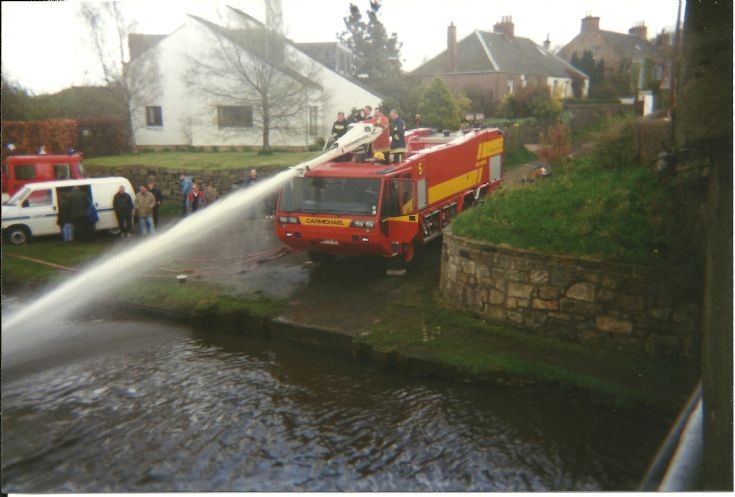
The Airport crash trucks have a 14" ground clearence and depending on under the surface and the Dif locks and low box engaged they may be able to cross, but with most Airport crash trucks the lockers are low down could be a hazard!!
Added by Bob ewing on 18 January 2013.
Added by Bob ewing on 18 January 2013.
Intersting question Pav, by the time a crash truck couples up hard suction hose, and primes the pump for an open water lift thay may be too late for the incident. But a fire pump is a fire pump so why couldn't actually lift from open water?
Added by Colin Foster on 18 January 2013.
Added by Colin Foster on 18 January 2013.
Airport crash trucks are designed above all to be gotten into action quickly. The first two or three minutes are what matters, and crash tenders rely on the water and foam concentrate which they carry on board, along with dry powder on some rigs. The need to carry huge amounts of these is incidentally why they are usually a great deal bigger and heavier than other types of fire trucks.
There is no time to find an open water source and set in to it - and no crew members on board to do it, as most crash tender crews are a maximum of three, and units are now almost all designed to be operated by just the driver on his own.
Even La Guardia airport, which is surrounded by water, does not have crash trucks which carry suctions. These trucks often need to pump on the move, and tying them down with suction hoses or hydrant supply hoses defeats this objective.
Years ago, when chassis were smaller and carried less weight, it was common to have a "nurse" tanker to back up each crash truck, connected by a 50 foot 3-inch hose - but this has died out, now that these monster eight-wheelers have such high carrying and pumping capacities.
Added by Rob Johnson on 18 January 2013.
There is no time to find an open water source and set in to it - and no crew members on board to do it, as most crash tender crews are a maximum of three, and units are now almost all designed to be operated by just the driver on his own.
Even La Guardia airport, which is surrounded by water, does not have crash trucks which carry suctions. These trucks often need to pump on the move, and tying them down with suction hoses or hydrant supply hoses defeats this objective.
Years ago, when chassis were smaller and carried less weight, it was common to have a "nurse" tanker to back up each crash truck, connected by a 50 foot 3-inch hose - but this has died out, now that these monster eight-wheelers have such high carrying and pumping capacities.
Added by Rob Johnson on 18 January 2013.
See picture 465, picture 17766 and picture 23719.
They all show crash tenders with what appear to be suction inlets.
Added by Monkey Boy on 27 January 2013.
They all show crash tenders with what appear to be suction inlets.
Added by Monkey Boy on 27 January 2013.
Just as tanks have gotten larger, so have the replenishment connections been upgraded to accept LDH with the benefit of greatly increased flows.
Added by Rob Johnson on 28 January 2013.
Added by Rob Johnson on 28 January 2013.
Joel P, help me out here, Monkey Boy has spotted picture 23719 with what appears to be suction hose coupled up to the water intake, Robo suggests it's LDH (large diameter hose). I would have thought spec's for fire fighting pumps to include the ability to draft from open water, regardless whether they are airport crash trucks? Can you assist please, ,
Added by Pav on 29 January 2013.
Added by Pav on 29 January 2013.
Hi Pav - in picture 23719 it is correct - LD suction hose and the truck is drafting. all of the crash trucks Rosenbauer builds have the ability to draft, and usually carry hard suction hose on the top of the tank.
Added by Joel P on 29 January 2013.
Added by Joel P on 29 January 2013.
Pav - there is no law against airport fire trucks having suction inlets - indeed, it may make sense if they are also expected to be used off the sirport for grass fires and this extended response area includes accessible open water sources.
The point is that fighting aircraft fires does not allow time to hook up suction (or hydrant) hoses.
Picture 23719 is captioned to the effect that this truck is undergoing flow testing; because this is a prolonged test, it has to be connected to an external source other than the tank - which typically only has the capacity to supply the pump at maximum output for around two minutes. This is being done at the plant where the Rosenbauer truck was built - so the feed could be either suction dropped into a permanent underground tank or LDH attached to a main.
Because the pump is normally operating from a gravity (tank) feed, the supply should be pressurized at 1 AT for comparison purposes. This does not suggest that anyone would try to fight an aircraft fire by connecting up either suction or LDH - it would be just too time-consuming.
Added by Rob Johnson on 29 January 2013.
The point is that fighting aircraft fires does not allow time to hook up suction (or hydrant) hoses.
Picture 23719 is captioned to the effect that this truck is undergoing flow testing; because this is a prolonged test, it has to be connected to an external source other than the tank - which typically only has the capacity to supply the pump at maximum output for around two minutes. This is being done at the plant where the Rosenbauer truck was built - so the feed could be either suction dropped into a permanent underground tank or LDH attached to a main.
Because the pump is normally operating from a gravity (tank) feed, the supply should be pressurized at 1 AT for comparison purposes. This does not suggest that anyone would try to fight an aircraft fire by connecting up either suction or LDH - it would be just too time-consuming.
Added by Rob Johnson on 29 January 2013.
Mr Johnson, your point is, in my opinion, both accurate and well articulated but answers a different question to the one initially posed.
Added by Monkey Boy on 29 January 2013.
Added by Monkey Boy on 29 January 2013.
RAF MFV and RIV have suction points under the cab
Added by Graham on 07 February 2013.
Added by Graham on 07 February 2013.
Carmichael


Added by Pav on 18 January 2013.