
Upload a Picture
About this Site | Links | Random Pic | Advanced Search
Home | Latest Additions | Contributors
| Visitors
Fire Engine Photos

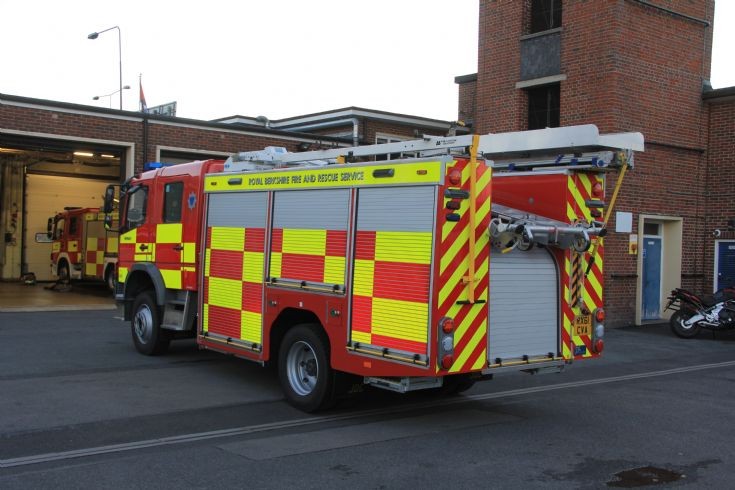
I think it may be an optical illusion - the vehicle is a 4 x 4 so the bodywork is higher from the ground ? giving the impression the heel of the ladder is lower than it actually is ? - are the two fixtures under the rear lockers slide out platforms allowing the 'shorter firefighter' to reach into the top of the lockers ?
Added by Rick Loudon on 01 January 2013.
Added by Rick Loudon on 01 January 2013.
UK bodybuilders seem reluctant to use powered ladder racks, such as are now very common in Europe, relying on gravity to slide the ground ladders out - hence the low-hanging 135 butt. This is fine, but it does waste a lot of potentially useful locker and/or tank space. In many countries, PWT type pumpers have tanks from 3, 000 to 3, 600 liters - up to twice what is carried on most British units - as well as a very comprehensive set of hydraulic, CA and electric powered rescue gear.
Added by Rob Johnson on 01 January 2013.
Added by Rob Johnson on 01 January 2013.
As regards step height, it is common practice for newer German units to have the lower section of the side locker covers in the form of a swing-down step, so that all of the full-height side locker space can be easily accessed. The midship locker cover includes a slide-out step to access the locker above the rear wheels.
These are standard now, and the idea probably originated on high ground clearance 4X4 pumpers, which are of course very popular in Germany. Some builders also offer optional electric switching, so that all lockers can be simultaneously opened and steps positioned as soon as the truck arrives on scene.
Added by Rob Johnson on 02 January 2013.
These are standard now, and the idea probably originated on high ground clearance 4X4 pumpers, which are of course very popular in Germany. Some builders also offer optional electric switching, so that all lockers can be simultaneously opened and steps positioned as soon as the truck arrives on scene.
Added by Rob Johnson on 02 January 2013.
What's the white thing stowed above the ladders on the off-side?
Added by Yelp Bullhorn on 05 January 2013.
Added by Yelp Bullhorn on 05 January 2013.
Is that not on the near-side, Barrie? The object that is puzzling me looks more like a slide!
Added by Yelp Bullhorn on 10 January 2013.
Added by Yelp Bullhorn on 10 January 2013.
Could the "slide" be suction hose stowage? The Dutch like to carry the suctions on the roof like this, although they usually have a powered rack for the ladders and suctions, instead of this kind of lever system. I am suggesting this because the appliance does not seem to have anywhere else to store suction hoses.
Added by Rob Johnson on 10 January 2013.
Added by Rob Johnson on 10 January 2013.
Comment removed at request of Commentor
The firefighting culture is a bit different in Germany, just as it is here in the US. Basically, in both countries, the fire service "owns" the scene. The police automatically attend, and always close off the street(s). In many jurisdictions, it is actually illegal to pass any parked fire engine, unless signalled to do so by a firefighter or police officer.
Appliances are frequently positioned at intersections, and nobody worries about staging units in the center of the street and taking up the full width of the road. In many narrow German side streets this is necessary in any case, and especially if a TL is being used. So the folding step poses few problems, as operators are used to parking only in a location where the crew can access the lockers and use the steps.
As your comments suggest, the sliding step may be a better option in some countries like the UK - as it is in Sweden, for example. It can be supplemented by fold-down shelving, but some kind of step access is necessary if the full potential height of the side lockers is to be put to good use - especially if we are talking about a 4X4, with its high ground clearance.
Some US trucks with high side lockers have several small folding steps attached to the inner side walls of the lockers. These also function as hand-holds. They are slower to deploy, but take up very little space, and firefighters are accustomed to them, because the same design has been used as external steps to access deck guns and hose beds for decades. Perhaps this solution would also work well in the UK?
Added by Rob Johnson on 11 January 2013.
Appliances are frequently positioned at intersections, and nobody worries about staging units in the center of the street and taking up the full width of the road. In many narrow German side streets this is necessary in any case, and especially if a TL is being used. So the folding step poses few problems, as operators are used to parking only in a location where the crew can access the lockers and use the steps.
As your comments suggest, the sliding step may be a better option in some countries like the UK - as it is in Sweden, for example. It can be supplemented by fold-down shelving, but some kind of step access is necessary if the full potential height of the side lockers is to be put to good use - especially if we are talking about a 4X4, with its high ground clearance.
Some US trucks with high side lockers have several small folding steps attached to the inner side walls of the lockers. These also function as hand-holds. They are slower to deploy, but take up very little space, and firefighters are accustomed to them, because the same design has been used as external steps to access deck guns and hose beds for decades. Perhaps this solution would also work well in the UK?
Added by Rob Johnson on 11 January 2013.
Comment removed at request of Commentor
Andy - I agree completely.
It seems that the problem will only get worse, as we add more and more different kinds of specialized rescue gear, infra-red cameras, CAFS compressors, foam proportioners, traffic management items, hazmat first response gemar, generators, ventilation fans, lighting, EMS first responder kits and all the rest.
As fire services all over the World have to increasingly do more with less, specialst vehicles will continue to be few and far between, and first responding pumps will take on more and more additional specialized roles. Of course, this means a continuous process of finding space for ever-increasing amounts of equipment.
Most US and European pumps now have bodywork which is at least as high as the crewcab roof, and often much higher, but this still seems to be relatively rare in the UK. It appears that the equipment schedule in Britain is probably less comprehensive, and the typical 1, 800 liter water tank is also rather small when compared to most other countries - except for pumpers which are designated for city use.
I believe British fire brigades and appliance contractors will have to start thinking about finding some more additional innovative solutions which are being used in other countries, including ways of maximizing the entire rear body cube's utility.
With this in mind, there are numerous examples on this site of trucks from many different countries which demonstrate innovative stowage solutions. None is perfect, but it might be helpful if more UK fire service officials took a critical look at some of them.
Added by Rob Johnson on 11 January 2013.
It seems that the problem will only get worse, as we add more and more different kinds of specialized rescue gear, infra-red cameras, CAFS compressors, foam proportioners, traffic management items, hazmat first response gemar, generators, ventilation fans, lighting, EMS first responder kits and all the rest.
As fire services all over the World have to increasingly do more with less, specialst vehicles will continue to be few and far between, and first responding pumps will take on more and more additional specialized roles. Of course, this means a continuous process of finding space for ever-increasing amounts of equipment.
Most US and European pumps now have bodywork which is at least as high as the crewcab roof, and often much higher, but this still seems to be relatively rare in the UK. It appears that the equipment schedule in Britain is probably less comprehensive, and the typical 1, 800 liter water tank is also rather small when compared to most other countries - except for pumpers which are designated for city use.
I believe British fire brigades and appliance contractors will have to start thinking about finding some more additional innovative solutions which are being used in other countries, including ways of maximizing the entire rear body cube's utility.
With this in mind, there are numerous examples on this site of trucks from many different countries which demonstrate innovative stowage solutions. None is perfect, but it might be helpful if more UK fire service officials took a critical look at some of them.
Added by Rob Johnson on 11 January 2013.
Mercedes-Benz


Added by Tom on 01 January 2013.