
Upload a Picture
About this Site | Links | Random Pic | Advanced Search
Home | Latest Additions | Contributors
| Visitors
Fire Engine Photos
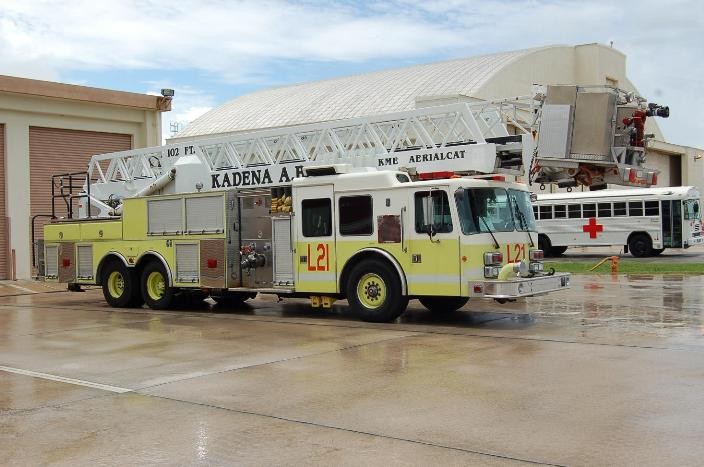
A few US departments ran 135 foot ladders for a period in the 1970s through the 1990s. In practice, few US cities have many buildings over 100 feet and less than 135, so these were all eventually replaced by 100-110 foot ladders.
There wer also a handful of purchases of Calvar "Firebird" 125 and 150 foor Snorkels, but these were also subsequently replaced by smaller units.
Hi-rise fires are typically fought by inside crews, and mandatory construction methods and materials tend to reduce the risk of structural failure, except in isolated cases like the World Trade Center terrorist attack.
So cities like New York use 100 foot ladders and either 75 foot or 95 foot aerial platforms, Chicago, where I live, is home to three of the tallest structures in the country, and has ladders from 104 to 110 feet. But a call to my 44 floor building brings no less than 38 firefighters, with four engines, two ladders, a rescue truck, a snorkel, a high rise unit, an ambulance, a Batallion Chief's car and a safety officer's car.
In addition, ladders over 110 feet tend to be very unwieldly, as the chassis is extra long and the vehicle ends up being really heavy and slow - not to mention their cost!
A few truly gigantic ladders and platforms exist, but these are mainly in third World countries with new hi rise buildings and perhaps less stringent building codes.
Added by Rob Johnson on 30 May 2014.
There wer also a handful of purchases of Calvar "Firebird" 125 and 150 foor Snorkels, but these were also subsequently replaced by smaller units.
Hi-rise fires are typically fought by inside crews, and mandatory construction methods and materials tend to reduce the risk of structural failure, except in isolated cases like the World Trade Center terrorist attack.
So cities like New York use 100 foot ladders and either 75 foot or 95 foot aerial platforms, Chicago, where I live, is home to three of the tallest structures in the country, and has ladders from 104 to 110 feet. But a call to my 44 floor building brings no less than 38 firefighters, with four engines, two ladders, a rescue truck, a snorkel, a high rise unit, an ambulance, a Batallion Chief's car and a safety officer's car.
In addition, ladders over 110 feet tend to be very unwieldly, as the chassis is extra long and the vehicle ends up being really heavy and slow - not to mention their cost!
A few truly gigantic ladders and platforms exist, but these are mainly in third World countries with new hi rise buildings and perhaps less stringent building codes.
Added by Rob Johnson on 30 May 2014.
Bronto must be lighter, possibly cheaper, much more manouverable, they are used all over europe, why dont yuo see much of them in America.
Added by John Macrae on 14 June 2014.
Added by John Macrae on 14 June 2014.
John:- Almost all US aerial ladders and platforms have a four to eight man cab, also carry a full complement of eight or so ground ladders of many types and lengths up to 40 feet (12 meters), as well as extensive rescue, forcible entry and ventilation equipment. These are mandated by NFPA, which sets the standards for firefighting vehicles. Many also include a pump (usually 7000 LPM) a tank of around 1000 liters and both 5 inch (150mm)supply hose and 2.5 inch (65mm) attack hoses.
If you look at a Bronto in the travel configuration, the basket ends up stored amidships and quite low on the chassis. This does not leave enough room for all the other equipment, which is required to comply with NFPA standards.
Having said this, there are a few Brontos in use in North America, but they are really not all that popular. In some cases, the truck actually ends up even longer, to accommodate the basket storage.
Added by Rob Johnson on 17 June 2014.
If you look at a Bronto in the travel configuration, the basket ends up stored amidships and quite low on the chassis. This does not leave enough room for all the other equipment, which is required to comply with NFPA standards.
Having said this, there are a few Brontos in use in North America, but they are really not all that popular. In some cases, the truck actually ends up even longer, to accommodate the basket storage.
Added by Rob Johnson on 17 June 2014.
KME


Added by John Macrae on 17 July 2012.