
Upload a Picture
About this Site | Links | Random Pic | Advanced Search
Home | Latest Additions | Contributors
| Visitors
Fire Engine Photos
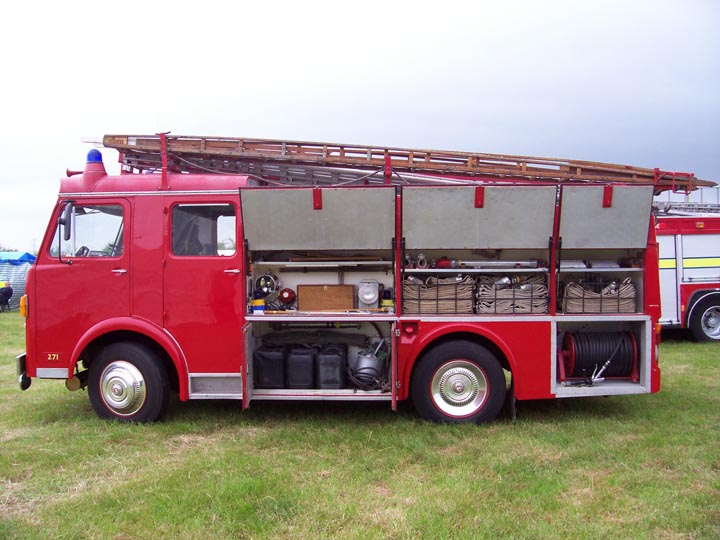
Dennis D series XTT310S left side
We have the sister ship to SJY845T WHICH IS SHOWN ON YOUR WEBSITE the dennis d series. We have the XTT310S 1978 Dennis D series which is now owned by father and son roy and jason browne of hampshire.
The Dennis we have was in service from 1978 to 1992 at Moretonhampstead in Devon, and the call sign was 271. It came out of service after being in a road traffic accident but it was rebuilt and repainted then on delivery back ran into the back of a car and never returned to active service. This is just part of our engine collection at present we have six appliances at different stages of restoration.
We have the sister ship to SJY845T WHICH IS SHOWN ON YOUR WEBSITE the dennis d series. We have the XTT310S 1978 Dennis D series which is now owned by father and son roy and jason browne of hampshire.
The Dennis we have was in service from 1978 to 1992 at Moretonhampstead in Devon, and the call sign was 271. It came out of service after being in a road traffic accident but it was rebuilt and repainted then on delivery back ran into the back of a car and never returned to active service. This is just part of our engine collection at present we have six appliances at different stages of restoration.
When I joined North Yorkshire fire brigade in 1977 we had 2 brand new Bedford TK Water Ladders. We carried I think 11 lengths of 70mm delivery hose flaked down the nearside lockers on both appliances with a small roller shutter in the rear panel. We would slide up the roller shutter and pull out the male coupling and the pump could drive of to lay the hose. To replace the hose on the appliance, the side roller shutters were lifted up and 2 panels were unclipped and a number of firemen could then pass the hose through the small locker at the rear and the hose flaked. This job was not one of my favourite jobs. I don't think I have any photos but will have a look and post at a later date.
Added by Paul Warnock on 12 June 2013.
Added by Paul Warnock on 12 June 2013.
It seems to have been a short lived fashion. Some of Lancs Fords were fitted out to carry about 8 lengths flaked for laying. I don't think it was often used and the hose ended up back in rolls.
Added by Neal Glover on 12 June 2013.
Added by Neal Glover on 12 June 2013.
These are individual lengths, which seem to be in baskets with four lengths in each. By counting the "folds" , it looks like each basket contains around 200 feet.
This is a bit different than having several preconneted lengths accessible from the rear, as Paul and Neal mention - and reminds me of the German practice of having either 3X15 meters of 52MM or 2X20 meters of 75MM hose in baskets.
I have to wonder if this idea lasted for very long - it certainly seems very unusual.
Added by Rob Johnson on 13 June 2013.
This is a bit different than having several preconneted lengths accessible from the rear, as Paul and Neal mention - and reminds me of the German practice of having either 3X15 meters of 52MM or 2X20 meters of 75MM hose in baskets.
I have to wonder if this idea lasted for very long - it certainly seems very unusual.
Added by Rob Johnson on 13 June 2013.
when I was RDS with L&B at Stn 58, we carried some flaked 45mm hose in bread baskets. they were quickly deployed and just as quick re-flaked back into the tray.
Added by Stevie Murray on 13 June 2013.
Added by Stevie Murray on 13 June 2013.
I remember a write in Fire at the time and Devon were very proud of these multi purpose appliances. I can't remember the details but they were claimed to be about 5 appliances in one. Pump, ET, WrT, FoT and maybe Hose layer in one. I seem to remember a hatch in the rear locker for paying out hose. Some were built new and some earlier machines modified.
Added by Neal Glover on 13 June 2013.
Added by Neal Glover on 13 June 2013.
The little D series Dennis was a rather small appliance, not much bigger than the older F7, so I think any claim that it could usefully fill all of these five roles seems a bit fanciful. But I do like the shiny wheel covers - usually only seen on South American fire trucks.
It does seem that the only places outside the American Continent where preconnected flaked hoses are a commonplace approach are Australia and New Zealand. We also have the baskets in some European countries and of course the wheeled hose carts which are standard in Japan; these too carry flaked hoses (as distinct from the Europeam hose carts which have preconnected rolled hoses).
Japanes firefighters also use satchel packs with small diameter flaked hoses for interior jobs - they just sling the pack over one shoulder and let the hose spill out behind them as they run in.
This is similar to the US practice of carrying one or more "suitcase packs " of 1.75 inch, to be carried inside on hi-rise interior attack assignments, and the Swedish 45MM hexagonal mini-pack - which serves the same purpose.
Added by Rob Johnson on 13 June 2013.
It does seem that the only places outside the American Continent where preconnected flaked hoses are a commonplace approach are Australia and New Zealand. We also have the baskets in some European countries and of course the wheeled hose carts which are standard in Japan; these too carry flaked hoses (as distinct from the Europeam hose carts which have preconnected rolled hoses).
Japanes firefighters also use satchel packs with small diameter flaked hoses for interior jobs - they just sling the pack over one shoulder and let the hose spill out behind them as they run in.
This is similar to the US practice of carrying one or more "suitcase packs " of 1.75 inch, to be carried inside on hi-rise interior attack assignments, and the Swedish 45MM hexagonal mini-pack - which serves the same purpose.
Added by Rob Johnson on 13 June 2013.
Rob, the F7 was a fairly large machine, similar to an F12. I think you may mean to compare the "D" series with an F8. I would imagine the wheel trims are non standard. Maybe added during preservation.
Added by Michael G on 14 June 2013.
Added by Michael G on 14 June 2013.
Yes I was referring to the F7. I don't think I'll ever get used to Dennis' numbering system!
Added by Rob Johnson on 16 June 2013.
Added by Rob Johnson on 16 June 2013.
Wheel trims are standard, Plymouth City traditional carried over into Devon by CFO Killoran in 1974.
Added by Avonmouth on 16 June 2013.
Added by Avonmouth on 16 June 2013.
These beautiful proper all red and lockered Ds came from workshops WITH the wheel trims..... and a bell !! They were as a rule really well loved and maintained by fleet and individual stations. They were one of the last real old fashioned (real).. in house bodied appliances I think.
Added by Colin Duncan on 16 June 2013.
Added by Colin Duncan on 16 June 2013.
What a lovely machine. Old RAF firemen will recall the flaked hose held in cradles in the pump locker of the Thornycroft DP2 appliances. Usually connected to a 20x FB, but easily replaced by other branches. A joy to deploy and a quick way to get to work.
The habit has never proved popular in Britain due to winding streets and other considerations. I have watched US machines roll along laying hundreds of feet of delivery within minutes, a sight to behold. Flaked hose has its merits on airfields, wide streets etc. Fact is in an urban / historical and built up area it has no place.
Added by John Stott on 17 June 2013.
The habit has never proved popular in Britain due to winding streets and other considerations. I have watched US machines roll along laying hundreds of feet of delivery within minutes, a sight to behold. Flaked hose has its merits on airfields, wide streets etc. Fact is in an urban / historical and built up area it has no place.
Added by John Stott on 17 June 2013.
John - I agree with you about flaked versus rolled hoses - its very much "horses for courses". But there is one interesting exception.
In Japan, the SOP is to have a US style mid-mount pump, with a rear-mounted four wheeled hose cart loaded with preconnected flaked delivery hose.
Japanese towns are full of very narrow streets and alleys, which are actually often too restricted for even the smallest pumpers. So the hose cart is sometimes the only "vehicle" which can get in there - and some are battery-operated ride-on carts, which are quite fast! The hose is flaked, because flaking increases the length of hoses which can be carried, compared to winding the hose around a reel, European-style. The larger carts carry both 70MM for the initial long stretch and 45MM for the attack line(s) on-scene, if required.
Some of the photos on this site show these hose carts and there are a few videos on Youtube which show them being deployed.
Incidentally, this combination of small pumpers with very large hose capacities helps explain why the vast majority of urban Japanese pumpers have no water tank - there just isn't room!
In Germany, the hose baskets with two to three lengths of flaked hose are now standrd. But they are quite controversial, because a lot of firefighters argue that they are no faster than running out Dutch-rolled individual lengths of hose. which is the old SOP. There is, however, no arguement against the fact that you can get the same hose load into a smaller space if it is flaked, which can be a plus if a pump has to carry a lot of other equipment.
By the way, most US pumpers also carry 600 to 800 feet of 5 inch supply hose in the bed. Many Fire Departments have an SOP for one member to connect this to the nearest hydrant while the engine is still being driven to the scene. This means the supply line is often hooked up even before the attack lines are deployed, so the water tank is sometimes not even needed.
Added by Rob Johnson on 17 June 2013.
In Japan, the SOP is to have a US style mid-mount pump, with a rear-mounted four wheeled hose cart loaded with preconnected flaked delivery hose.
Japanese towns are full of very narrow streets and alleys, which are actually often too restricted for even the smallest pumpers. So the hose cart is sometimes the only "vehicle" which can get in there - and some are battery-operated ride-on carts, which are quite fast! The hose is flaked, because flaking increases the length of hoses which can be carried, compared to winding the hose around a reel, European-style. The larger carts carry both 70MM for the initial long stretch and 45MM for the attack line(s) on-scene, if required.
Some of the photos on this site show these hose carts and there are a few videos on Youtube which show them being deployed.
Incidentally, this combination of small pumpers with very large hose capacities helps explain why the vast majority of urban Japanese pumpers have no water tank - there just isn't room!
In Germany, the hose baskets with two to three lengths of flaked hose are now standrd. But they are quite controversial, because a lot of firefighters argue that they are no faster than running out Dutch-rolled individual lengths of hose. which is the old SOP. There is, however, no arguement against the fact that you can get the same hose load into a smaller space if it is flaked, which can be a plus if a pump has to carry a lot of other equipment.
By the way, most US pumpers also carry 600 to 800 feet of 5 inch supply hose in the bed. Many Fire Departments have an SOP for one member to connect this to the nearest hydrant while the engine is still being driven to the scene. This means the supply line is often hooked up even before the attack lines are deployed, so the water tank is sometimes not even needed.
Added by Rob Johnson on 17 June 2013.
The Multi Purpose Pump concept was first introduced in Plymouth during the late 1960s when a fleet of Leyland Carmichaels was introduced, they were all red with chrome wheel trims and carried delivery hose in wire baskets. This was carried over into Devon after 1974 and all new appliances were so designed and a number converted to Multi Purpose, gradually many of these features disappeared over the years as pumping appliances evolved. All Plymouth eventually sported chrome trims including the AEC merryweather TL.
Added by Avonmouth on 17 June 2013.
Added by Avonmouth on 17 June 2013.
Thanks for the observations Rob. I guess we all have our preferences, I have noticed the Japanese hose carts and it is certainly radical to my old brain!
Over the years I came to favour Dutch rolled, luckily I carried the argument on some retained stations I served on. Too many older minds were stuck in drill competition mode!
I admit to marvelling at some of the capabilities of tubing nowadays, with differing pressures and nozzles a remarkable performance is shown for knockdown.
I take on board your comments on Japan, they have some very interesting machines and practices. Some of the smaller pumps such as the Isuzu would seem well suited to British needs, Australian volunteer brigades seem to love them.
Added by John Stott on 18 June 2013.
Over the years I came to favour Dutch rolled, luckily I carried the argument on some retained stations I served on. Too many older minds were stuck in drill competition mode!
I admit to marvelling at some of the capabilities of tubing nowadays, with differing pressures and nozzles a remarkable performance is shown for knockdown.
I take on board your comments on Japan, they have some very interesting machines and practices. Some of the smaller pumps such as the Isuzu would seem well suited to British needs, Australian volunteer brigades seem to love them.
Added by John Stott on 18 June 2013.
"Japanese towns are full of very narrow streets and alleys, which are actually often too restricted for even the smallest pumpers."
Same can be said for a lot of Devon towns, Brixham for example has a number of small alleyways & steps which appliances would get no where near. Devon also has Dartmoor where there are limited water supplies so would require large lengths of hosing to get to a water source.
Maybe these were the reasons for favouring flaked hose baskets?
Added by Neil A on 18 June 2013.
Same can be said for a lot of Devon towns, Brixham for example has a number of small alleyways & steps which appliances would get no where near. Devon also has Dartmoor where there are limited water supplies so would require large lengths of hosing to get to a water source.
Maybe these were the reasons for favouring flaked hose baskets?
Added by Neil A on 18 June 2013.
I think there is another reason US fire departments can get away with scattering long hose lines all over the roads. Here, the police always attend fire calls, often in large numbers, and frequently they get there before the first fire trucks. This means the fire department "owns" the scene. The roads are closed, sometimes for several blocks, and gawkers are placed behind tape lines - so the firefighters can work safely and without interruption. I don't think any American firefighter has ever seen a hose ramp!
In some countries, the police are a lot less active - I saw a serious fire in Paris where there was no visible police presence and firefighters were trying to run hoses amidst fast-moving traffic with no effort at all on their part to even bother to try to slow them down!
Added by Rob Johnson on 18 June 2013.
In some countries, the police are a lot less active - I saw a serious fire in Paris where there was no visible police presence and firefighters were trying to run hoses amidst fast-moving traffic with no effort at all on their part to even bother to try to slow them down!
Added by Rob Johnson on 18 June 2013.
Comment removed at request of Commentor
Dennis


Added by Rob Johnson on 12 June 2013.