
Upload a Picture
About this Site | Links | Random Pic | Advanced Search
Home | Latest Additions | Contributors
| Visitors
Fire Engine Photos
No: 31574 Contributor: Marcel Sloover Year: 2011 Manufacturer: American LaFrance Country: United States of America
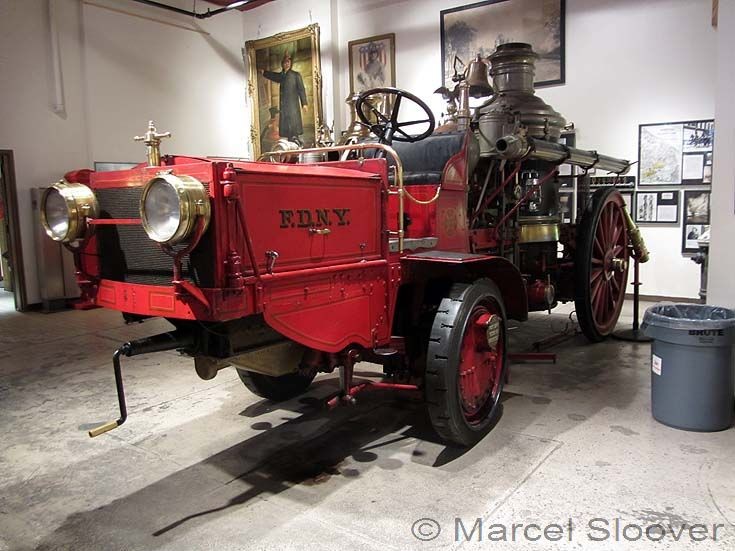
Metropolitan Steamer 1912 NYC Fire museum
This was a former Horse drawn steam fire engine built by American LaFrance. In 1912 a Van Blerk gasoline engine was added. This apparatus number 3384 was placed with Engine 93 in 1913.
This was a former Horse drawn steam fire engine built by American LaFrance. In 1912 a Van Blerk gasoline engine was added. This apparatus number 3384 was placed with Engine 93 in 1913.
This picture is in the following groups
Fire Museum New York City, USA
Fire Museum New York City, USA
American LaFrance


In the 1900s, departments started buying self-propelled pumps, but found that steam operated self-propelled pumps were not very efficient, especially as the steam engines did not provide full power immediately. For the pumps, this was not a problem, because it took a few minutes for the horses to get the truck to the scene, plus a few more for the hoses to be connected and run out. But it tended to slow down response times if the drive wheels were connected to the steam engine.
Horses were very expensive to maintain and feed, so departments were eager to replace them, but it made no sense to replace entire pumpers, which were often quite new and still serviceable in their own right.
Different solutions cropped up. One was to mount the steam pump on a gasolene truck chassis. A second - shown here - was to use the old chassis and pump, with the addition of a front wheel drive power unit.
To overcome the problem of a powered and steered front axle, the solution was a hybrid drive system. These were built by several manufacturers around the 1908 to 1920 period. Christie was the main US supplier, utilizing a transverse engine, while in Germany Loehner-Porsche built several hybrid front end conversions for steam pumpers. (These were some of the first inventions of young Dr. Porsche, who later developed the VW Beetle and then the Porsche sports car).
The engine drove a generator, with electruc power supplied to the front wheel motors, which also served as brakes. This was very advanced technology 100 years ago, and these conversions worked well, until eventually being replaced by "modern" gasolene pumpers. Some of them survived in to the 1930s.
Added by Rob Johnson on 15 January 2013.