
Upload a Picture
About this Site | Links | Random Pic | Advanced Search
Home | Latest Additions | Contributors
| Visitors
add commentComments:
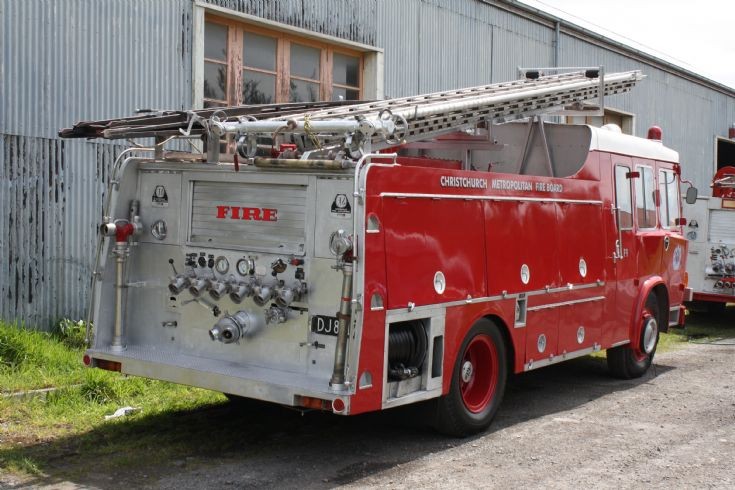
G'day Rob, back in my day New Zealand always ran with two double-headed standpipes, one a "London" screw down and the other a ball-type for the older hydrants. It appears in this case they have two screw downs as the old ball type would have probably been long phased out when this photo was taken. (And a ball-type are probably as rare as 'rocking horse poo' to come by)? The collector head was normal too, you know the old story Rob, "females to the fire, males to the rear!" So the collector heads had two or three male fittings depending on the requirements of the Brigade in question, and would have had blank caps fitted. I have never seen a pump with six deliveries that I can remember, I hope David can enlighten us Rob. Hope all is well with you, mate.
Added by Pav on 24 November 2018.
Added by Pav on 24 November 2018.
Thanks Pav:
Some English brigades had a four way collector and carried only one standpipe at one time - I seem to remember Liverpool even had a five inlet collector! Reverse thinking in the Antipodes...
As for me, I am still poking my nose in where it may or may not be wanted, trying to add a bit of a historical perspective here and there when I think I can...
Added by Rob Johnson on 27 November 2018.
Some English brigades had a four way collector and carried only one standpipe at one time - I seem to remember Liverpool even had a five inlet collector! Reverse thinking in the Antipodes...
As for me, I am still poking my nose in where it may or may not be wanted, trying to add a bit of a historical perspective here and there when I think I can...
Added by Rob Johnson on 27 November 2018.
Comment removed at request of Commentor
Andy:
Anything's possible, but a four or even five inlet collector would have been a better solution to save locker space and - even more important - reduce friction losses in the supply hoses...
London used quad collectors for decades to compensate for low hydrant flows and/or pressures in some districts, and Liverpool even had five inlets on all their pumps for several years.
The old adage for pumps using 70 mm hoses was one inlet for each delivery, and this has been pretty widespread practice among fire services in most countries that use 65 or 70 mm for hydrant supply.
Here in the US, it is not at all unusual for our standard 5650 LPM pumpers to set into a hydrant with two 5 inch (125 mm) hoses, using a T connector on the hydrant steamer outlet and two of their three or four 6" (150 mm) suction inlets with the requisite adaptors.
(Usually, they have two side, one front and one rear inlet, but individual departments sometimes do things differently.)
Paris - and some other French cities - often use a single 110 mm soft suction line to supply both their 2000 LPM pumps and the 1000 LPM first aid units too. The pump has one 110 and two 65 mm inlets, all of which can be utilized if necessary.
Added by Rob Johnson on 28 November 2018.
Anything's possible, but a four or even five inlet collector would have been a better solution to save locker space and - even more important - reduce friction losses in the supply hoses...
London used quad collectors for decades to compensate for low hydrant flows and/or pressures in some districts, and Liverpool even had five inlets on all their pumps for several years.
The old adage for pumps using 70 mm hoses was one inlet for each delivery, and this has been pretty widespread practice among fire services in most countries that use 65 or 70 mm for hydrant supply.
Here in the US, it is not at all unusual for our standard 5650 LPM pumpers to set into a hydrant with two 5 inch (125 mm) hoses, using a T connector on the hydrant steamer outlet and two of their three or four 6" (150 mm) suction inlets with the requisite adaptors.
(Usually, they have two side, one front and one rear inlet, but individual departments sometimes do things differently.)
Paris - and some other French cities - often use a single 110 mm soft suction line to supply both their 2000 LPM pumps and the 1000 LPM first aid units too. The pump has one 110 and two 65 mm inlets, all of which can be utilized if necessary.
Added by Rob Johnson on 28 November 2018.
Comment removed at request of Commentor
Many countries actually mandate minimum hydrant flow and spacing between hydrants to guarantee adequate LPM for the kinds and sizes of structures in the vicinity.
I have seen examples of this in UK literature, but I am not sure if these standards are legally enforceable, nor whether they are retrospective or only applied to new building developments.
A single 45 mm line with a variable output branch maxes out at around 450 LPM, which can be a bit feeble. In France, hydrants must flow at least 1000 LPM and in Germany there are some variations but the smallest main is 100 mm and the lowest permitted pressure is 3.5 AT which usually gives a flow of around 1200 to 1600 LPM depending on the condition of the plumbing.
Here in the US, the minimum useful flow is usually reckoned to be 2840 LPM.
But - as you point out - in all three cases this means that it is pretty rare for any pumper's theoretical capacity to be satisfied by a single hydrant.
Here in central Chicago, though, we do have large mains at around 5.5 AT and all hydrants have dual 115 mm outlets, which means that our 5650 LPM pumpers can often work flat out from a single hydrant if necessary.
Added by Rob Johnson on 11 December 2018.
I have seen examples of this in UK literature, but I am not sure if these standards are legally enforceable, nor whether they are retrospective or only applied to new building developments.
A single 45 mm line with a variable output branch maxes out at around 450 LPM, which can be a bit feeble. In France, hydrants must flow at least 1000 LPM and in Germany there are some variations but the smallest main is 100 mm and the lowest permitted pressure is 3.5 AT which usually gives a flow of around 1200 to 1600 LPM depending on the condition of the plumbing.
Here in the US, the minimum useful flow is usually reckoned to be 2840 LPM.
But - as you point out - in all three cases this means that it is pretty rare for any pumper's theoretical capacity to be satisfied by a single hydrant.
Here in central Chicago, though, we do have large mains at around 5.5 AT and all hydrants have dual 115 mm outlets, which means that our 5650 LPM pumpers can often work flat out from a single hydrant if necessary.
Added by Rob Johnson on 11 December 2018.
Comment removed at request of Commentor
Comment removed at request of Commentor
Most European countries have similar construction practices which are comparable to British ones, using poured concrete and blocks, and a lot less wood than here. Germany in particular seems to have even higher standards, especially when it comes to residential buildings.
But many European countries have quite stringent formal regulations when it comes to hydrant capacity, pressure, flow and spacing. These seem most often to require the ability to support two 45mm lines from each hydrant, with spacing usually between 100 and 200 meters apart.
Although the high pressure reel is favored in both Belgium ad the Netherlands, where it usually has a CAF system too, as well as in Italy, fire services in other countries rarely rely on them at fires in buildings. They continue to be deployed at car fires, trash fires and vegetation fires, but rarely in occupied structures.
For example, French and German pumpers have only one reel, but they usually have at least one preconnected 45/52 mm line - which can be brought to work very quickly. This is typically fitted with a variable flow branch, which can be switched between 150, 250, 350 and 450 LPM.
I think this trend is because of the much higher interior fire load in modern times, with hydrocarbons and other synthetics so widely used in furnishings, appliances and just about every household item.
As you say, firefighting needs and solutions vary from place to place. Australia seems to have smaller structures than in North America, but a lot of wood is still being used in construction there...
Added by Rob Johnson on 20 December 2018.
But many European countries have quite stringent formal regulations when it comes to hydrant capacity, pressure, flow and spacing. These seem most often to require the ability to support two 45mm lines from each hydrant, with spacing usually between 100 and 200 meters apart.
Although the high pressure reel is favored in both Belgium ad the Netherlands, where it usually has a CAF system too, as well as in Italy, fire services in other countries rarely rely on them at fires in buildings. They continue to be deployed at car fires, trash fires and vegetation fires, but rarely in occupied structures.
For example, French and German pumpers have only one reel, but they usually have at least one preconnected 45/52 mm line - which can be brought to work very quickly. This is typically fitted with a variable flow branch, which can be switched between 150, 250, 350 and 450 LPM.
I think this trend is because of the much higher interior fire load in modern times, with hydrocarbons and other synthetics so widely used in furnishings, appliances and just about every household item.
As you say, firefighting needs and solutions vary from place to place. Australia seems to have smaller structures than in North America, but a lot of wood is still being used in construction there...
Added by Rob Johnson on 20 December 2018.
Comment removed at request of Commentor
Over the holidays I revisited several videos of firefighting operations which I had seen before from Belgium, the Netherlands and Italy.
What struck me as being remarkable was how often crews in these countries relied on high pressure hose reels to attack quite serious fires in large commercial properties.
As you mentioned, a hose reel may well, do the job 90% of the time, but it occurs to me that sometimes firefighters who are used to relying on them may be very slow to get heavier water lines to work - with quite unfortunate results.
High pressure hose reels are still fitted on some pumpers in north America, but the vast majority of fire departments no longer have them at all, mainly because their ease of use caused exactly the same problem...
Added by Rob Johnson on 04 January 2019.
What struck me as being remarkable was how often crews in these countries relied on high pressure hose reels to attack quite serious fires in large commercial properties.
As you mentioned, a hose reel may well, do the job 90% of the time, but it occurs to me that sometimes firefighters who are used to relying on them may be very slow to get heavier water lines to work - with quite unfortunate results.
High pressure hose reels are still fitted on some pumpers in north America, but the vast majority of fire departments no longer have them at all, mainly because their ease of use caused exactly the same problem...
Added by Rob Johnson on 04 January 2019.
A couple of clarifications:
1- Actually the 45 or - in Germany - the 52 mm is not used for hydrant connections. 65/70/75 (usually twinned) or 110 is the norm. In Japan, 140 mm hard suction is most often deployed.
2- Several European manufacturers have offered CAF installations which can also be used with the 23 mm hosereel systems at low pressure for quite a few years. These are increasingly popular and have now been standardized on all pumpers in many cities, including Paris and Berlin. The newest versions can add Type A solution or Type B compound to the flow for either type of fire.
These pumpers also still have dual pressure pumps and can flow 400 LPM at 40 AT to the HP reel(s)as and when preferred.
CAFS advocates, such as Vienna, have actually reduced the water tank capacities on their newest pumps, because the CAF system gets the job done with much less water than an equivalent high pressure reel.
Added by Rob Johnson on 08 January 2019.
1- Actually the 45 or - in Germany - the 52 mm is not used for hydrant connections. 65/70/75 (usually twinned) or 110 is the norm. In Japan, 140 mm hard suction is most often deployed.
2- Several European manufacturers have offered CAF installations which can also be used with the 23 mm hosereel systems at low pressure for quite a few years. These are increasingly popular and have now been standardized on all pumpers in many cities, including Paris and Berlin. The newest versions can add Type A solution or Type B compound to the flow for either type of fire.
These pumpers also still have dual pressure pumps and can flow 400 LPM at 40 AT to the HP reel(s)as and when preferred.
CAFS advocates, such as Vienna, have actually reduced the water tank capacities on their newest pumps, because the CAF system gets the job done with much less water than an equivalent high pressure reel.
Added by Rob Johnson on 08 January 2019.
Comment removed at request of Commentor
Andy:
I think the idea of having a 45 mm line ready to go is an excellent SOP. This is not the practice in a lot of European countries it seems, and something I have never seen - although of course both hose reels and 45s are frequently used together.
I think fire services can usefully learn from understanding best practices in other countries, although as you point out the UK and US have quite different conditions a lot of the time.
For this reason I like to see what other European countries are doing - particularly when it comes to new developments - because their challenges are usually very similar to what fire services encounter in the UK.
One trend s the "open plan" ground floor in newer homes, which provides that the kitchen, living area and staircase are all in the same one room. This means that a small kitchen fire can become a whole house fire very quickly - and pose a much different problem for the first crew to arrive, especially if it has less than five members and needs to get a team inside in BA.
Added by Rob Johnson on 09 January 2019.
I think the idea of having a 45 mm line ready to go is an excellent SOP. This is not the practice in a lot of European countries it seems, and something I have never seen - although of course both hose reels and 45s are frequently used together.
I think fire services can usefully learn from understanding best practices in other countries, although as you point out the UK and US have quite different conditions a lot of the time.
For this reason I like to see what other European countries are doing - particularly when it comes to new developments - because their challenges are usually very similar to what fire services encounter in the UK.
One trend s the "open plan" ground floor in newer homes, which provides that the kitchen, living area and staircase are all in the same one room. This means that a small kitchen fire can become a whole house fire very quickly - and pose a much different problem for the first crew to arrive, especially if it has less than five members and needs to get a team inside in BA.
Added by Rob Johnson on 09 January 2019.
ERF


Added by Rob Johnson on 22 August 2017.